
Radlett Aerodrome had been the home of the Handley Page Company for over 50 years, and had seen the likes of the famous Handley Page Victor roar down its runway. Opened in 1929, many famous aircraft were produced by the company. Sadly, the company fell into liquidation in 1970, and the site, like many airfields in the UK, fell into disuse.
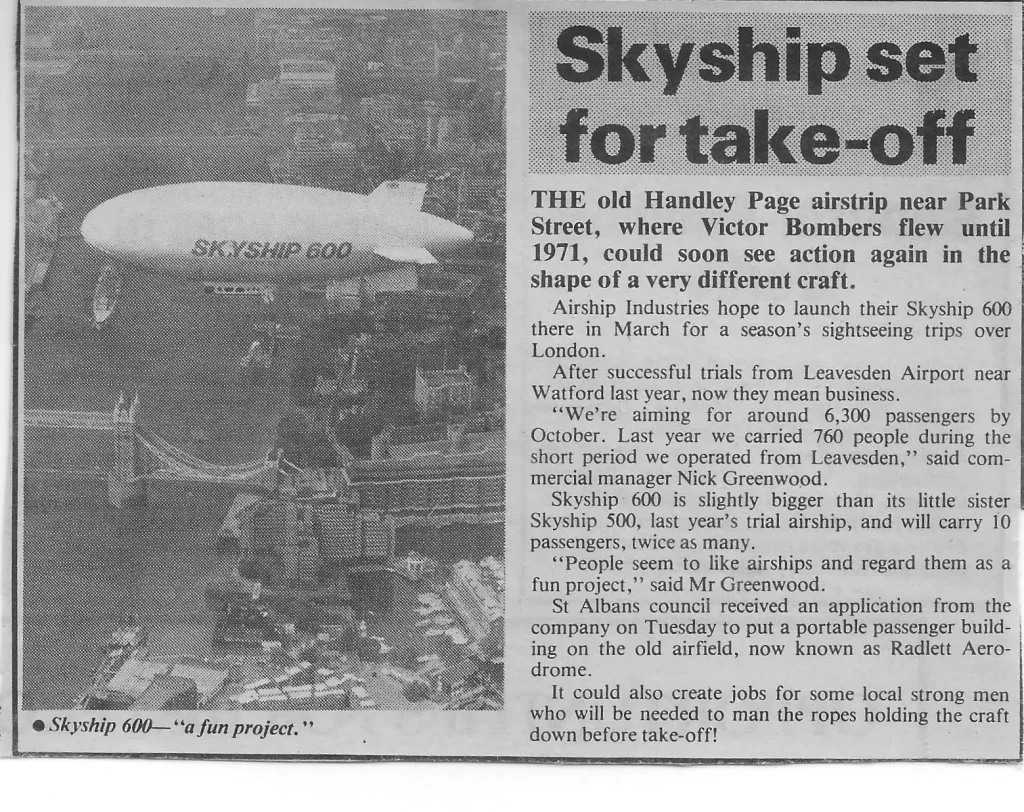
Airship Industries had always looked to use skyships as a multi role aircraft, and that included it’s evaluation as passenger transport, and were able to obtain a Civil Aviation Authority approval for licensing the Skyship 500, and later the Skyship 600 model airship, not only as flying billboards, but to offer passenger flights.
The idea was hoped that it would be a very lucrative revenue stream for the company, along with the advertising revenue from sponsoring the airship with company logos, along with further confidence from the general public as to the safe return of airships for passenger carrying trips.
In 1986 it was decided that the base at Cardington for operations and assembly of the UK Airship Industries operations, was not able to offer the number sightseeing flights over London, as Cardington was too far to make multiple daily trips a viable option. The flight operations from Cardington had been hugely popular for ships to begin their advertising tours, however a base closer to the Capital were needed.
Leavesdon Areodrome in Hertfordshire had been pointed out as a potential base by Operations Manager, Martin Hull, who had known that Goodyear had used the airfield sight in the early 1970’s for it’s Europa flights over London.
A 10 week trial operation was carried out in early 1986 with the use of a Skyship 500, which operated a series of short flights from Leavsedon Aerodrome near Watford in Hertfordshire.
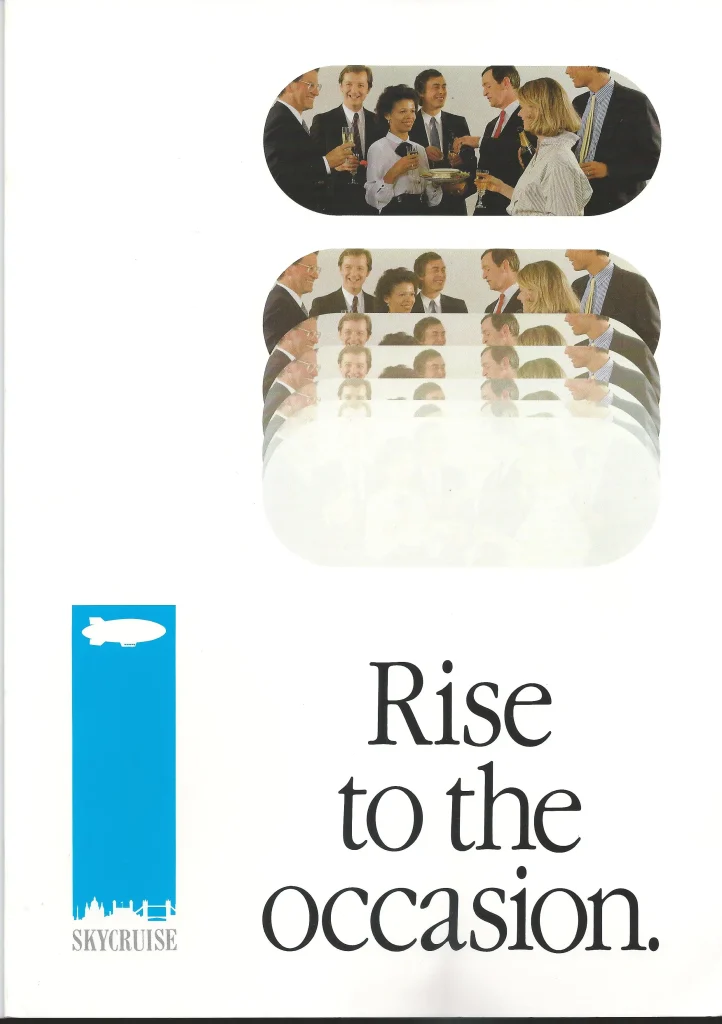
Following the Leavesdon trial flights and concept evaluation, a new base for running the newly launched, “Skycruise” operations was needed, and would become the first new purpose built “airship terminal”, to be constructed in the UK since 1929.
The Skycruise concept was to offer, in comparison to an aeroplane, reasonably low lever sightseeing flights over the landmarks of London.
For the Skycruise London trips, the skyships would follow the same route as the early airship pioneers, by following the Midland railway line down through Bedfordshire, and Hertfordshire, in to the airspace over London.
Skycruise 1987

The Radlett aerodrome was bordered by the same Midland Railway to the east, which had been used to navigate airships down to London, and transected by the M25 motorway to the south. The location was far enough away from dense populations, as with Cardington, not to raise too many objections.
There had been concerns with regards to noise pollution from the Porsche engines on the ships, so a site away from residential areas was preferred.
The Handley Page Aerodrome site had been closed and was currently being used by Redland Aggregates for aggregate extraction; however, this would not impact the operations of the flight area on the airfield. One group of people who had to agree with the use of Radlett as an “airship port” were the local district councillors.
Planning had to be approved, and there were some local concerns raised with regards to the noise levels from the ducted engines. However, the team at Airship Industries were able to convince the district planners by taking them on a local flight so that they could not only see but also hear the noise, and take into account that it would only be an issue on takeoff and landing.
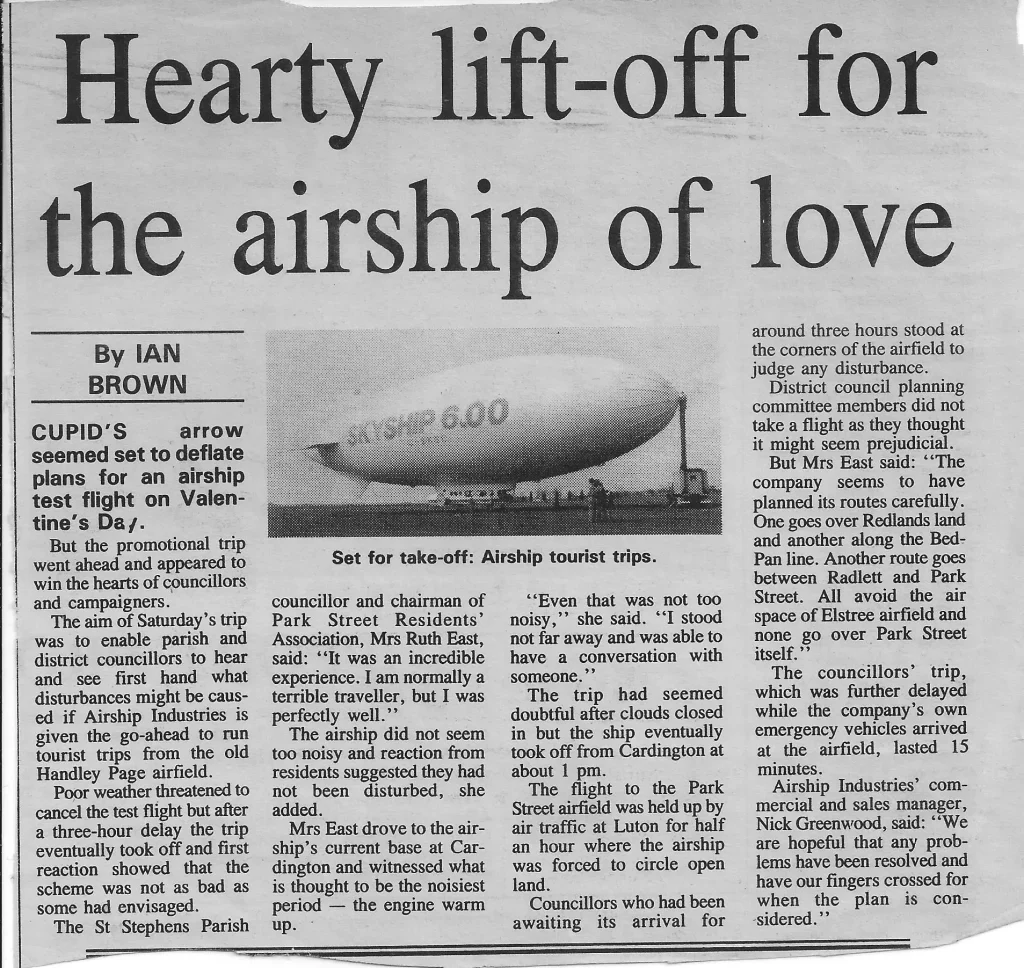
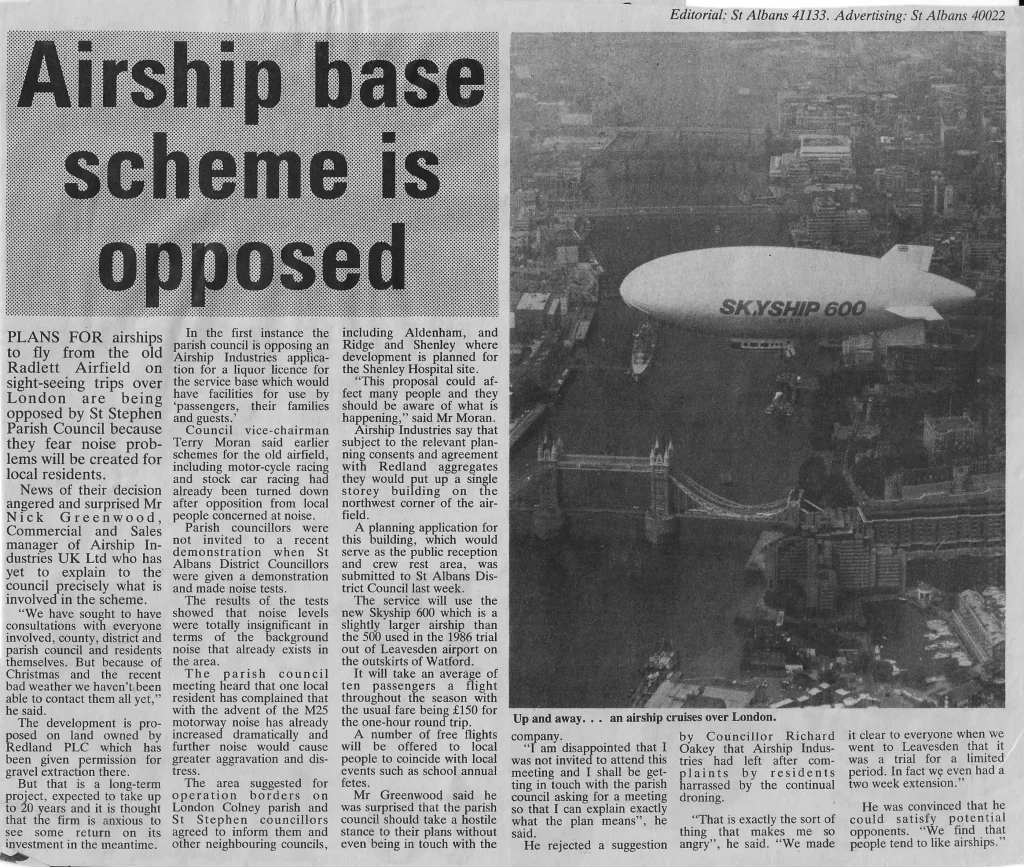
Not surprisingly, they considered the objection, but were in agreement that the noise level was acceptable, and approved the plans.
Terminal Location
This would mean that the Skycruise operations could be closer to London for the sightseeing tours, but also cut down on the duration of the flights on offer, offering more flights to keep up with demand.
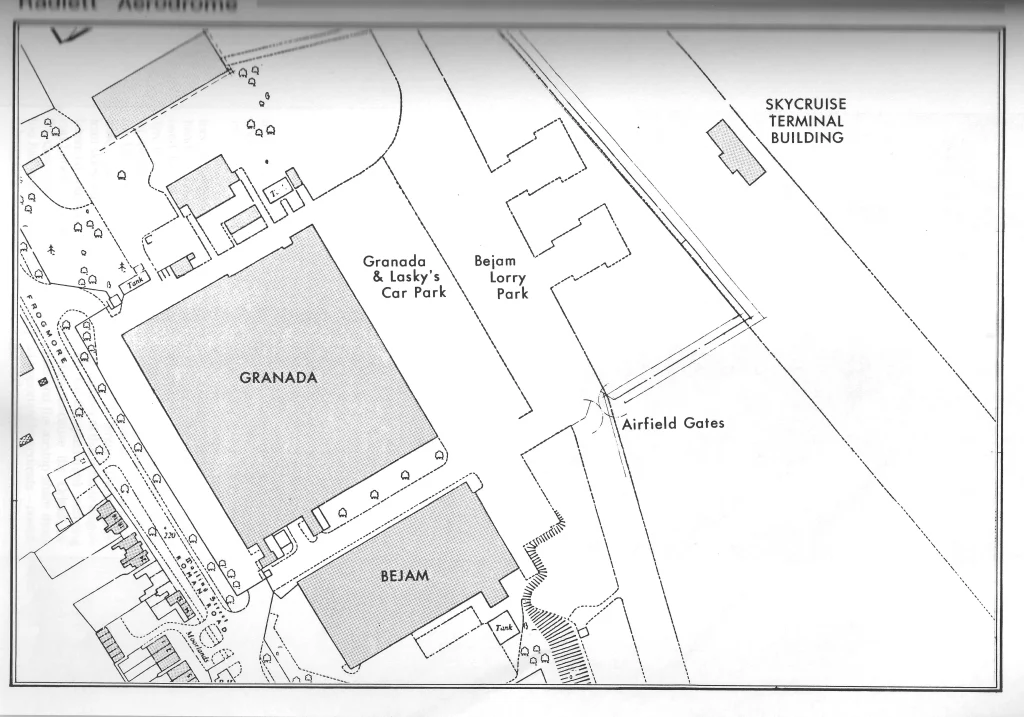
The original Handley Page workshops, which had been used for the construction of the Handley Page Victor “V” bomber in the 1950s and used up to the 1960s, were still available but had not been used for about 10 years and had fallen into disrepair.


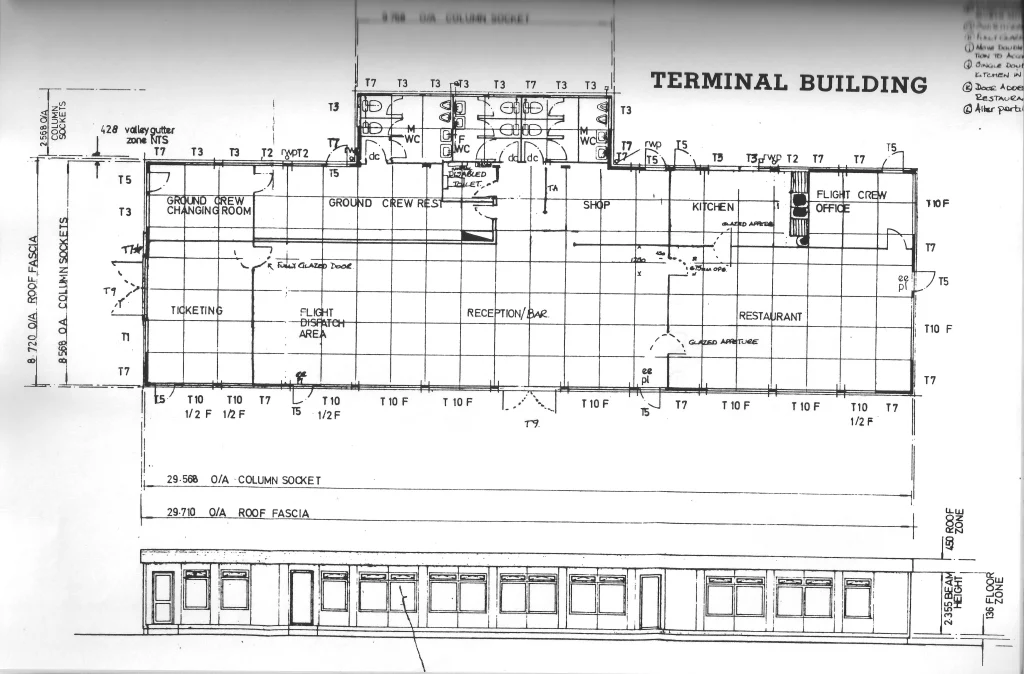
It was decided that a new purpose-built building would be constructed as the Skycruise “terminal” on the edge of the runway. The terminal would provide purpose-built offices for the staff and crew members, plus also provide a more modern departure lounge for the passengers awaiting the Skycruise. The Terapin Company was contacted to provide the temporary building structure, which was a popular choice of alternative building construction in the 1980s. This was to be much larger than the structure which had been used at the Leaveden Aerodrome site.
The Terminal
The new terminal building was designed to accommodate the following activities:
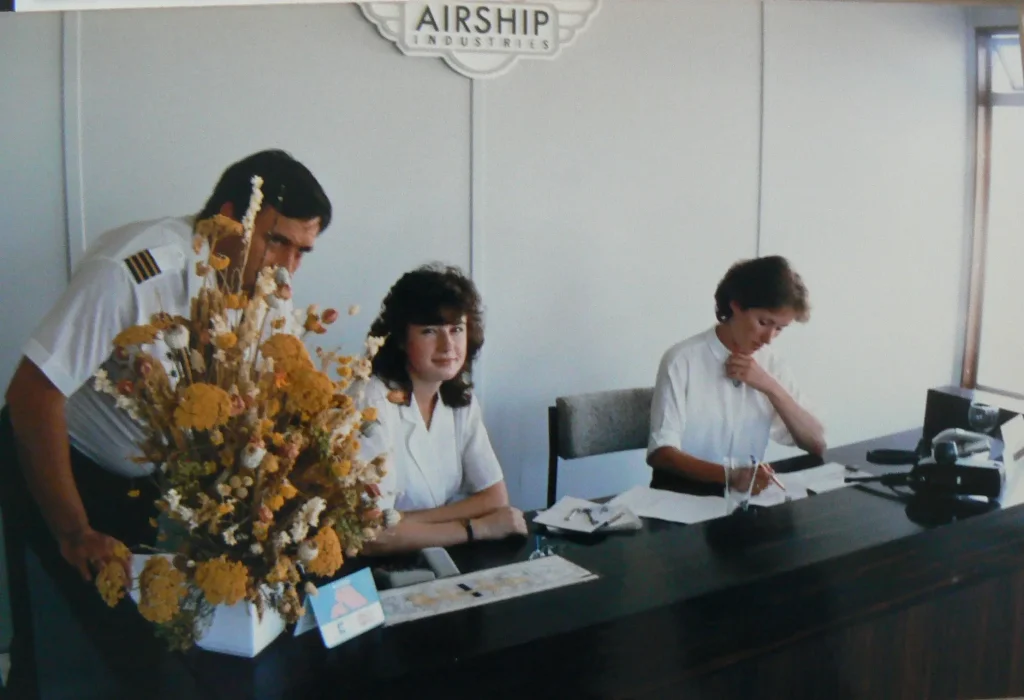
Check-in desks
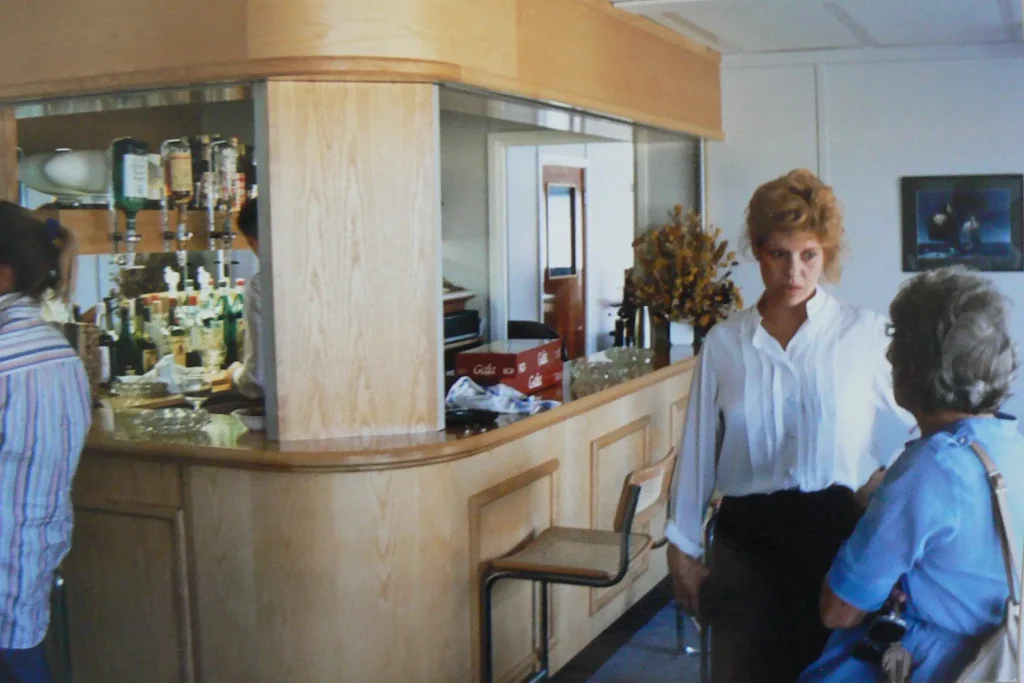
Reception/Bar
Restaurant
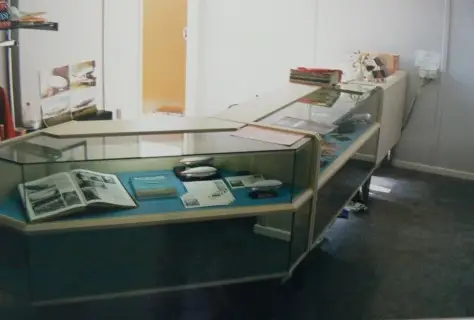
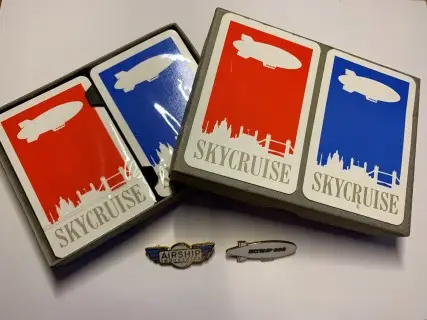
Merchandising shop
Kitchen
Flight Crew Offices
Ground Crew restroom
Ground Crew changing room
Toilets
It was envisaged that the terminal building could also be used for corporate hospitality events.

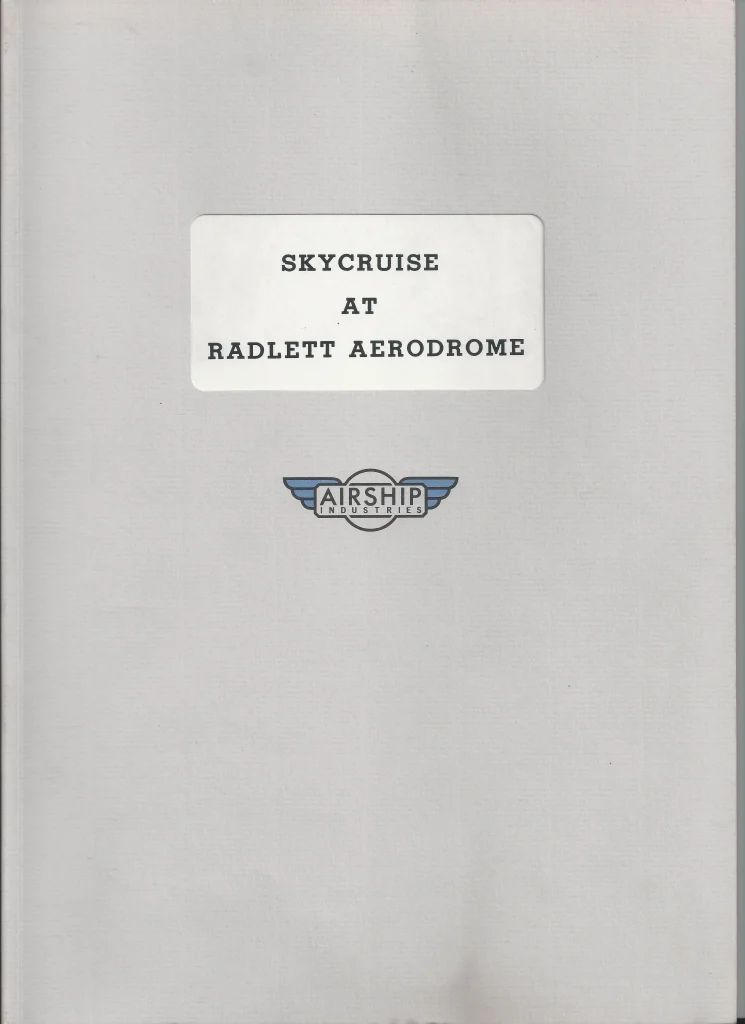
1987 Season planning and objections
A step forward for passenger flights came in 8th January 1987 when the SK600 class of ship was awarded full Passenger Transport Certification by the UK Civil Aviation Authority. This meant that the larger ship, with a larger passenger complement, could be used for flights.
With this, the new larger Skyship 600 could be used and carry an average of 10 passengers per flight throughout the season, although the ship could carry a maximum of 18 passengers, it would compare to the average of 5 passengers per flight on the Skyship 500 trial operation.
The flight operations would be run from 30th March to 16th October, howeve,r problems arose just before the launch of the Skycruise operations as both Skyship 600-1 and SK 500-02 had been damaged in a freak storm with winds over 80 mph damaged both ships on the masts at Cardington, causing both to be accidentally deflated. The Skyship SK 500-02 was not to be repaired, but frantic repairs were made to the Skyship 600 to be ready in time to start flight operations.
Repairs were made to SK 600-1 at Cardington, and a new envelope was manufactured and delivered. In the meantime, the new terminal building was constructed, using a modular design of portacabin, which was a popular temporary building solution at the time. The operations were ready by the first week in May 1987.
Skyship 600 General arrangement.
Inaugural Flight
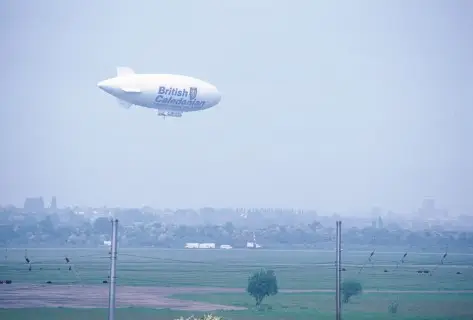
On 11th May 1987, the first London flight was formally launched by the Japanese Ambassador, Mr. Yamazaki, accompanied by Alan Birchmore of Airship Industries, as well as representatives from British Caledonian Airways who were sponsoring the Skyship.
Resplendent in it’s British Caledonian livery, and the presence of the Japanese ambassador served to promote Airship Industries’ reputation overseas.
The flights from Radlett lasted an hour and a quarter each, allowing for a short 15-minute turnaround for the changing of passengers and crews if needed.
The tight schedule would allow around five flights per day, with space in the summer months, and longer days, for more evening flights if required.
The advertised flight schedule was timetabled as follows
| Flight | Off Peak Season | Peak Season |
|---|---|---|
| 30th March – 29th May 21st September – 16th October 5 days a week: Monday to Friday Ticket Price – £125 (£350 today) | 1 June – 20 September 7 days a week Ticket Price £ 150 (£430 today) | |
| 1st | 10:00 | 09:30 |
| 2nd | 11:30 | 11:00 |
| 3rd | 13:30 | 13:00 |
| 4th | 15:00 | 14:30 |
| 5th | 16:30 | 18:00 |
| 6th | 19:30 |
The 7-day-a-week plan was hoped but in reality, it would be subject to weather conditions and full pilot availability. The company was looking at a sixty per cent flight schedule, depending on weather conditions and light, reducing to a 50 per cent schedule in the autumn and winter months.
In the second half of the summer 1987 season, the sponsorship changed from British Caledonian to Fuji, and operations ran until the end of August.

Some of the flight operations didn’t quite go as planned, as there were reports of some flights occasionally having to be cancelled due to the limited number of airship pilots, splitting their time between both Radlett and Cardington.
The Cardington flights, which had been operating the previous summers, were limited to local flights over Bedford.
Season Finale
The Skycruise operations at Radlett were brought to a close in September of 1987, as the SK 600-1 had entered into a sponsorship deal with German beer maker, Löwenbräu, and was to be flown down to Munich in time for the September Munich Beer Festival. This meant that the ship be prepared and then flown down to Munich in time for the festival, which ran from 12th to 16th September.
SK600-1 flew up to Cardington to be prepared with the new livery, and then down across the English Channel to Calais and onwards across Europe to Munich, with overnight stops at Reims and Karlsruhe.
However, the concept was repeated using the airships based in Paris, Toronto, New York, San Fransico and Sydney to provide sightseeing flights and also aerial advertising.
The season closed in early September 1987 as it was decided that the winter months, with shorter daylight hours and poor weather, would impinge on profitability with flights from the terminal.
Alas, the first season of Skycruise operations across the globe did not break even in pure passenger terms. Operating airships was expensive in terms of manpower costs, and it was seen that despite the popularity, the profits would not come from the passenger numbers, until the numbers of ground crew were reduced, or the seating capacity increased.
With the planning for the 1988 season, Airship Industries was dealt a financial blow when, in February, the U.S. Defence budgets were cut, and thus the cancellation of the large U.S. Navy order for the larger Skyship 5000.
The company then had to look for additional sources of funding. However, the SK-600-01 returned from a successful mini Skyscruise operation in Munich and headed straight for Cardington, where an advertising contract had been secured from local brewer Charles Wells, and the ship would operate locally sponsored and VIP flights from Cardington for the 1988 season.
This was followed by operations in France with the Paris Skycruise operations, and with the only CAA-certified airship, which had obtained advertising bookings from Konica in Germany, this meant that the 1988 Skycruise operations could not take place.
The Skycruise Radlett terminal was therefore closed and returned to the leasing company, Terapin Portable Buildings.
One of the main problems was that, despite popularity, passenger revenue alone never came near covering even part of the costs, which had to be paid by the advertising on the side.
Also, resistance from the locals to a prolonged series of flights, who regarded it as the “advertiser’s airship”, produced some negative publicity for the sponsor, which defeated the point of hiring the airship.
Regional flights were conducted for a week at a time in various locations but did not have the appeal of the more popular advertisers, as flying over London and the wider audience, and prestigious PR was gained.
Did you fly from Radlett in an airship? What was it like?
The Skycruise flights and operations were very popular, and many flights were taken over London. Do you have memories or photos you would like to share and add to this page? Please contact us with details.
Acknowledgement and Thanks
With special thanks to Alastair Reid and Martin Hull of Airship Industries for their assistance, personal photos and sharing their knowledge in compiling this page.
Thanks also to Ian Griggs and Phil Keirle of Landscape Images (Landimages.co.uk) for allowing us to use the Radlett Skyship photos and for capturing the Skyships from Radlett in the 1987 season, from their excellent photographic website.