
The new Sentinel 1000 was the latest addition to the Skyship fleet and became classed as the largest Airship in the world at the time.
Sentinel 1000 was developed following the advancements of the Skyship 600 and was seen as an intermediate-sized ship for gaining experience for the forthcoming Sentinel 5000 project, which was progressing in the early 1990s. At the time, Airship Industries had gone into partnership with Westinghouse Incorporated, which was a major shareholder for the U.S. production and operations.
Design and Construction
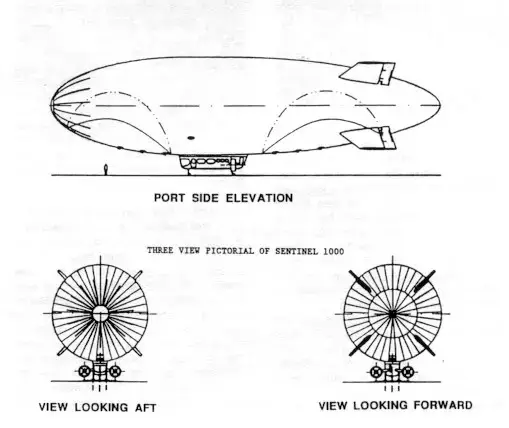
The Sentinel 1000 was again a move forward in existing skyship design, taking proven ideas and production concepts from the previous design and adapting them with new designs. The gondola was an existing Skyship 600 gondola, and the same power plant as Twin Porsche 930/67 turbo-charged engines, giving 255 hp. The envelope was much larger, by 30ft in length and 5 ft in diameter, but this gave the ship an extra 88,000 cft of gas in the envelope.
The total disposable load of this was 5,962lbs. To distribute the weight equally on landing, the landing gear was adapted by adding 2 more landing gear, giving a distinctive “tri-gear” landing arrangement. Another adaptation of the original design was the change from a standard “+ – cruciform” configuration tailfin to an “x” configuration. This had been previously used in U.S. airships in the 50’s and 60’s. The advantage of this was for larger enveloped airships, giving ample clearance on take-off when the nose of the ship is pulled “up”.
The ship was to operate at a cruising speed of 62 mph at a cruising altitude of between 1,000 to 4,000 ft with a maximum altitude of 8,000 ft.
First Flight
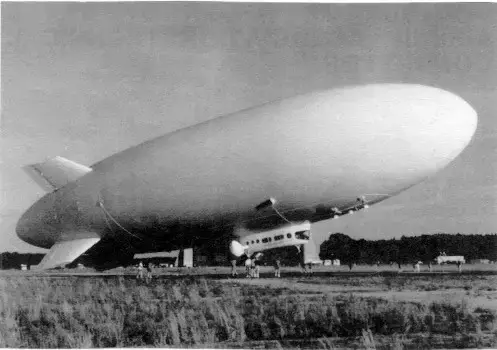
The first flight of the Sentinel 1000 occurred on 26 June 1991. By this time, Westinghouse Airships Inc. was managing the program, and DARPA was providing the funding.
Fly-by-light technology
It wasn’t until May 1992 that the Sentinel 1000 airship made its first flight with the GEC Avionics fly-by-light flight control system (FCS). This was the first flight of a production-standard FCS and also the first of an airship FCS incorporating auto-stabiliser and autopilot functions to reduce the workload of piloting the airship on lengthy
missions.

The system uses fibre optic cables rather than traditional electrical wiring, making it highly resistant to electromagnetic interference (EMI) and lightning strikes. A prototype system was previously installed and tested on an Airship Industries Skyship 600. The Sentinel 1000 received US Type Certificate TS00002AT, which originally was issued to Westinghouse Airship, Inc. on 22 October 1993.

Weeksville Fire and loss
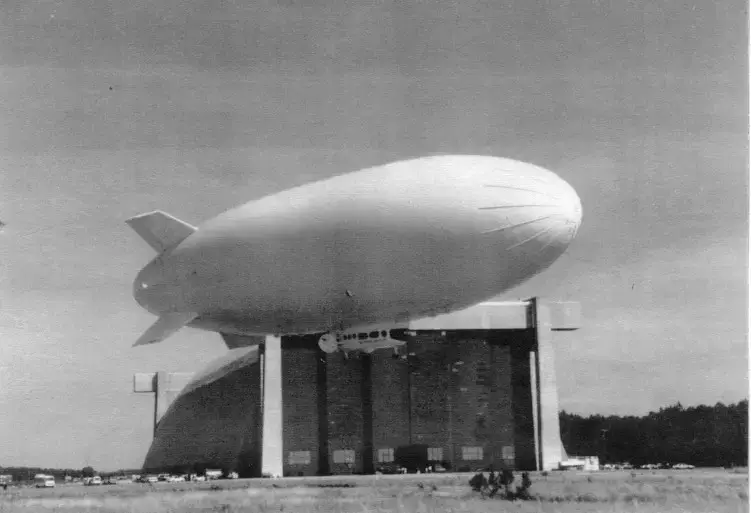
The ship was under trial in 1994; however, disaster struck in 1995 in the Weeksville Hangar in the US, where the ship had been constructed. On August 3rd 1995, Airdock #2 was destroyed by fire in the early hours of the morning. WAI Sentinel 1000 (the largest airship in the world) was destroyed in the hangar at 12:55 AM.
The airship Hangar at Weeksville, NC, was the largest wood construction building in the world, measuring half a mile long by 298′ wide by 192′ high with 180-ton doors mounted on railroad tracks. Constructed in 1942, it housed US Navy Airship Squadron ZP-14, protector of Hampton Roads and Outer Banks shipping lanes from German U-boats.
In 1966, the decommissioned facility was sold to Westinghouse. In 1989, Westinghouse changed its operations and moved the aerostat operation to TCOM, L.P. Commercial Skyships seen in the U.S.A., such as “Bud One”, “Fuji”, and “Met Life” were built there.
On August 3, 1995, during reconstruction of the door supports, the Hangar burned to the ground, causing $100 million in damage. The Sentinel 1000 was destroyed in the blaze and not reconstructed.
The company, Airship Management Services, operated a fleet of skyships in the USA, and also included in their inventory a Sentinel 1000, which they would be able to construct for operators.
Images and photos reproduced by kind permission and copyright” Airshipworld” – Laurie Soffe, and thanks to AHT member Jean-Pierre Lauwers for providing additional information on the ship.