
It was thought that the British airship died following the loss of the R101 and the dismantling of the R100. Various plans were offered to revive the airship; however, it was not until almost exactly 50 years later did a new breed of British airship took to the skies.
Aerospace Developments Limited

It was in 1971 that a company was formed, named Aerospace Developments, a partnership of an airship enthusiast, John Wood, and Roger Munk, naval architects. Later on in that year, the company was awarded a study by the Shell Oil company to develop a large rigid airship capable of transporting pressurised natural gas.
However, in 1974, after a major budget review arising from the sharp escalation of oil prices, Shell resolved to cut back their long-term research and development expenditure, and accordingly, the airship gas transporter project was shelved. As a result of this, the Munk/Wood partnership was free to design and build their own airship prototype, albeit on a modest scale.
The first ship, the AD 500, flew made it’s maiden voyage on 3rd February 1979, however whilst moored out a month later, a gale blew on 8th March in the early hours, and trying to get the prototype ship, back in to the shed, a decision was made to pull the rip chord on the envelope.
The disaster finished off the Aerospace Developments company, but with the promise of new funds, the company reformed as Airship Developments Limited. Initially, the AD500, which was to become the prototype for a successful series of Skyship 500’s took shape on the drawing board back in 1976. Airship Developments, the company formed for the venture, later Airship Industries, went on to create a very successful fleet of multi-role airships.
The Skyship 500 was seen as a modest-sized airship of only 182,000cft. From the outset of the project, the designers were to incorporate the most modern materials wherever possible, where technology could offer.
Propulsion

One of the main and most important features of the new ship was the propulsion system. The designers carried an idea which had been utilised in the earliest days of the airship programme, the use of vectored thrust engines.
The propellers, housed in ducted fans, tilted in order to drive the airship upwards or downwards; a principle very similar to the Harrier Jump Jet Vertical Take Off and Landing (V/STOL) applies to maximum advantage.
The propulsion ducts allowed the units to swivel through 200 degrees of rotation, allowing full manoeuvrability of the ship. Unlike previous airship designs, putting the fans into “cowls” gives the advantage of low propeller noise and improved safety to passengers boarding the ship, as well as focusing thrust from the propellers.
Gondola Design
The influence of Roger Munk’s maritime background would be seen in the design of the large gondola. This was constructed of Kevlar, making it a giant reinforced plastic shell, being not only sturdy but also offering design flexibility, ease of manufacture and also very low maintenance.
The gondola itself is suspended from the top of the envelope by a fail-safe system of 14 Kevlar suspension cables and a sheer collar for horizontal restraint. The load of the gondola is spread along four arched parabolic load curtains bonded to the top of the envelope.
The layout of the gondola is for maximum comfort, with the Skyship 500 able to carry 9 passengers and 3 crew. The large windows could be opened and offered spectacular views for those who enjoyed the flights.
The nose of the gondola offered a spectacular view for the pilots, who could see almost 180 degrees of unimpeded visibility by the large windscreen.
Even though the ship has 2 seats in the cockpit, the Skyship was developed for one-pilot operation. The control is offered by twin control yokes which operate all of the control surfaces, as there are no rudder pedals as in conventional aircraft. The engines are operated by a single lever control mounted on a central control console.
Prototype AD 500
By March 1978, all the major components had been assembled in the No1. Hanger at Cardington, a fitting place for the rebirth of the airship, as it was the same hanger which had assembled the R101 some 50 years earlier.
The construction of the ship did not go without its problems, and the initial launch of the ship had to be set back. A buyer had also been found for the new product, and so it was important that the new airship prove its viability.
The prototype, the AD500, was first flown on 3rd February 1979. Using vectored thrust and ducted engines, this enhanced the ships’ manoeuvrability, and hence did away with the need for a large and expensive ground handling crew.


The prototype was short-lived as disaster struck the AD500 on 8th March 1979, when moored out at Cardington, a storm blew up and the crew were unable to take the ship into the shed. It was agreed that the emergency rip cord would be used to deflate the ship before it would be destroyed.
The loss of the AD 500 caused the financial collapse of Aerospace Developments as a company; however, the ship, G-BECE, was eminently repairable. However, over the next two years, the company, through a merger with Major Malcolm Wren’s Thermoskyships company, and and subsequent de-merger, the creation of the company known as Airship Industries, the design crew were back together. The team used the AD 500 prototype design to create the Skyship 500 series.
All was not lost, having proved itself a success, orders for the ship soon came in, and the first of the new Skyship 500s were produced.
Skyship 500-02 (G-B1HN)
A Landmark in the Revival of the Modern Airship
The Skyship 500-02, registered G-B1HN, was one of the most important airships of the 1980s. Built by Airship Industries at Cardington, Bedfordshire, it was the first production-standard Skyship 500 and played a pivotal role in proving that modern lighter-than-air craft could operate safely, commercially, and profitably.
From its first flight in 1981 to its retirement in 1987, G-B1HN served as a technology demonstrator, flying billboard, television platform, passenger carrier, and even a candidate for military roles.

Development and Design Improvements
After the first prototype, SK500-01, was caught up in an unresolved insurance dispute, Airship Industries opted to build an entirely new airship rather than repair the original. The new ship incorporated numerous improvements, making it faster, lighter, and more reliable than its predecessor:
- Structural weight reduction: 136 kg lighter, thanks to titanium engine frames and aluminium ducted fan assemblies.
- More powerful engines: Two 204 hp Porsche 930/10 piston engines replaced the earlier 190 hp units.
- Advanced propulsor control: Electric variable-pitch fan systems replaced the troublesome hydraulics.
- Envelope upgrade: A new laminate fabric greatly reduced helium permeability, lowering running costs.
- Performance increase: Maximum speed rose from 52 knots to 64 knots, improving commercial flexibility.
Components were sourced from multiple subcontractors, but final assembly and integration were carried out in the Cardington airship sheds — the historic home of British rigid airship development.
First Flights and Early Testing (1981–1982)
G-B1HN’s maiden flight took place on 28 September 1981, with chief pilot Nick Bennet at the controls. Early flights were deliberately limited in altitude and speed until airworthiness checks could be completed.
In October 1981, a minor mooring mishap caused light damage, briefly pausing the programme. By April 1982, the airship had completed 50 hours of trials, including a well-publicised demonstration over central London that helped attract new investors to the company.
By August 1982, G-B1HN had flown 87 sorties totalling 183 hours. In September, the Civil Aviation Authority granted it a Special Category Airworthiness Certificate, allowing operations beyond purely experimental flights.
Trials, Demonstrations, and Military Interest
With certification in place, SK500-02 took part in a wide range of trials to explore potential roles:
- Maritime radar picket over the English Channel — testing surveillance capabilities.
- Paris airport shuttle concept — exploring short-haul passenger viability.
- London Docklands terminal proposal — assessing urban airship infrastructure needs.
- Portable mast trials in Edinburgh — proving field-deployment capability.
An Airborne Early Warning (AEW) concept for use in the Falklands War was evaluated, but time constraints prevented deployment.
Commercial and Public Engagement (1983–1985)
From 1983 onwards, G-B1HN became a high-visibility ambassador for modern airship technology. It appeared at the Farnborough Airshow, on the BBC’s Tomorrow’s World, and at numerous public events.


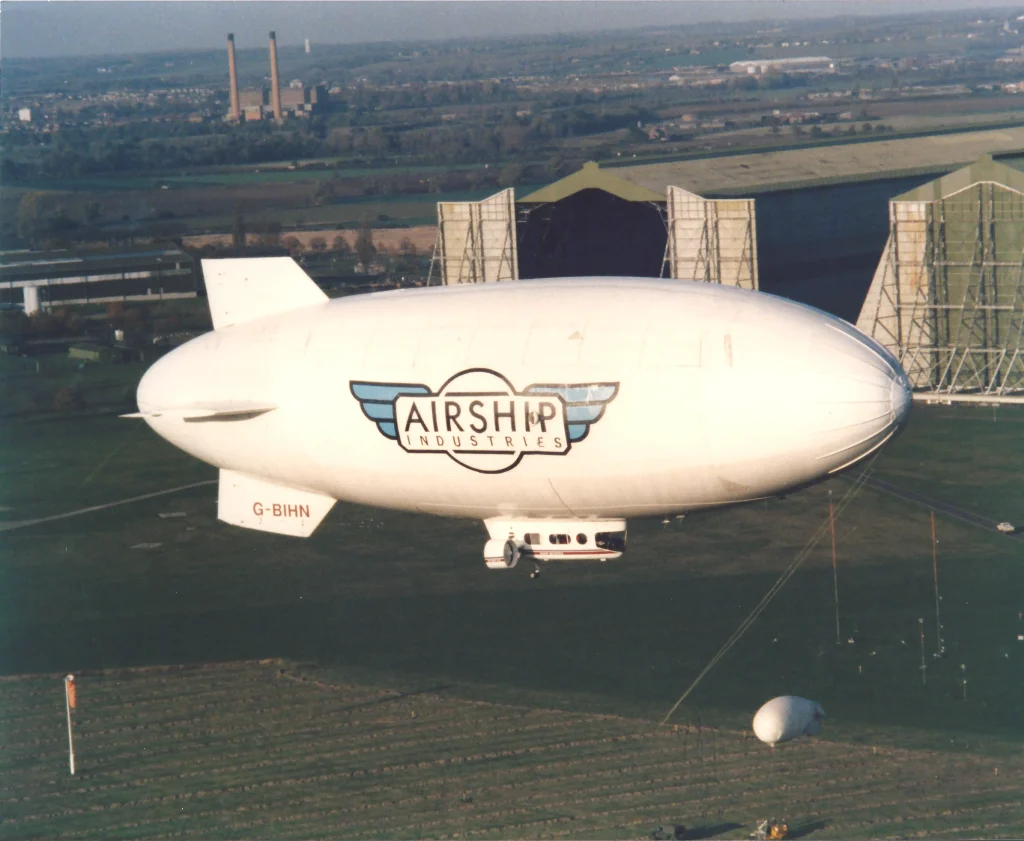
1985 First commercial Advertising
In March 1985, SK500-02 was readied for its first commercial advertising contract with Australian brewer, owned by the Airship Industries Chairman, Alan Bond. Swan Lager was being introduced into the UK market, and it made good sense for him to use his advertising assets in full by promoting it in the UK.
The ship was fitted with a larger and deeper banner for the first time and flew a series of promotional flights over the capital. These drew significant attention in the media and captured the attention of corporate agencies. Airship advertising in the UK was a complete novelty and seemed to have great potential. After the London flights, the ship went down to Bournemouth and along the south coast before returning to Cardington via major towns and cities.
It also proved itself as an aerial advertising platform, carrying branding for:
- Fuji Film
- Swan Lager
- British Caledonian
- Pan Am
- Rowntree (Novo Livery)
- Disney

Additionally, the airship was used as a television camera platform at events including the Wimbledon Championships, cricket matches at Lord’s, and major horse races.
In November 1984, the Skyship 500-02 made history as the first modern airship to receive a full Transport Category Certificate of Airworthiness, clearing the way for passenger service.
1980’s A Decade of Success
In the following years, 1981-1990, six Skyship 500 series ships were built. The hub of activities was based at the Cardington No.1 Hangar, where it was often common to see Skyships in a series of production and delivery.
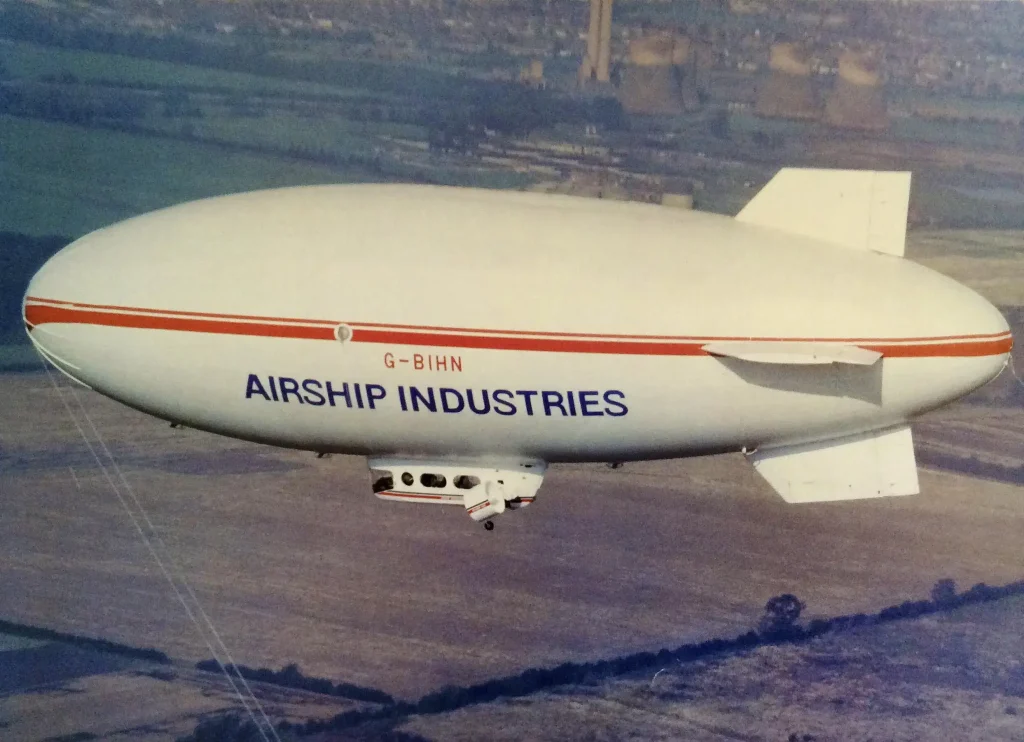

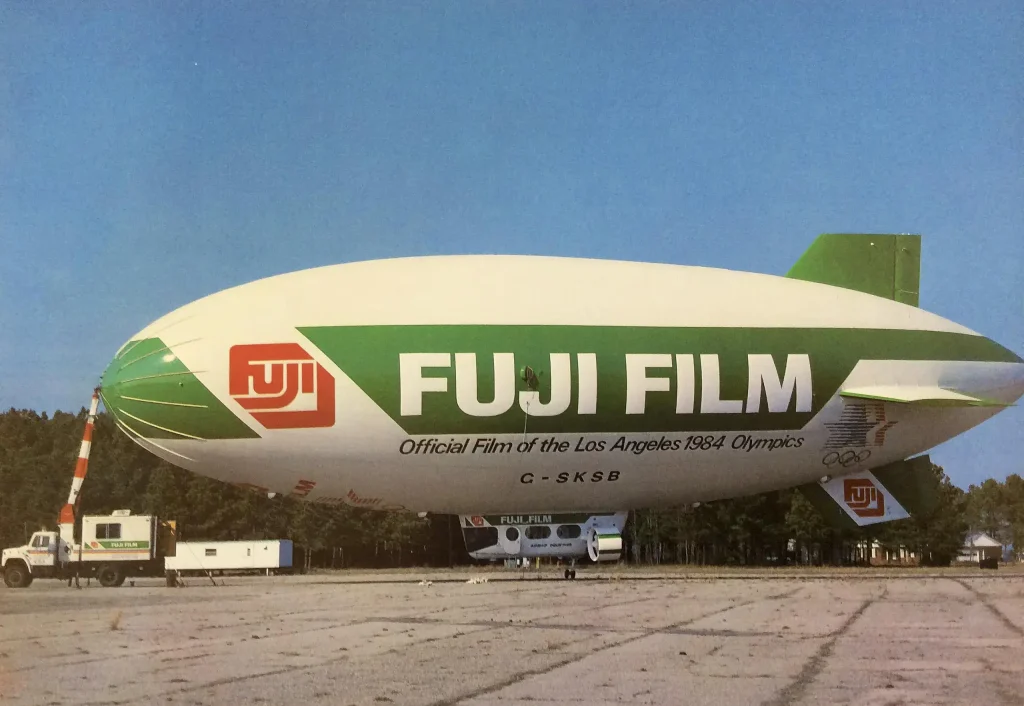
The ships were used worldwide not only for advertising but for security and passenger sky cruises over the major cities. In 1983, the first ever charter of an Airship was arranged, and the sponsor of the ship was Fuji. The ship was delivered in March 1984, and in July of that year, the company made its first outright sale of a ship to Japan Airship Services, a division of Japan Airlines. Later, another sale was made to JAS, the Korean Government and one to Tokyo Metropolitan Police for internal security.
Later on, in 1984 Los Angeles Olympics were a true showcase for the ship, being involved in the opening ceremony.

The Fuji chartered ship had the words Welcome emblazoned on its side. Later on in that year, the use of the same ship, GBIHN, was shown to full effect in the hit James Bond film A View to a Kill.
SkyShip 500 A View to a Kill – “Zorin Industries”
Not often does a modern airship have such a lead role in a film. This page describes the role of the Skyship 500 in the James Bond Film “A View to a Kill with two airships making an integral part of the film
In 1984, Airship Industries managed a major marketing coup with the inclusion of their Skyship 500 series airship in the James Bond Film, “A View to a Kill”. The original story, coming from a short story by Ian Fleming, was adapted, and the use of airships in the plotline came from the finale of the 007 continuation novel written by John Gardner called Role of Honour, which was published in 1984.
The film was to be the last outing for Roger Moore, who was completing his seventh Bond adventure after 13 years.
At the time, Airship Industries had produced a fleet of ships which were recognisable over many capitals of the world, offering tours or advertising sponsorship deals. As the producers of the Bond film franchise always wanted to include the most current technology, this included the lighter-than-air interest.
At the time in 1984, the team at Airship Industries were extremely busy with the Civil Aviation Authority (CAA) certification of Skyship 500 GB-1HN, which was looking to be certified for passenger flight. The James Bond team at EON approached Airship Industries to lease the airship. Despite it being a great product placement for the company to have the airship in the film, they were unable to spare the use of the ship for filming.
The EON team approached Airship Industries again, and this time were able to persuade them to let them have the for seven days over the summer of 1984 for filming.
In the film, the first introduction to lighter-than-air travel is when the villain Max Zorin, played by Christopher Walken, makes an appearance in an airship used as a “mobile” flying headquarters and conference suite, in a planned but currently nonexistent Skyship 6000. In an interior scene within the airship, which was used as a floating boardroom, a map of his plans emerges from the boardroom table, a nice homage to the scene where a 3D diorama map emerges from the pool table in the 1964 film, “Goldfinger”. Again, the villain of the piece explains to his cohorts how the plan is unveiled.
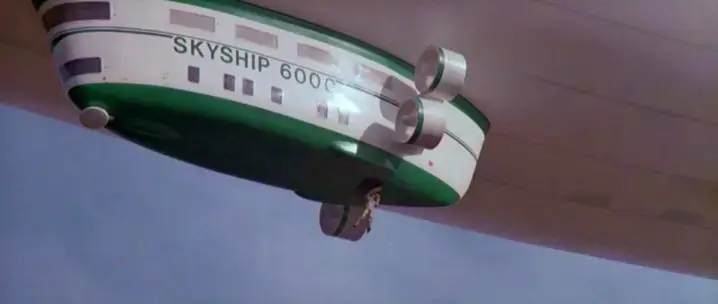
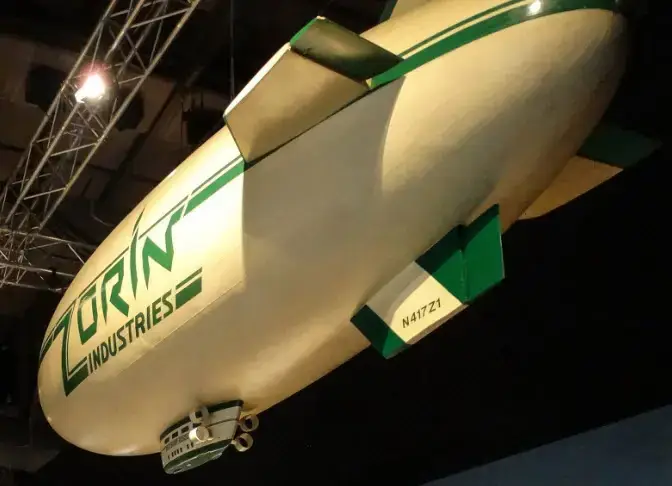

A mock-up model had been made showing a larger Skyship 5000 with a double-decked gondola and four ducted propulsion units. This was shown floating over San Francisco Bay, and cleverly disposing of a conference passenger. The ship was similar to the designs at the time of a larger skyship 5000, and the envelope and shape of the gondola can be seen as almost direct copies of the designs. The ship was mocked up in green Zorin Industries livery. As the ship flies into San Fransico for the final half of the film, our Villain’s assistant, May Day, portrayed by Grace Jones, looks out of the front of the ship’s gondola, exclaims “What a View..” and Christopher Walken finishes the line “… to a Kill”.
This was an initial taster for the choice of travel made by the villain, the later inclusion of an airship in the climax of the film on the Golden Gate Bridge.
For the finale, the ship in question was a very real Skyship 500 registration G-B1HN. At the time, a similar skyship, SK 500 -004 (G-SKSB) the was operating a promotional tour of the U.S. and Los Angeles and had played a major part in the opening ceremony of the 1984 Olympic Games.
For that, the Skyship SK500-04 had a “WELCOME” banner across the side of the hull and flew over the stadium at the start of the ceremony. On board, the ABC camera crew provided the only air-to-ground shots, broadcasting through the ceremony. The Skyship also carried security and surveillance personnel, attracting government agency interest in the role of airships. At the time, it was the only aircraft permitted to fly into the airspace around the stadium.
During the 1984 season, the ship was in predominantly green and red livery of Fuji Film sponsorship for Fuji Tape. As the film was set around California, the Bond Production team were also able to utilise the ship and shots of the ship over San Francisco and famous landmarks. Full co-operation had been granted by the Mayor of San Fransico for the filming.
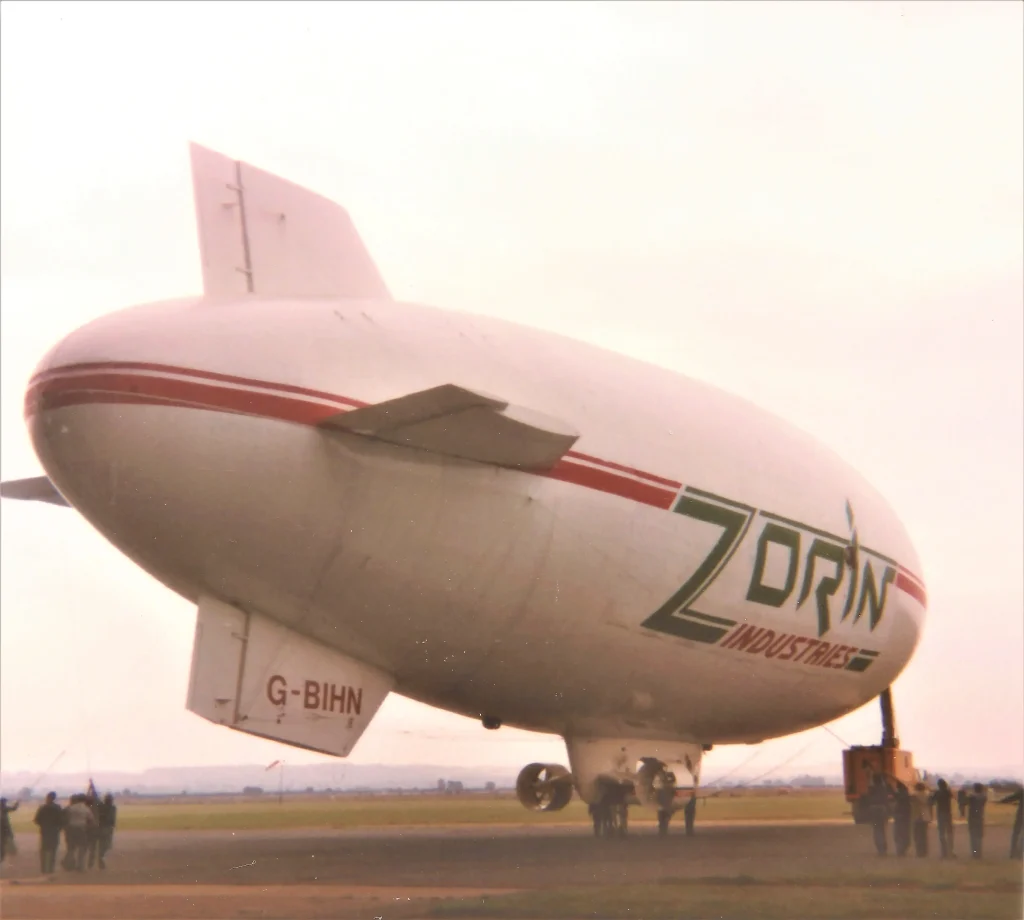


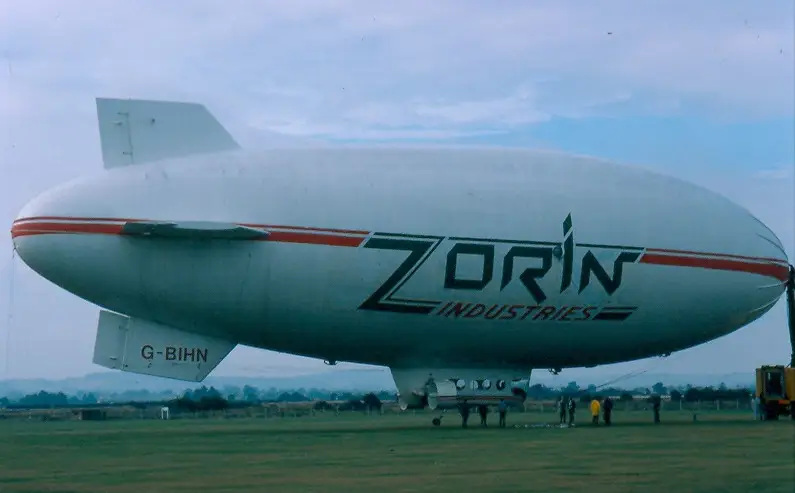
The Skyship to be used in the film was adapted with a similar livery, bearing the fictitious Company of “Zorin Industries” and various smaller-scale yet perfectly working models of the ship were used at various stages.
In the film, the ship is used as an escape vehicle for Max Zorin and his assistants to observe the destruction of Silicon Valley from above.
In the summer of 1984 G-B1HN had the Zorin Industries logo painted on the side of the envelope in the Cardington Shed, and then was flown down to Shoreham airfield in Surrey, where it would be based for one week of filming.
In the film, the Skyship is used as an escape vehicle for Max Zorin and his assistants to observe the destruction of Silicon Valley from above. The escape airship was hidden inside a portable contractor’s office (portacabin) where the top extension collapsed down. In the film, this allowed escapees to enter the office door, and clever camera angles do not reveal fully what is hidden inside. A few valves are opened, and the villains sit inside a gondola, then start up the engines. The gas begins to inflate the envelope, and the roof of the building collapses open, allowing the envelope to inflate through the top.
This is shown for a wonderful dramatic effect, as in real life, this is not possible, as inflation can take up to 24 hours; however, with the benefit of Pinewood magic, this inflation takes approximately 2 minutes.
It does, however, provide a striking effect showing the fin structure and also an excellent vectoring of the engines as the “ship” provides a vertical takeoff and landing (VTOL) takeoff out of the cabin.
A very good action sequence takes place with the ship used as a kidnapping vehicle, where Stacey Sutton, our Bond Girl for this film, played by the late Tanya Roberts, is kidnapped and dragged into the airship. The sequence was filmed at the Amberley Mine Museum in Sussex, which had been used as the scenes of Zorin Industries’ Californian mine on the San Andreas Fault. For the shots, the Skyship 500 flies down into the quarry pit.
Our hero James Bond dramatically grabs the bow mooring lines, and is carried off over the San Francisco skyline, narrowly missing some of the famous buildings,s including a close encounter with the TransAmerica building.
The final sequence takes place on the Golden Gate Bridge, where James Bond manages to curtail the villains get away by tying the mooring lines to the superstructure.
During this time, a very convincing Skyship 500 show the airship in view during the whole sequence. However, this is, of course, a very impressive mock-up filmed on the back lot of Pinewood Studios, filmed in October 1984, with a scale model replica of the top of the Golden Gate Bridge. The scenes are intercut between shots of models, the actual Skyship and impressive, convincing gondola closeups.


During the final act on top of the Golden Gate Bridge, our hero, James Bond, has fought off the villain Max Zorin, but his henchmen, still on the ship, reach for the weapons locker.
Rather than attempt to shoot James Bond, who had previously hidden under the bridge pipe, more drastic weapons were chosen. As the ship had been at Max Zorin’s Californian mine, where much high explosives were used in the film, some were contained in the weapons locker. The clumsy use of dynamite was lit by an assailant, but it was dropped as James Bond cuts the ship free from its moorings.
With all the James Bond movies in the franchise, the ending had to be dramatic and thus normally show a large explosion. A View to a Kill was to be no exception. The ending had to be dramatic, but also be careful not to totally discredit the fledgling industry, which was always trying to move away from this historical stigma. Within the terms of the leasing contract with the EON, the 007 production company, Airship Industries had stipulated that the airship could not be shown as exploding in the similar expectations as airship disasters in the past, notably the LZ-129 Hindenburg. It was known that this would be the image and sales potential.
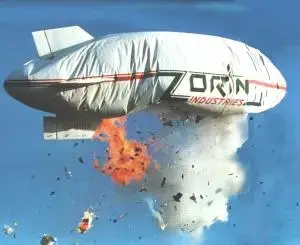
The special effects are impressive, and in keeping with the leasing contract from Airship Industries, the film shows the gondola, and not the envelope of gas, exploding. This, of course, shows that the inert helium being safe as the envelope is seen deflating and slowly sinking to the sea below, and indeed any airborn vehicle with a large pack of dynamite rolling around the cabin, would have suffered the same fate.
Three Skyships Come Sailing
o see one Skyship in the sky was a treat, to see two was exceptional, but only once were there three airships in flight at Cardington.
On 24th September 1985, the latest Skyship, SK 600-02, was completed, and it was decided to have its first test flight. At the time, there were two other Skyships which were in the shed, and it was decided for a fantastic and rare photo opportunity to have three ships in flight at the same time. The fleet consisted of SK 600-1, SK 500-02 and the latest 600 ship, the SK600-2.


The test flight lasted 1 hour and 5 minutes, and went without a hitch. At this time, the photographers were able to snap the only time three airships were sailing from Cardington.
A description by Den Burchmore of the flight:
On 24th September 1985 here at Cardington, Skyship 600-02 G-SKSD, had her maiden flight piloted by Cdr Nick Bennett. On take-off she rose gently to approximately 500 ft and trials were carried out. During this time Skyship 600-01 and 500-02 left their respective masts and on return of the other ship were able to the most wonderful display of flying. There were three airships flying in formation shooting up the airstrip in line astern chasing each other around in a circle and generally showing the versatility of the ships and the pilots’ skill. There were many firsts that day at Cardington three ships together, six pilots together, display formation flying, all probably not seen since the 1920’s There was also the maiden flight itself.
The maiden flight of Skyship 600-02 G-SKSD lasted one hour and fifty minutes but provided a spectacle and a rare gathering of airships.
After the success of the test flight, there were two short weeks of further test flights for SK600-2, when the ship was taken back in to the shed, deflated and prepared for shipping in October 1985, to Australia where a new airship hangar had been build for it at Schofield Airport, Sydney, from where it would be based for operating advertising and Skycruise tours.
| Airship Reference | Registration | Base | Maiden Flight |
| SK 600-01 | G-SKSC | Cardington, Beds. | 6th March 1984 |
| SK 500-02 | G-B1HN | Cardington, Beds. | 28th September 1981 |
| SK 600-02 | G-SKSD | Schofield Airport, Sydney | 24th September 1985 |
SkyCruise Operations
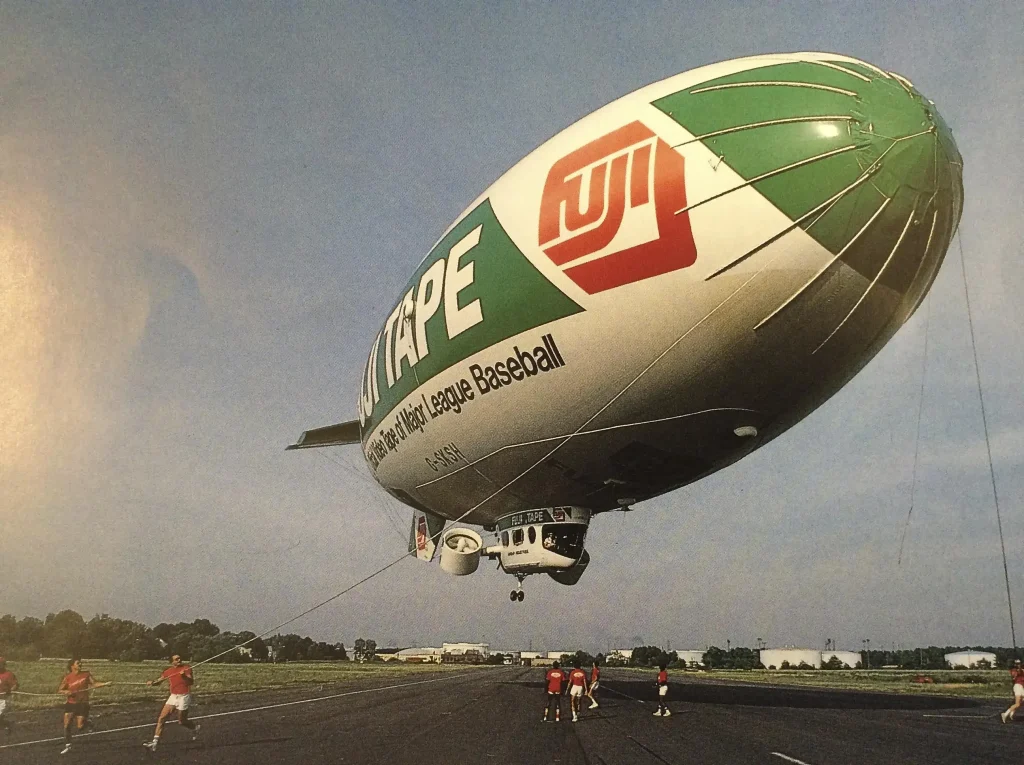
By mid-1988, there were 5 Skyship 500s in operation throughout the world. In the latter part of the 1980’s the Airship Industries Skyships and Skycruise programme had been immensely popular. Many advertising contracts had been agreed, and the Skyship 500 was seen in many cities whilst touring America, predominantly with a Fuji livery


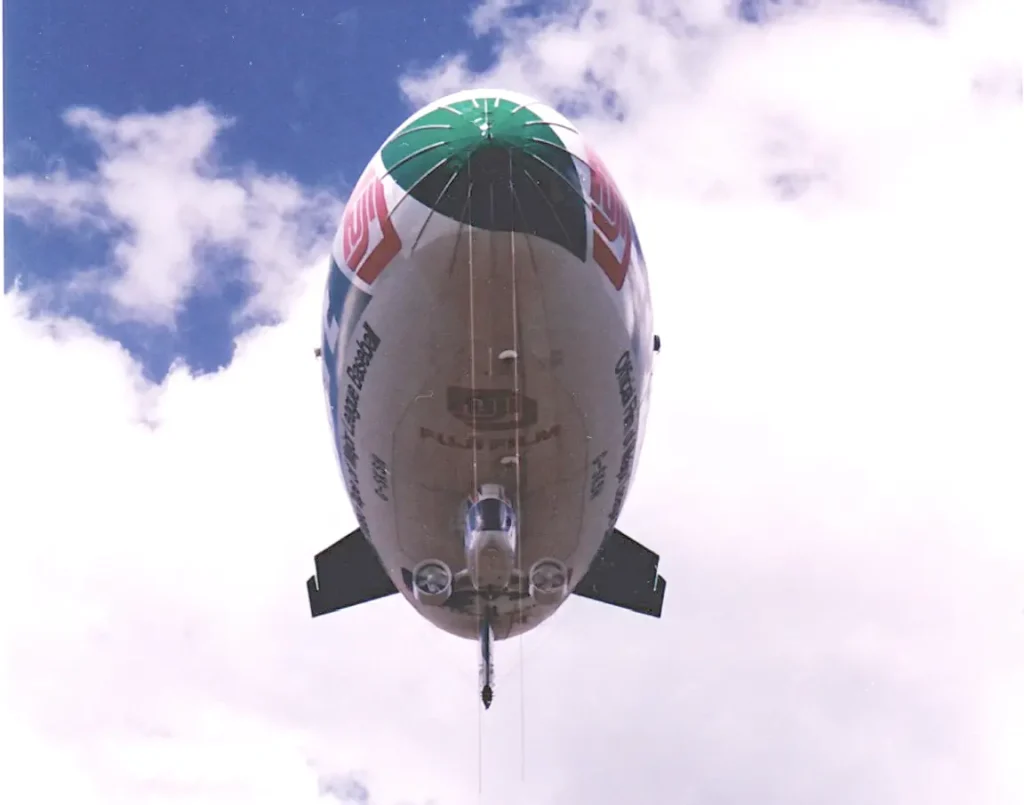
Not just showing that airships were flying billboards, but also for a scheduled passenger flight programme over the major cities of the world.
The 1987 Skycruise programme was offering a schedule of 700 flights in a season (from March to October), and the popularity was so high for the seats on the airships that all flights were sold out within 72 hours.
Originally running flights from Cardington, the popularity grew so that a new base of operations was needed for passenger-specific trips, as the flights over London were hugely popular and sold out for weeks.

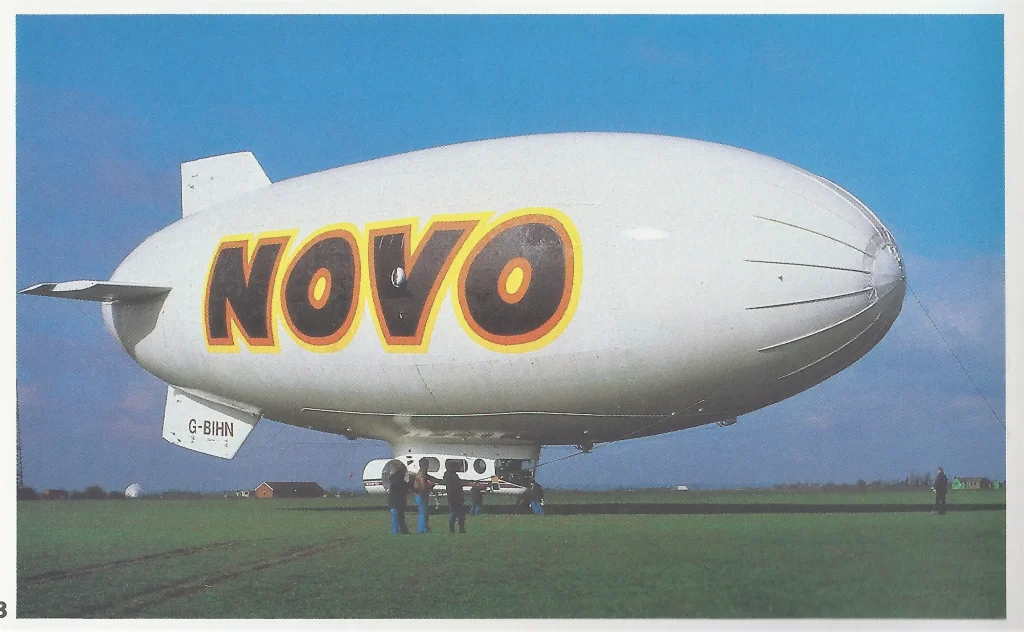

Airship Industries decided on a new passenger operation base, and a SkyCruise terminal was set up on the old Handley Page aerodrome, situated between south of St Albans and north of Radlett in Hertfordshire.
Legacy
The Skyship 500-02 demonstrated that modern airships could be:
- Fully certified for passenger operations
- Versatile as advertising, broadcast, and tourism platforms
- Operable from both fixed bases and portable masts
It paved the way for the Skyship 600 series and played a crucial role in reviving interest in lighter-than-air transport in the late 20th century.
The Skyship 500 model was seen as the proving model in the Airship Industries fleet and was immensely popular. Multiple times per season, the advertising livery could be changed, with Airship Industries offering monthly advertising contracts on the side of the ships. The Skyship range was enhanced with the addition of the 500-HL (heavy lift) series, whereby a Skyship 500 gondola was attached to a larger Skyship 600 envelope. This had the added advantage of offering up 30% more lift for the airship with no additional weight costs.
Skyship 500 Fleet
| Airship Reference | Registration | Base | Maiden Flight | Brief Ship History |
| 500-01 | G-BECE | Cardington | 3rd February 1979 | Known as the prototype AD 500, carried out a successful test flight, but after the second flight, whilst attached to the mobile mast-head / nose cone failed in high winds in March 1979. Deflated. Not rebuilt. Gondola and engines are at the South Yorkshire Aircraft Museum, “viewable but stored outside pending restoration” |
| 500-02 | G-B1HN | Cardington | 28th September, 1981 | SKYSHIP 500 G-B1HN was active from September 1981 to 27th March 1987 and the first airship to hold a public transport Certificate of Aviation, operating the first Skycruise fare-paying passenger flights over London from Cardington and later Leavesdon. G-B1HN was wrecked spectacularly on 27th March 1987 in a gale when the fixed mooring mast broke under the strain, destroying the envelope. G-B1HN is most well-known for being used in the James Bond film “A View to a Kill” as the villain Zorin’s vehicle of choice, and also used on the BBC’s Blue Peter and Tomorrow’s World. 27th March 1987 deflated when a storm at Cardington snapped the mast. Not rebuilt |
| 500-03 | G-SKSA | Weeksville (USA) | 26th August 1983 | Assembled in Canada. Sent to UK for conversion to HL 1988 |
| 500-04 (HL) | G-SKSB | Weeksville (USA) | March 1984 | The Skyship 500HL G-SKSB was built in Toronto by LTA Systems, later moved to Weeksville, NC. On 17 March 1985, its port elevator failed mid-flight over Kansas, tearing the envelope and forcing a rapid descent that damaged the gondola. Originally in Fuji Film livery (with mismatched green stripes), it was repaired, flew a year in the US, then returned to Slingsby for conversion to 500HL. Due to CAA cable-strength rules, it only received an Aerial Work certificate, was used for trials at Cardington, and never entered commercial service before the company closed. |
| 500-05 | JA-1003 | Tokyo | May 1984 | Skyship 500 G-SKSE, registered in Japan as JA 1003, was assembled in a shipyard in Tokyo for Japan Airship services the principal pilots being Brian Collins and Dave Burns, tasked with training the Japanese pilots and starting commercial operations. Lost in a training accident in March 1988. |
| 500-06 | G-SKSH | Touring USA | August 1985 | Assembled in the USA. Converted to HL in June 1990. Crashed in Argentina on 22nd November 1996. |