
Further development of the Skyship 500 led to the release of the successful “sister ship”, the Skyship 600.
The Skyship 500 model had proved to be very successful in a very short time, and it was always intended to prove bigger ships; the new Skyship 600 was to show that bigger is better.
To fill the demand for more airships, the designers at Airship Industries agreed that a new ship was required with a larger payload capacity. It was agreed that the original design of the ship was indeed very sound, and so with a few simple alterations, the Skyship 500 design was enhanced to become the new Skyship 600. There had always been a plan to “grow” the fleet of ships and provide larger enveloped ships, with more capabilities and an expanded operational focus.
The key changes and benefits were that by offering a greater payload, the airship benefited from an advantage in physics over heavier aircraft. The extension of the envelope by some 30% would give an increase in lift by 50%.

The new Skyship 600 was born. With an increased payload, the main role of the ship, passenger trips, could be enhanced by the ability to carry more passengers. The gondola was enhanced by stretching the original design and adding three round windows at the back of the main cabin.
The passenger accommodation increased to carry up to 18 passengers in comfort and crew. With the ability to not only carry more passengers on a Skycruise but also to carry more multi-role tasks, the 600 was in demand. Even though the ship now carried more weight, its performance matched that of the 500 by the two Porsche engines, benefiting from being “turbocharged”.
Passenger Layout – Skyship 600
The Skycruise tours were so successful that Airship Industries operated a scheduled air service over the major cities of the world. However, the multi-role aspect of the airship was accepted. With all the ships benefiting from such a large envelope, the aerial advertising revenue was a significant benefit for the company; however, this was not its main role.

The ships were used for scheduled passenger flights over many capitals of the world, and the airborne coastal surveillance was an additional role. The airships were also seen as very stable and enduring camera platforms used by many television companies for broadcasting major events. Unlike helicopters, the airship provides a durable, low-noise, vibration-free platform for broadcasters.
First Flight

The first Skyship 600 (600-1 registration G-SKSC) emerged from the Cardington shed, and after initial tests and trim trials, took to the skies with a maiden flight on 6th March 1984. The new, larger envelope and elongated gondola showed the work carried out to enhance the Skyship series.
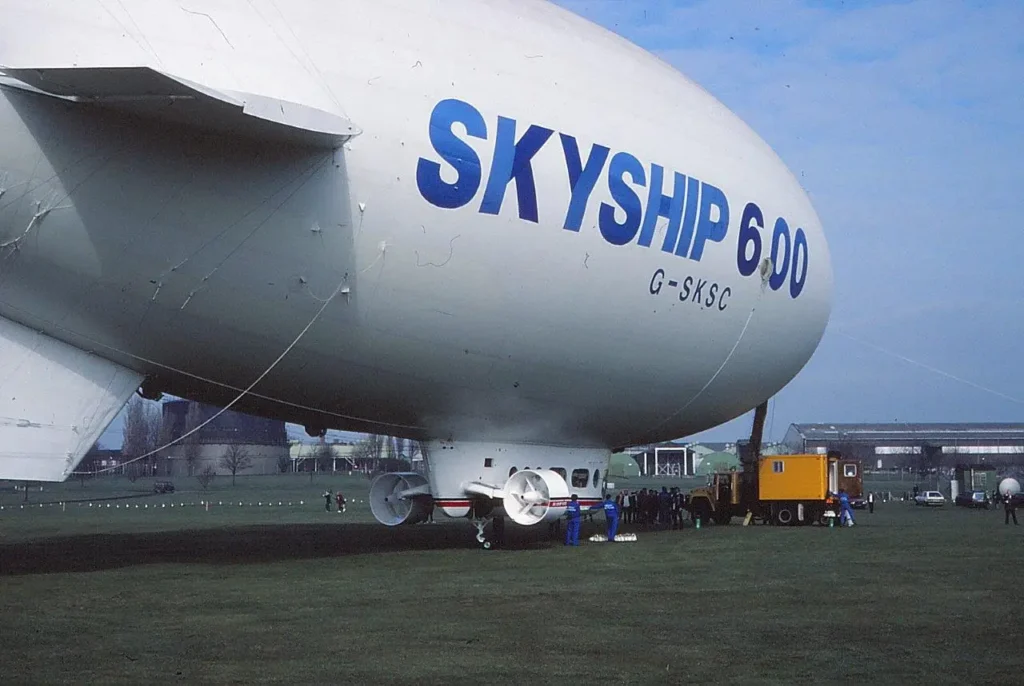


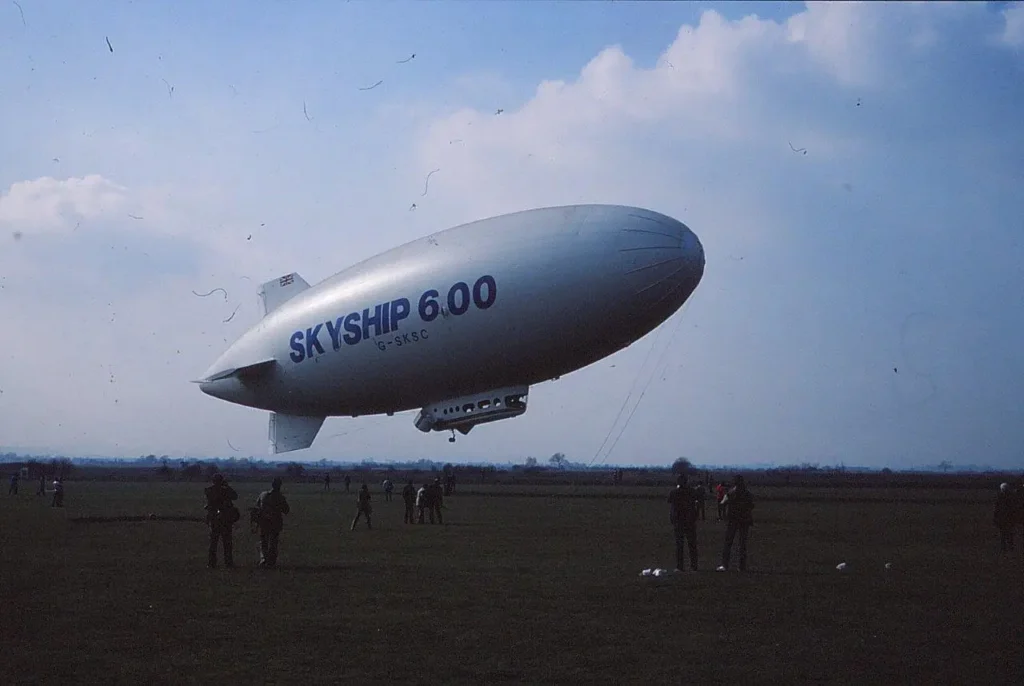
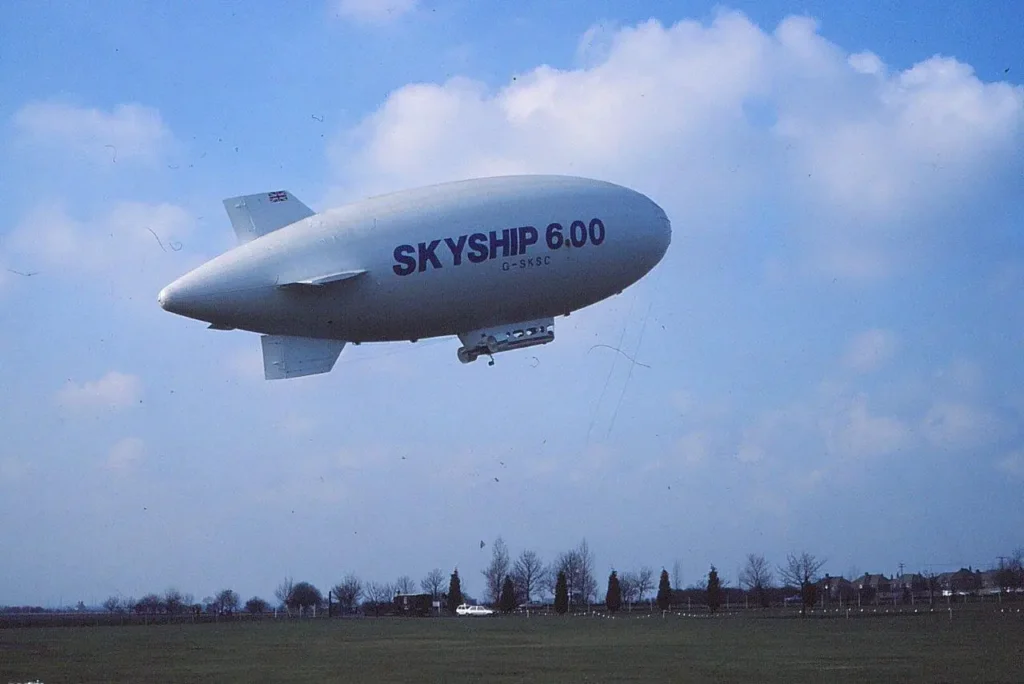
Skyship 600 G-SKSC was operational from March 1984 until the cessation of company operations in September 1990, being one of the longest-lived skyships. The airship was employed in the certification programme for the Skyship 600 series and conducted evaluation and trials flights with the French Navy in November 1984. It was subsequently operated on commercial Skyship tour flights alongside G-B1HN, as well as on advertising and promotional contracts.
A second ship (600-2 registration G-SKSD, later re-registered (VH-HAA) was launched in September 1985.

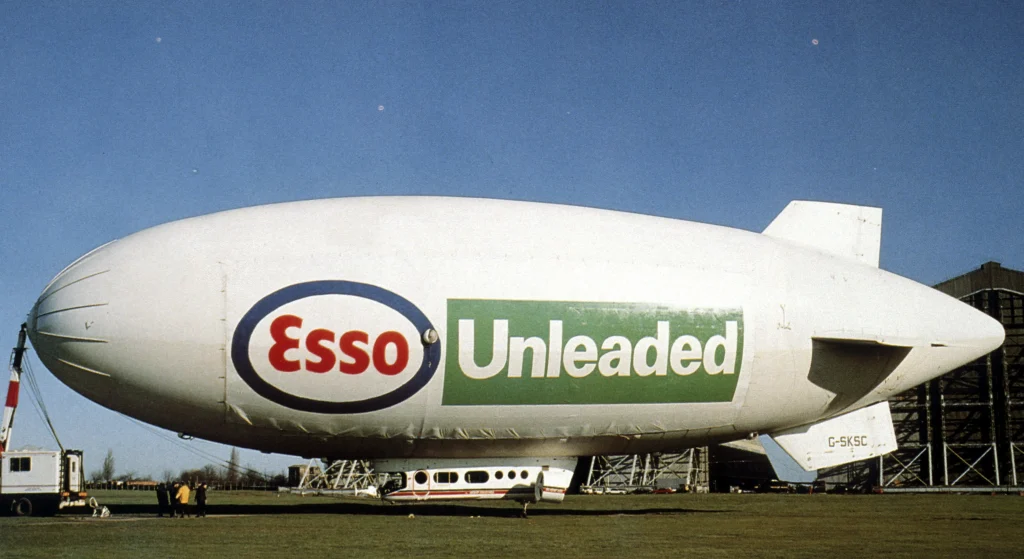

Offshore Configuration – Skyship 600 – Marine
Government interest in the airship grew as it was proving a reliable and cheaper alternative to existing facilities. Their low cost, long flying durations and stability as aerial platforms were becoming more attractive for fisheries protection and surveillance. Important trials were carried out with the French Navy and the American Government during the 1980s.
A Skyship 600 was adapted with a winch system in the gondola, whereby the ship successfully lowered and recovered a small maritime patrol boat. This was seen as a great success in the role of the airship being able to operate in a multitude of environments.


In 1988, the 600 series was distributed throughout the world with a total of seven airships completed and in operation.
After the collapse of Airship Industries in September 1990, many of them were re-fitted, and some remain in operation, operated by many airship management companies.
Further enhancements to the Skyship 600 – December 2002
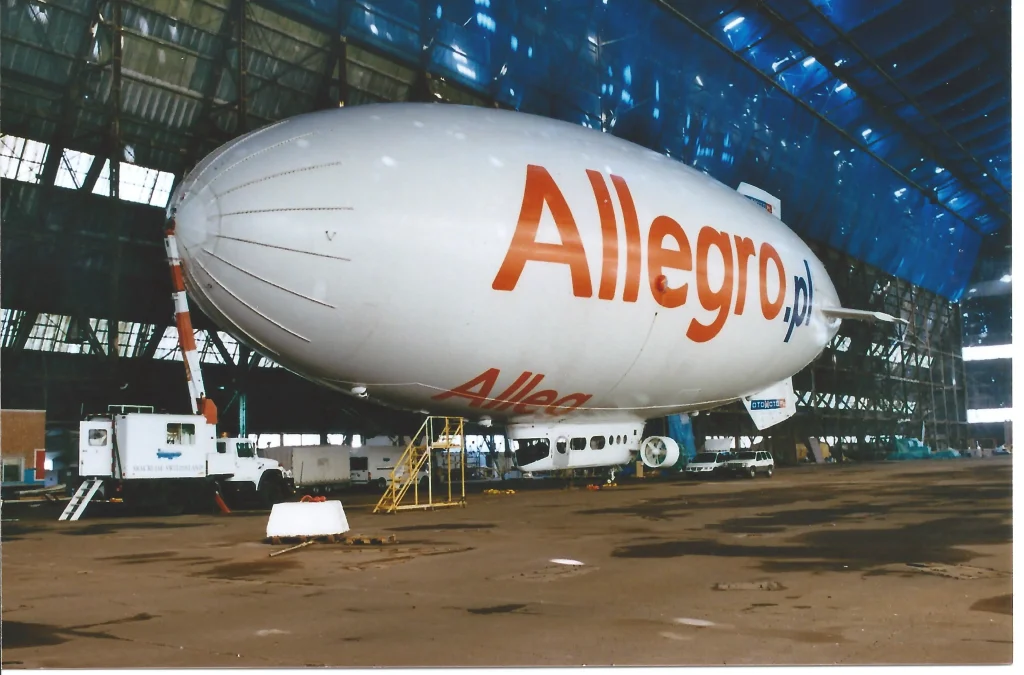
On December 23rd 2002, the FAA certified the aptly named “Santos-Dumont”, a new Skyship 600, with a Lycoming engine propulsion system. Based out of Elizabeth City NC, the ship operated by Airship Management Services was launched with newly outfitted with Textron Lycoming IO-540 engines. This vectorable thrust outboard propulsion system required a Supplemental Type Certificate. FAA officials awarded the Supplemental Type Certificate (STC) following a series of flight performances on Skyship N606SA.
The new Textron Lycoming IO-540 twin outboard vectorable thrust engines are mounted in swivelling, ducted fans, and each produces 300 hp. They replace the original Porsche 930 turbine inboard engines of 255 hp that have powered the Skyship 600 series since its introduction in 1985.
The new propulsion system enhances the aircraft’s capability for hovering and holding station; facilitates faster takeoffs, quicker response in landings, and boosts overall in-flight manoeuvrability.
The new airship was named in honour of Alberto Santos-Dumont, the Brazilian aviation pioneer who won the Deutsch Prize in Paris by becoming the first to fly a dirigible in controlled flight around the Eiffel Tower more than 100 years ago (in 1901) and who later introduced powered fixed-wing flight to Europe.
Outfitted with a new envelope from TCOM L.P., “Santos-Dumont” made its maiden test flight on January 18, 2002.


The Great Blimp Race, New York, 5th July 1986

To see one Skyship in the sky was a treat, to see two is rare, but five at once?
This is what happened on Saturday, 5th July 1986, when four airships raced around Manhattan and New York State.
The date was chosen as it was also the centenary celebrations of the Statue of Liberty. The weekend of events held in New York was also to coincide with the refurbished statue.
The race was billed as the first of its kind in the history of aviation, although the organisers seemed to have overlooked that lighter-than-air and balloon racing had been going on for many decades before this. However, this time it would be airships which would have the fun.
A press conference was held at 10:00 am on Tuesday, 3rd June, in the Observation Tower of the Empire State Building. Again, this was a nod to the perceived idea that the Empire State Building was to be used as a mooring mast for airships; despite a couple of attempts, this was not to be the case in the 1930s.
Sponsored by the Daily News, the press were ushered in to meet the Captains of the airships who were in the race. Details were outlined of the concept, idea, indeed, the rules of the race.
The idea is to raise awareness of the airships, promoters and sponsors, but also award a prize of $25,000 ($62,000 in 2022) from Citibank to the winners’ chosen charity.
Of the fifteen in the world at the time, four ships were to be competing in the race, with a fifth used as a filming platform
The Airships
| Airship | Year Built | Registration | Sponsor | Captain |
| SK 500-03 | 1983 | G-SKSA | Citibank | Captain Peter Buckley |
| SK 500-06 | 1985 | G-SKSH | Fuji Film | Captain Trevor Hunt |
| WDL | 1975 | D-LDFM | McDonald’s | Captain Alfred (Corky) Belanger |
| SK 600-03 | 1985 | G-SKSG | Resorts International | Captain William J Boughton |
| SK 600-04* | 1986 | Observer for New York Daily News | Observer for the New York Daily News |
*The Skyship 600 SK600-04 was the fastest airship in the Airship Industries fleet at the time, but was not allowed to participate in the race, as the SK600-03 was heavier as it was carrying an illuminating advertising nightsign.
The Resorts International airship, SK 600-03, was the first of the SK 600 class to fly in the United States, on 11th July 1985.
The Course

A twelve-mile course was devised to test the airship’s speed and the pilot’s skills.
The airships would leave New York Harbour heading south on an FAA-approved flight plan. They proceeded on a course due south over Staten Island to Keansburg, New Jersey. Following the Jersey shore, south to Asbury Park, where the formation will make a 180-degree turn north on a course that takes them past the beaches of Sandy Hook and Coney Island.
The route took them east, past the Rockaways to Jones Beach. As the airships hovered over Jones Beach, they were saluted by the New York Pop’s Orchestra led by Stich Henderson. Stich, who was deemed the Grand Marshall of the race, composed a special symphony entitled “Blimphony” for the occasion. The 85-piece orchestra entertained beachgoers and spectators.
Turning north west from the beaches, across Long Island, and not far from Mineola, where the first airship, the R 34, touched down, making the first east-west crossing of the Atlantic, some 67 years earlier.
The route then turned them eastwards down Long Island Sound, over the Bronx, and back over the George Washington Bridge.
The final stretch of the race was down the Hudson River on the west side of Manhattan, to the Statue of Liberty.
The Race


Starting at 4:00 pm when the airships rendezvoused over the George Washington Bridge at an altitude of 1,000ft. A 50-year-old de Havilland Gypsy Moth biplane flew across the front of the airship’s bows, trailing a banner to signal the start of the race.
The McDonald’s WDL airship first took the lead; however, this didn’t last very long as both the Fuji SK 500 06 and the Resorts SK600-03 overtook it.
Fuji’s SK 500 06 won with a time of 15 minutes and 36 seconds, with the Resorts SK600-03 in second. This was a very good performance of the ship, considering it was carrying the extra weight of the light-up nightsign. The WDL McDonald’s ship came in third.. According to the New York Times recap that day,
“The Citibank dirigible, moving at a bank-line pace of 17 minutes 16 seconds, brought up the rear”
However, this is an unfair comment not to do with the speed of the ship, but it was flown in the race with one of its propellers having issues.
The following personal account is a reflection of the day from Rod Burgess, who was the co-pilot of SK500-3, the “Citibank” airship.
I was Peter Buckley’s co-pilot on SK500-03 / G-SKSA, the ‘Citibank Blimp’ that day. It was quite a day. We were operating out of Republic Field (KFRG), Farmingdale, NY, out on Long Island, and the ship was doing about three weeks of ‘exposure’ flying around New York City, showing the advertising banners to the public.
Only days before, on 23 June, I’d passed my Civil Aviation Authority General Flying Test to qualify as an airship pilot, having joined Airship Industries that spring at Cardington. Peter was our Chief Pilot and Manager of Flight Ops. Since no CAA examiner was airship-qualified, Peter actually sat in the right-hand seat and ran the test, with Capt John Sweet, the examiner standing behind us making sure everything was done properly.
I remember John turning up in full uniform, complete with hat and collar-and-tie despite the fact that the temperature in the gondola used to get up to about 100 degrees Fahrenheit in the summer.
We knew we were at a disadvantage for the race. As you can see in the photographs, ‘SA was of the original design for the SKS 500, with the blunt tail. Both ‘Fuji’ (SK500-06 / ‘SH) and all the SKS 600 models had a more streamlined, pointed tail. Fuji’s advertising was painted directly onto the envelope, whereas the rest of us had fabric banners stretched along the sides and ‘Resorts’ had the illuminated night-sign, which added weight and drag.
The banners tended to ripple and flap in the airflow, causing drag. We didn’t know quite what to expect of the WDL-built ‘McDonalds’ – and Corky’s mount was a bit of a dark horse. All-in-all, Fuji was the favourite to win.
But Peter had a plan! The night before, ‘the boss’ persuaded the engineers to tweak the blade angles on Citibank’s propellers, hoping to squeeze a knot or two extra out of the old girl.
Normal cruising speed for both the 600 and 500 was 30 kt and the flight manual top speed was 50 kt for both. But airships, even more than fixed-wing aeroplanes, each have their own peculiarities and no two apparently identical ships will achieve the same speed at the same loading and power setting. Peter reckoned we might just be able to surprise the other guys.
On the day of the parade and the Great Blimp Race, we were up over New York Harbor good and early. The harbour was crammed with vessels of every size, shape and variety. I remember one heart-stopping moment: just as we passed quite low over an immense US Navy battleship, she fired a salute. Peter nearly leapt out of his skin.
“What was that?”
“They just fired a salute” I replied.
“Thank [expletive] for that. I thought we’d burst a ballonet!” Now that would have been entertaining.
As the other airships gathered, Peter acted as commodore of the gaggle. He led the five ships around the parade route in line astern. A close look at the map will show that we flew barely outside the perimeter fence of JFK International. I reckon we passed about 2 miles south of the control tower ‘not above one thousand feet’ at ATC instruction.
After turning inshore over Jones Beach, we headed NW across Nassau County, a little west of the red line planned and shown on the map. Approaching the vicinity of La Guardia airport, I was stunned to have the Tower controller suggest that we bring the whole fleet directly over the field on our way to join the Hudson River.
Sadly, due to a slight misunderstanding, Peter declined the offer and we passed just outside the airport’s NE boundary. Somehow, I can’t imagine many other international airports letting a bunch of slow-moving, wallowing airships within a country mile of them the way both New Yorkers did that day!
And so, to the final act – the Great Blimp Race itself. It took a bit of wriggling and squirming to get the four participants properly lined up over the George Washington Bridge but we finally managed it. And then we were off! The course was almost a straight line down the Hudson from the ‘GW’ to New York Harbour and the finishing line was a line of sight from Battery Park to the torch held by ‘Lady Liberty’.
No sooner had we started than it became clear that Peter’s propeller tweak was not going to give us an edge. In fact, the props didn’t like it at all and, if anything, ‘SA was not even achieving the speeds we normally saw. With the engines at max throttle, we watched the rest of the field steadily drawing away from us. Oh, the shame of it! Last place. I’m sure the official times are more accurate but my log book shows that Fuji took 15:20 to complete the course and we took 17:00. The ship was airborne continuously for 10 hours, 30 minutes and we covered an estimated 200 nm in that time.
I have a great many fantastic memories of my time flying airships in Britain, Europe and the USA but I can honestly say that the day of the Great Blimp Race is a very special one.
The winning team were presented with a 2ft long airship trophy from James Hodge, the publisher of the Daily News, and a cheque for $25,000, which was passed to the Boys’ Clubs of America as their chosen charity.


Once the race was over, all five airships circled the Statue of Liberty before returning to their local operational fields in New York State.
Did you know, there were seven?
Out of a total of fifteen airships in the world in 1986, there were seven airships seen over New York over the celebratory weekend. The other two airships were both Goodyear Aerospace GZ20 class ships, one named Enterprise (N1A) and America (N3A). Goodyear had ordered the crews not to participate in the race.
At the time, the Navy contract for a large non-rigid patrol airship had not been finalised, and Goodyear Aerospace didn’t want the risk of coming second to a Skyship to tarnish their image.
According to pilot Trevor Hunt, in the SK 500-06 confirmed that the Goodyear pilots had been told to stay away from the Fuji liveried ship in Long Beach, after our camera crew filmed them slowly overtaking them. Hunt commented that the best part was that he was filmed restarting the port engine, and then left them standing.
Did you see the race? Were you there at the celebratory events that weekend? If you have any photos or recollections, please share them with us.
The Race Legacy
A second New York Blimp race was organised on Independence Day, 4th July 2011, where three airships were used:
Lighship A170LS – DirectTV Sponsorship
Lightship A60+ Horizon Blue Cross Shield Sponsorship
Lightship A60+ Hangar One Vodka Sponsorship
Again, the route was a race down the Hudson River and around the Statue of Liberty.
The winner was Hangar One Vodka.
Videos: Skyship Stories Episodes 1-8
What was it like to fly these wonderful machines? In the Skyship Stories videos, we hear from Airship Industries pilot and AHT member, Rod Burgess, who explains what it was like to fly Skyship, but also what life was like on the road on tour with Airship Industries in the 1980s.
The original interview was over two hours long, and so we’ve broken it down into a series of illustrated and animated episodes, each covering a different aspect of skyship piloting.
Special thanks to AHT member Stephan Niemeyer for his excellent 3D animations, which brought the series to life and illustrated the topics.


Episode 1: How to become a Skyship Pilot
For nearly a decade, Skyships were the airships seen gracefully flying over the major cities of the world. In this series of interviews, we talk to Skyship pilot Rod Burgess about his time at Airship Industries and hear some amazing stories. In this first episode, we hear about how he became a Skyship pilot and what it was like at Cardington in the 1980s.
Episode 2: Skyships on Tour
In this episode, our expert Skyship pilot, Rod Burgess, explains what it was like to take a Skyship on tour, and it’s not as easy as you think…
Episode 3: The Great Blimp Race
Welcome to Episode 3 of Skyship Stories. In this episode, our skyship pilot, Rod Burgess, explains what it was like to participate in a unique skyship race over New York in 1986. Listen as he explains the amazing details around this time when half of all the world’s airships were in one city at once, and has never been repeated since.
Episode 4: Flying Skyships
In this episode, our expert Skyship Pilot, Rod Burgess, provides a fascinating insight into flying a Skyship. Rod explains what it was like to fly these amazing machines and gives details of the technical aspects of airship flying.
Episode 5: Factors in Flying
In episode 5, we explore the main factors which affect the way an airship can fly. Rod Burgess, our expert Skyship pilot, explains what it’s like to fly in varying weather and delves into how temperature can affect the Skyship.
Episode 6: Landing Skyships
Flying a Skyship, as we have learned, is not quite as easy as it looks. Landing a Skyship, now that’s a different matter altogether. In this episode, Rod explains the intricacies and teamwork needed to land a Skyship and details a lot of different factors involved.
Episode 7: Ground Handling Skyships
In this episode, we look at some of the challenges around keeping a skyship on the ground. Ground handling is one of the key challenges to lighter-than-air flight in general, and Rod explains some of the different concepts tried with the rigid airships of the past, and where the problems occur for non-rigid airships in general.
Episode 8: Skyships in the Snow
So you think that Skyships are all weather? Well, Rod explains what conditions a Skyship can be moored on the ground and how snow can be a particular problem. In this, our last episode of the series, Rod explains one of the close shaves he had with a Skyship in the snow.
Skyship 600 Fleet
| Airship Reference | Registration | Base | Maiden Flight | Brief Operational History |
| 600-01 | G-SKSC | Paris | March 1984 | Skyship 600 G-SKSD made one two hour flight only, in September 1985, and can be seen in the famous photo of 3 Skyships flying together, which was the only time the three ships flew together in the UK.600 G-SKSC was assembled in March 1984 at Cardington, and the G-SKSD’s enveolpe was inflated under a net where it remained for some time as there was no money to complete it. Having spent the best part of two years as a hanger queen with the envelope inflated under a net and the gondola on a trolley underneath, the Bond Corporation, who then owned Airship Industries wanted to start their Australian operation, and so the ship was completed and flown once to get a Certificate of Airworthiness, then dismantled and shipped to Australia. |
| 600-02 | VH-HAA (ex G-SKSD) | Sydney | September 1985 | Skyship 600 G-SKSC was active from March 1984 to the closure of the business in September 1990. The ship was used for certification of the 600 series, and flew trials with the French Navy in November 1984.The ship was used to operative Skyship tours with G-B1HN and also advertising contracts. G-SKSC was also damaged in the same gales as G-B1HN and also highlighted a design flaw: when moored up in strong winds the envelope stretched lenghways and after a while sprang backwards, causing the batons which laced the nose cone to the envelope, dig on to the envelope and eventually puncture it and let the wind split the envelope from end to end. G-SKSC was rebuilt with a new envelope and made its final Airship Industries flight in 1990. After the administrators were called in the team at Airship Industries persuaded them to allow “joyrides” to continue at Cardington to sell the company as a going concern. This formula was continued for a month until the company finally went in to liquidation. |
| 600-03 | G-SKSH | Touring Canada | July 1985 | |
| 600-04 | G- SKSF | Weeksville (USA) | June 1986 | |
| 600-05 | G-SKSJ | Touring USA | November 1986 | |
| 600-06 | VH-HAN | Japan | February 1987 | |
| 600-07 | G-SKSL | Tokyo | August 1987 |