
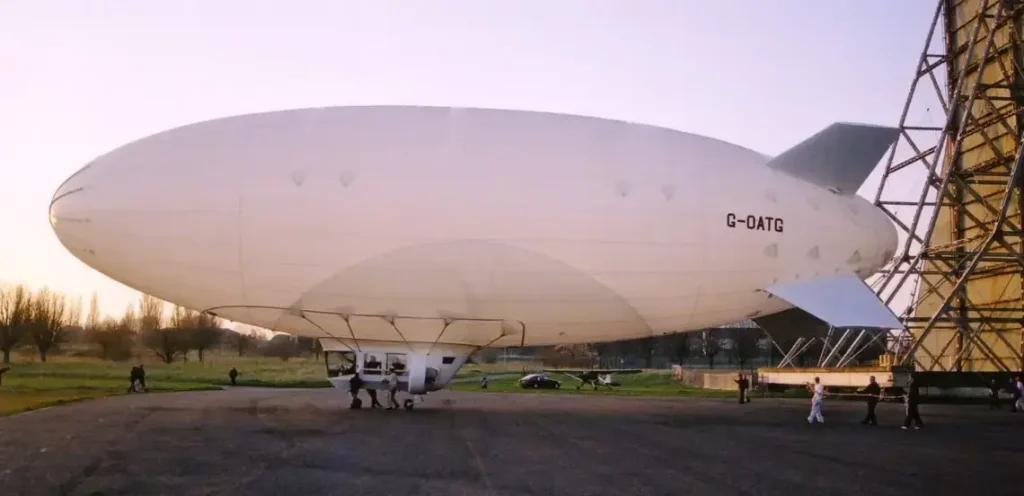
Airships returned to Cardington in the guise of the new ATG airship, the AT-10. The first of a new series of Airships

Introduction
Since the collapse of Airship Industries in September 1990, some of the group’s main employees and designers decided to continue with the airship programme and, in 1995, set up a small company named originally Airship Technologies Group, later to be known as Advanced Airship Technologies Group (ATG)
The company continued to pressure the market and prove airship and hybrid lighter-than-air craft. The AT-10 was devised using the advancements as seen in the Sentinel 1000; a cross-configuration tail fin was one of the main advancements carried forward on the smaller craft.
It was seen that a small pilot training and advertising vehicle would be needed by the company before embarking on its larger projects, and the AT-10 fulfilled that role. The AT-10 is a 4-5-seat commercial airship providing an advertising and camera platform capability allied to other uses such as pilot training.
Design
The ship design moved away from the earlier skyship configuration. The envelope is made of a laminated translucent fabric and a hull with an external cantenary collar system supporting the main payload module. A single ballonet was installed centrally located over the payload module (cabin) for hull pressure control.


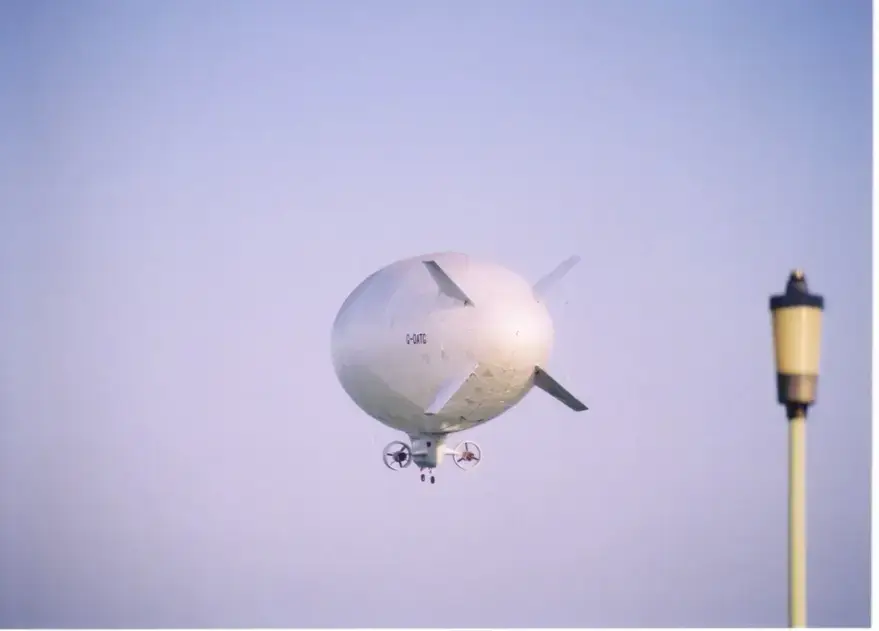
The payload or gondola comprises a single structural module with a flight deck comprising 2 pilot stations and 2 sidestick controls. The passenger compartment behind the flight deck allows seating for 4 passengers with a single large door entrance. The passenger seating configuration can be rearranged for the flexible location of equipment.
A small stowage compartment is also added with a small toilet on board for comfort. The AT-10 also carries a power plant of 2, 100bhp horizontally opposed two-stroke direct injection diesel engines. As with earlier airship technology, the AT-10 continues to use the fly-by-wire optical technology. It also had a flight control system provision for an autopilot facility.
The first flight of the AT-10 was on a sunny morning on 22nd March 2002, where the ship carried out her initial trials.

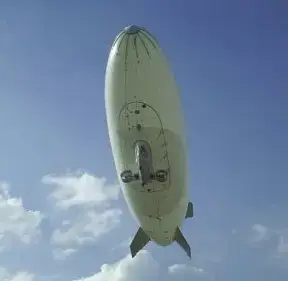

Further flight testing was made throughout 2003 and 2004 from Cardington, where it demonstrated effective controls with excellent stability and low-speed handling.
European type certification by EASA (European Union Aviation Safety Agency) was in progress in 2004.
Final Life
However, difficulties in certifying the first diesel engine ever used on an airship delayed the certification process. ATG sadly ran out of funds, and European certification was not completed. In 2005, Advanced Technologies Group (ATG) was placed in receivership. The owner of the AT-10 deflated the ship and gondola and took it to China.