
Introduction
The RNAS Kingsnorth design team took it upon themselves to correct the earlier design problems encountered with the Coastal class ship, and the crew’s feedback regarding the instability of the ship on takeoff and landing. In changing the control surfaces and making a more streamlined tail to the envelope, these stability problems were corrected.
The second class of “Coastal” were designated the “C*” (C Star) Class. Due to the technical problems which were being encountered at RNAS Kingsnorth with the development of the larger North Sea Class ships, it was decided that an interim class of ship was needed. With this saw the improvement of the Coastal Class ship, and the development of the C Star airship class.
Design

The control car of the C* class ship was similar to that of the existing Coastal Class ship, and indeed the prototype C* ship took the existing control car from the C.12. The C* ships retained the open cockpits but extended engine mounts were put at the rear, and the body was covered with plywood instead of fabric. In order to improve observation, four circular portholes of Triplex glass were provided for on either side of the car, and another placed on the floor of the pilots compartment. The feedback from the crews on the Coastal Class ship were incorporated in improving of the overall comfort of the car for the crew.
The main alteration, which was more recognizable was the change to the envelope. The common Astra Torres trilobe form was retained, but the length was increased to 207 feet and increasing the capacity to 210,000cft. The shape of the envelope became much more streamlined and graceful compared to the original Coastal Class envelope. This was a development project, and so the first three ships of the C* Class still had rather a blunt stern tip.
The later ships had more of a slender tail, with the length of the tail increasing by another 10ft, but without adding to the overall capacity. To improve control and stability, six balloonets were fitted, two large ones amidships, two smaller ones forward and another two aft. Each pair was connected by a tube, while the three starboard balloonets were further interconnected by the air delivery duct, which led from the airscoop positioned to collect air from the slipstream of the after engine. The duct was fitted externally at first but was later placed inside the envelope in order to improve streamlining.

Engines
The Coastal “Star” class ship enjoyed more powerful and reliable engines, with the aft engine being changed to a 220hp water-cooled Renault engine, whilst the forward engine was a 110hp water-cooled Berliet engine. On later models, the Renault engine was replaced by a water-cooled 240hp Fiat engine. Unlike the Coastal Class ships, there was no gunner position on the top of the envelope, so this saved some 250lb in weight, and allowed a gas release valve to be placed in the same position, but a pair of Lewis guns were carried in the control car, which also had fittings for two 230lb and two 100lb bombs. For the crew, five parachutes were also carried, the lines of which could be attached quickly to a harness worn at all times by each crew member.
Service Life
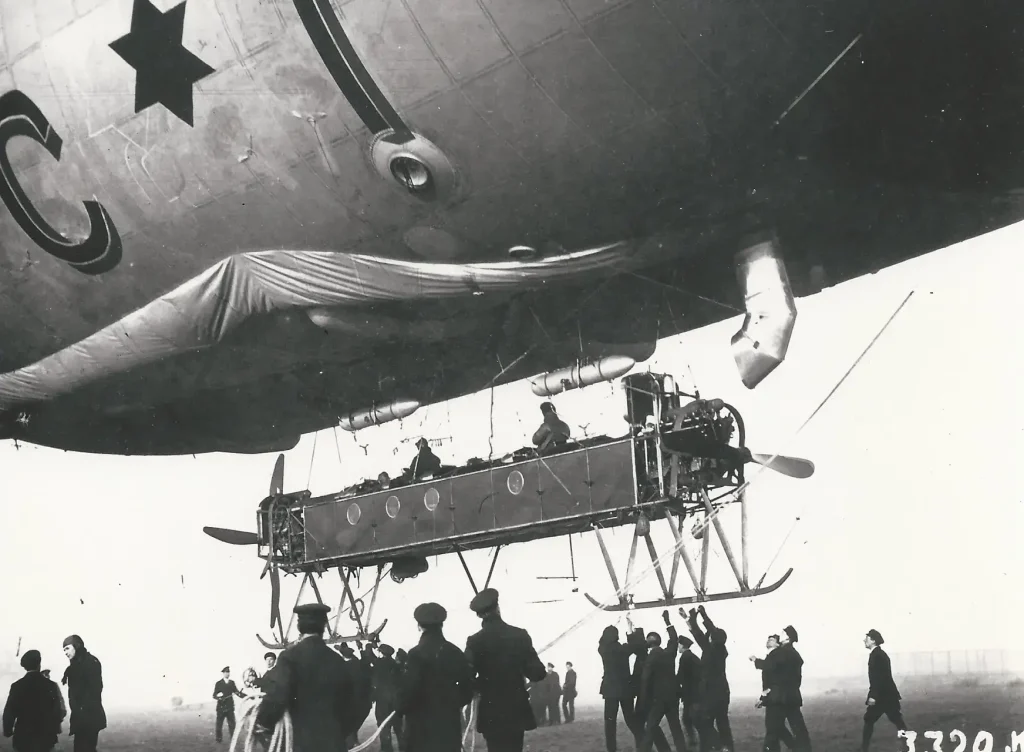
Although the rate of climb on a C* ship was not as fast as a Coastal class ship, the new ships proved to be superior in every other way and capable of a top speed of 56mph.
10 C* airships were completed and put into operation; however, they were not regarded as entirely successful as 20 were originally ordered, and production at RNAS Kingsnorth was discontinued in favour of the SS Twin Sea Scout airship, after the first 10 had been delivered between February to July 1918.
The C* airships had rather uneventful careers compared to those of the Coastal Class ships, as they came late in on to the scene of the war, and all carried out long and regular patrols carrying out their duties efficiently without incident. The longest continuous flight recorded was of 34 hours and 30 minutes by C84 commanded by Captain Cleary on 27th to 28th May 1918.