
Following the success of HMA No. 9, further ships were ordered by the Admiralty. Along with the Vickers Company, three new contractors were required to produce rigid ships. The Vickers Company had already proven itself with the design and construction of No. 9 and was the only company with any experience of building a large ship.
Following the trials and design success of HMA No. 9, it was agreed that the Zeppelin threat had to be tackled head-on; the Admiralty required more ships. There were initial problems at the Admiralty with regard to the change of staff and also the general opinion regarding rigid airships, as the successful non-rigid programme was expanding rapidly. However, in June of 1915, along with the Vickers Company, three new contractors were selected to produce rigid ships.
New Class of Airship
The three new contractors were Beardmore, Armstrong and Whitworth and finally, Shorts Brothers. All three companies were to become famous in the world of aviation. By October 1915, the drawings were approved, and three ships were ordered. By December, the pace of design and the requirement for big ships had increased dramatically and a further sixteen ships had been budgeted for by the Admiralty. All of these ships were to become known as the 23 Class, which were in effect stretched versions of the original No. 9.
The designs were seen in essence as modified versions of No.9, with an extra bay inserted in the middle of the ship. A gun platform was added to the top of the ship, designed to take a two-pound gun and two Lewis machine guns. The platform was surrounded by 18-inch sanctions carrying lifelines. These sanctions could be extended to double the height in order to carry a canvas windscreen. Three other Lewis guns were to be fitted at the extreme tail, in the control car further aft and on the top walking way.
Authorisation for the construction of additional rigid airships was granted before No. 9 was completed. The 23 Class (originally to consist of ten airships: No. 23 to 25, and R-26 to R-32 inclusive) would show improvement over No. 9 by providing an increase of between 57 and 65% in useful lift. Yet this was still insufficient to carry enough fuel for prolonged reconnaissance. These airships would thus also be relegated to experimental and training ships. R-27 through R-32 were removed from this classification once it was discerned that the design could not provide the desired performance, and those numbers were allotted to improved designs. No. 23 to R-26 design retention was authorised because training airships were still required, and work was already too advanced on these particular airships to make scrapping them viable.

Design and Construction
No. 23 was built by Vickers at Barrow and launched on September 19th, 1917, one year behind schedule. This class of airship was slightly larger than No. 9 with a volume of 26,618 m3 (940,000 cu. ft.) and a length of 163 m (535 ft). The diameter remained at 16.15 m (53 ft). Four Rolls-Royce engines of 250 h.p. each provided 280 h.p. more than No. 9, resulting in an increased speed of 87.7 km/h (54.5 mph) versus 68.4 km/h (42.5 mph) for No. 9. Incremental improvement in streamlining also contributed to the higher speed; for example elevators and rudders were simplified single as opposed to multiple surfaces. Useful lift varied slightly with each airship: No. 23 – 5.98 tons (6,078 kg/13,400 lbs), No. 24 – 6.16 tons (6,260 kg/13,800 lbs), No. 25 – 5.8 tons (5,897 kg/13,000 lbs), and R-26 provided the best useful lift thus far at 6.27 tons (6,373 kg/14,050 lbs).
None of these airships met with significant mishaps and collectively helped to train more airship crews. Noteworthy experiments were undertaken by No. 23 under the command of Major Ivor C. Little. These included the successful unmanned drop of a 2F.1 Sopwith Camel (N6814) aeroplane from 183 metres (600 ft) on November 3rd, 1918. (Trials conducted on October 2nd did not involve releasing the Camel, the purpose of the flight being to observe any in-flight anomalies with a parasitic aircraft). On November 6th, Lieutenant R. E. Keys piloted the released Camel to a successful landing at Pulham.
The bomb load was to be greater than that of HMA 9, but none was specified. The ships each possessed an external keel, to the same pattern as the No. 9. The cabin, being 45 feet long, contained crew accommodation, a wireless room and a bomb room. From the keel further aft were three gondolas, which were suspended below and accessible by open ladders. The ship’s gondolas also contained airtight buoyancy bags in case the ship had to land on water. This was a technical requirement of all ships since HMA 1 – the Mayfly. With this rapid expansion of the requirement for airship production, there were a few problems in that so far, only one company had actually built a ship and hence had all the facilities.
However, to help the programme, Vickers provided components to the other three companies to assist in production. The original ships were divided among the various contractors, and the registrations were allocated among them. Vickers received H.M.A. 23.
In April 1916, the Government approved a total fleet of 10, 23-class ships, but this was later modified in the light of further design technology available from Germany. The later ships became the R23X class and the R31 class.
First Flight
The HMA 23 was the first to be completed, and hence the designation of the class of ships. There were a number of delays in the initial construction, and the ship was completed on 26th August 1917. The ship was walked out of the shed on the morning of 19th September 1917 and undertook her first flight. On lift and trim trials, the HMA 23 was found to have a disposable lift of only 5.7 tons due to the machinery being two tons heavier than originally estimated. Although not unexpected, the figures were disappointing, and 2 weeks later, on the 18th October, the Admiralty decided that the design must be altered. The alterations to the ships included the removal of dynamos and bomb frames, and many other items which were deemed unnecessary were removed.


Modifications
The measures to be undertaken were aimed at lightening the airships by the elimination of all unnecessary weight. In addition to the removal of the dynamos, buffer wheels and bomb frames, many other small items not considered essential were either taken out or replaced with lighter equipment. The folding tables, which had been intended for the keel cabin, were never installed, and the original plan of fitting a two-pounder gun on the top platform was also discarded. The rear car was replaced by a smaller and lighter one containing an engine with direct drive to a single two-bladed propeller 13 feet 6 inches in diameter. As there was now no space for the auxiliary controls, these were transferred to the keel cabin.
Some of these modifications had already been carried out on the first three ships, while others followed in due course. Together they effected a marked, if not substantial, improvement to the airships’ performance.
All four of the 23-class airships were flown extensively, but although rather more efficient than No. 9 they still did not provide the performance which had been hoped for.
Service Life
HMA 23 herself had been commissioned on 15th October 1917, and left on that day for Pulham. She had a top speed of 52 mph and flew a total of 8,426 miles in 321 hours and 30 minutes. Although she carried out some patrols, usually under the command of Captain I. C. Little, she was used mainly for training and experimental work.
Experimental Work
Trials were undertaken in January 1918, at Pulham with a two-pounder gun in its mounting on the top platform of HMA 23. The gas valves were placed on either side of the hull rather than at the top to avoid the risk of escaping gas being ignited during firing.
Six shells were fired with the gun pointing downwards, but instead of embedding themselves in the mud of the airfield as expected, they seemed to have ricocheted into the surrounding countryside. The airship took the strain well, although some flexibility was present, which would have adversely affected aiming under combat conditions. No further action was taken in the matter because of the ever-present weight problem.

Trial launch of aeroplanes
Later in 1918, HMA 23 was involved in another experiment, this time to determine whether an aeroplane could be carried by an airship and released in mid-air either to repel attackers or to take offensive action on its own account. A Sopwith Camel was suspended beneath the envelope by specially prepared slings.
For the first trial, a dummy was placed in the cockpit, and the controls were locked. As the airship flew over Pulham air station, the aeroplane was released. It glided to the ground, showing that the slipping gear operated correctly. Another Camel was then taken up, this time piloted by Lieutenant E. Keys. As the aeroplane left No. 23, the pilot had no trouble in starting the engine. He pulled out of the dive to fly around the airship before landing safely.
No provision had been made for the retrieval of the aeroplane during flight, as the intention was that it should make its own return to base after action. As with other unusual projects tried out during the war, nothing further was attempted. Similar trials were held after the war with R.33, and the method was eventually perfected by the Americans in the early 1930s.
London Flights
A noteworthy departure from routine training and testing befell No. 23 on 6th December 1917, when she was sent to make an unannounced daylight flight over London, arriving out of the mist from Pulham around midday.
At a low altitude, she circled over Buckingham Palace, Whitehall and the City, where thousands of Londoners saw the lights twinkling in her gondolas; the red, white and blue roundels on her envelope and her designation numerals. Wartime censorship allowed press reports of the incident (“At last a British Zeppelin”), but the airship’s number could not be published, despite its having been so publicly displayed!
Twice in the following year, No. 23 flew again over London, on one occasion accompanied by R.26, but these appear to have been the high points in an otherwise mundane and unwarlike career. She was deleted in September 1919.


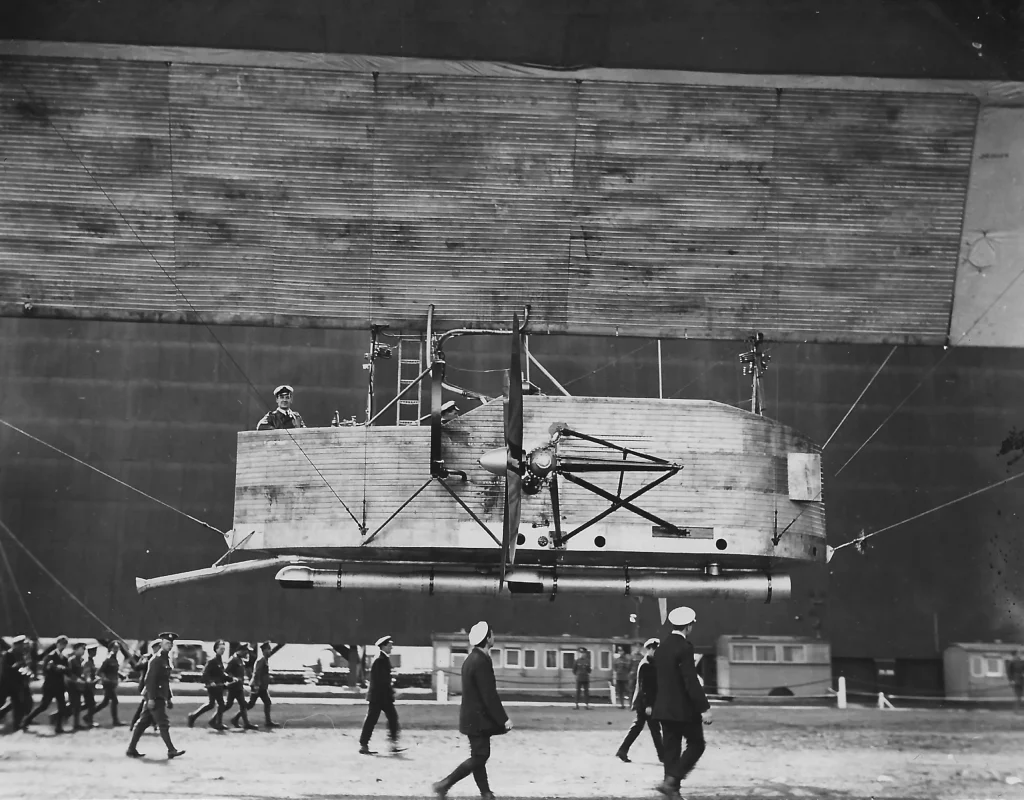
No. 23 recorded 321 hours and 30 minutes of flight.
All 23 class airships were functional, but were far outperformed by contemporary German airships and even by British non-rigid airships. If performance statistics along these lines were the sole criteria by which ordering further rigid airships was to be based, no more would have been built. But with the Battle of Jutland and the erroneous Allied perception that Zeppelins had saved the High Seas Fleet, there was a sudden surge in calls for reconnaissance airships from the Grand Fleet. Increasing British awareness of German technical progress with airships also helped badger a reluctant Britain forward. Further reading can be made in our extended research page on the 23X Class ships