
Introduction
Following the successes of the R33 and her sister ship the R34, further investment in airships was provided and saw the creation of the R36, R38 and the R80. Airships were now proving themselves as technically advanced aircraft, surpassing the aeroplane.
Imperial Airship Programme 1924-30
In 1924, the Government agreed to establish aerial communication links with the far corners of the Empire. The decision was made to construct two entirely new airships to serve air routes to Montreal, Canada, and Karachi, India, with the final view to have a ship to reach Australia. A plan was also made that the ships could be of military value to have the ability to carry some 200 troops or 5 aeroplanes. It was deemed that a ship of some 8,000,000 cft would be required. However, it was agreed to continue with the non-military version of the ships.
Imperial Airship Routes
The original plans by 1926 were to have routes from Canada to Australia with a regular connecting service and stops en route. The original specification led to a plan for 6 airships to cover this service and a series of airship bases along the way.
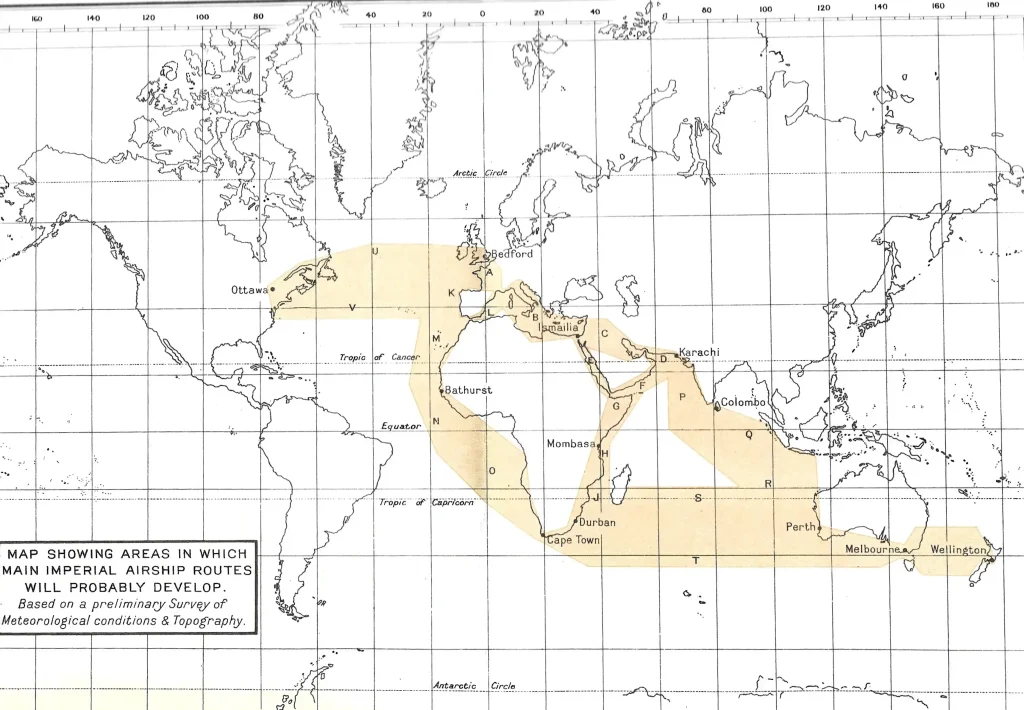
It has now been disclosed that the South African masthead was constructed at the same time as that for Montreal and shipped down to Cape Town. Also, a number of farms had been purchased outside Mombasa and Durban as sites for potential mast sites.
The Airships
The Airship Guarantee Company, a subsidiary of Vickers, won the contract to design and build one ship, and the Government would have its own design team to build the other. These two design teams decided to move away from the conventional, much copied Zeppelin designs and come up with two completely new prototype ships. It was agreed that the best features from both ships would be used in the next generation of airships. The Airship Guarantee Company designed and constructed the now-designated R100 at Howden, Yorkshire, and the Government-sponsored team built the designated R101 at Cardington. Hopes were high for both new ships and nearing completion, the specification and plans were already being drawn up for the R102 and R103.
By June 1930, the R100 was ready, and after testing, it flew successfully to Montreal and back. The R101, after various changes and initial setbacks, was finally seen to be the shape of things to come. With her lavish interiors, sleeping berths, lounge, smoking room and promenade decks, her comfort was comparable to that of an ocean liner.
After her initial test flights, by October 1930, she was ready to leave for India and the Imperial Conference. With the Secretary of State for Air, Lord Thompson of Cardington and most of the design team, she left on the night of 4th October. It was at 2.09am on the morning of the 5th that the R101 struck the ground near Beauvais, France. The project was reviewed following the loss of the R101, as most of the design team, the leading government sponsor, Lord Thompson of Cardington, and some of the most experienced airship crews died in the crash.
Imperial Airship Programme 1931-33
With the new ships being tested, plans were underway for the design concepts of the new class of Airships. Funding had been agreed, and the design specifications drawn up. The budgets and plans had been agreed upon to 1935 and included the refurbishment of the R33 and R36 for future testing, the R36 was to go to Egypt to be tested in tropical climates. The R102, R103 and R104 had been planned, and the concept specifications showed that they would carry up to 150 passengers. At Cardington, the design team had already started plans for the next generation. The R102 was to have a volume of 8,300,000 cubic fee,t which would have made it comparable to the LZ129 “Hindenburg” , which was completed some 6 years later.
Designated “Project H” (R102) had been agreed in August of 1930, with a capacity some 36% larger than the lengthened R101 was to be built at Cardington. It was to be powered by 7 improved Tornado engines.
Discussions during 1929 and 1930 centred on a still larger ship of 9,500,000 cubic feet capacity – the R103, but not yet designated. As quoted by Sir Peter Masefield, “This ship would be capable of regular operations with a non-stop travel to Egypt with a substantial payload. The ship would then move on with stops at Karachi, Rangoon and Singapore to Australia. It was expected to reach westwards to Montreal nonstop in all weathers”.
However, it was agreed that Project H (R102) could carry out the same duties being a smaller ship, if additional masts were built for refuelling. Plans and land surveys were carried out at Malta and Baghdad on the India route, and at Monkton, New Brunswick on the Canadian route.
The future plans also included the lengthening of the Cardington sheds and the building of a new shed capable of accommodating two ships side by side. An additional mast would also have to be built so that the R100 and R101 could run and operate services concurrently. This would also be backed up by a mobile transporter tower and supported by a second transporter tower at the Karachi base with its own shed and mooring mast. Recent research has confirmed that some 3 farms near Cape Town in South Africa had already been purchased by the Air Ministry with the intention to turn it into an airfield with its own mooring mast.
Initial Dimensions of the new R102
| Length | 822ft | Notes |
| Diameter | 134ft | Two-wing cars and three aft cars with two engines in tandem (tractor and pusher) |
| Engines | 7 reversible Tornado engines | Two Wing cars and three aft cars with two engines in tandem (tractor and pusher) |
| Volume | 8,300,000 cft | |
| Cruising speed | 60 knots |
Imperial Airship Programme Flight Plans 1931- 33
| 1931 | Ship | International Flights | United Kingdom |
| R100 | 2 return flights Cardington – Montreal | Local internal flights | |
| 2 return flights Cardington – Karachi | Local internal flights | ||
| R101 | 2 return flights Cardington – Montreal | Local internal flights | |
| 2 return flights Cardington – Karachi | Local internal flights |
| 1932 | Ship | International Flights | United Kingdom |
| R100 | 4 return flights Cardington – Montreal | Local internal flights | |
| 4 return flights Cardington – Karachi | Local internal flights | ||
| R101 | 4 return flights Cardington – Montreal | Local internal flights | |
| 4 return flights Cardington – Karachi | Local internal flights |
| 1933 | Ship | International Flights | United Kingdom |
| R100 | 4 return flights Cardington – Montreal | Local internal flights | |
| 4 return flights Cardington – Karachi | Local internal flights | ||
| R101 | 4 return flights Cardington – Montreal | Local internal flights | |
| 4 return flights Cardington – Karachi | Local internal flights | ||
| R102 | Home trials |
Revenue from fares
The single fare was to be £150 (equating to £8,500 in 2025), comparable with that charged by Imperial Airways on its London to Delhi route. It was also agreed and plans were underway that the tickets would be issued in agreement with a commercial travel agent to undertake the passenger administration and distribution of tickets.