
The R102, R103 and R104 had been planned, and the concept specifications showed that they would carry up to 150 passengers. At Cardington, the design team had already started plans for this next generation. The R102 initially was to have a volume of 8,300,000 cubic feet, which would have made it comparable to the LZ129 “Hindenburg”, which was completed some 6 years later.
Design concepts
Designated “Project H”, R102 had been agreed in August of 1930 with a capacity some 36% larger than the lengthened R101. It was to be built at Cardington and was to be powered by seven improved Tornado engines.
Discussions during 1929 and 1930 centred on a still larger ship of 9,500,000 cubic feet capacity – the R103, although it was not yet designated as such. As quoted by Sir Peter Masefield, “This ship would be capable of regular operations with a non-stop travel to Egypt with a substantial payload. The ship would then move on with stops at Karachi, Rangoon and Singapore to Australia. It was expected to reach westwards to Montreal nonstop in all weathers”.
However, it was agreed that Project H (R102) could carry out the same duties being a smaller ship if additional masts were built for refuelling. Plans and land surveys were carried out at Malta and Baghdad on the India route, and at Monkton, New Brunswick, on the Canadian route.
Due to the problems with operating in hotter climates, it was noted that there would be a loss of lift in the months between May and August, amounting to some 8% of gross lift. This would mean that some weight saving could be made, with either reducing the amount of reserve fuel carried, or passengers during those months. A proposal note in a document dated 20th March 1929 stated that
“On the India route, there is little doubt that for economic reasons alone, these re-fuelling towers will be erected at Malta, Marselles and in the vicinty of Basra and Aden when commerical services ae being run”
New Sheds
The future plans also included the lengthening of the Cardington sheds and the building of a new shed capable of accommodating two ships side by side. An additional mast would also have to be built so that the R100 and R101 could run and operate services concurrently.
What is interesting in the documents found is that the R 102 was still being planned in December 1930, some 2 months after the loss of the R.101
External Passenger Car
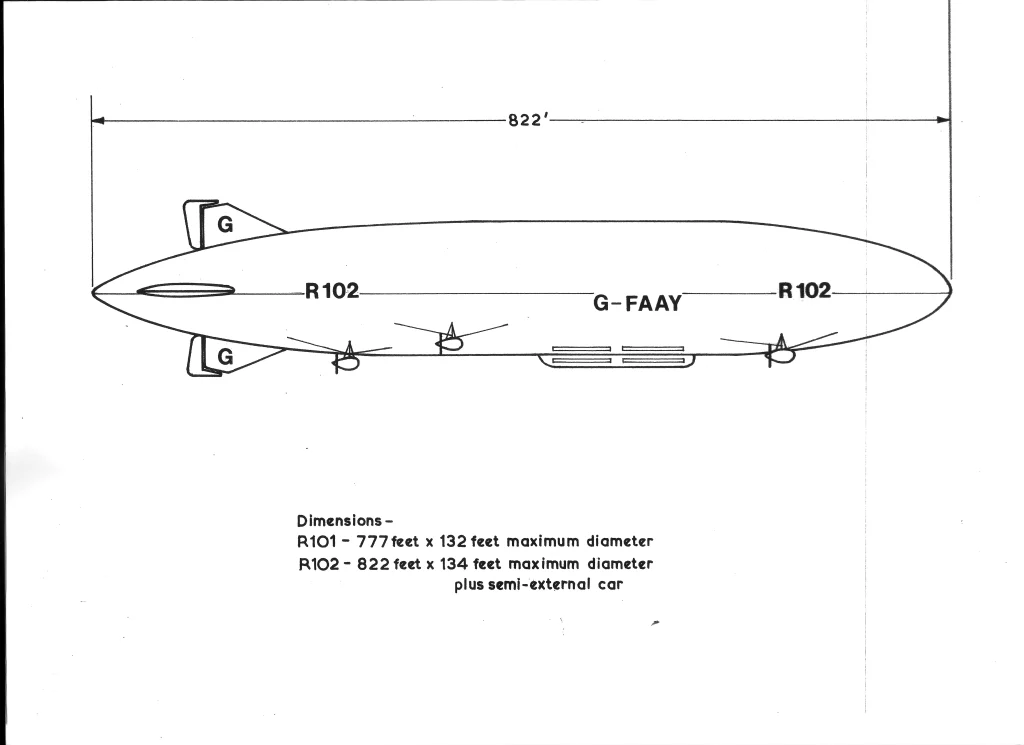
The plans of the R102 have not been discovered, but the uncovering of the potential conversion plans of the R100 has led to the “speculation” that the “142ft external car” would have looked like the artist’s impression shown here
It has been seen that a 35ft extra bay would be added to the already lengthened R101 design, giving the centre section of the ship a more “horizontal” section. The additional bay is fitted centrally to provide the maximum-sized gasbag and more lift.
Also, it was hoped that by placing some of the car externally to the ship, this would have given more room in the gasbag, which was immediately above the passenger accommodation. This would have also allowed more disposable lift suitable for more commercial operations. It was also planned that the R102 was to have some of the passenger accommodation protrude from below the main hull, and so this could have been seen as early concepts for part of the planned external smoking lounge for the R102. The passenger capacity of the R102 was deemed to be a realistic 50 passengers for a longer voyage duration.
The 7,5000,000 cubic feet ship, which was proposed to be built, would carry 50 passengers and 5 tons of freight under the worst conditions, either on the Indian or Atlantic route, provided the additional tower facilities are available. The difference in the design from the R100 and R101 shows that a more realistic approach had been learnt from the designs of the forerunners. The idea that a non-stop regular service would only be appropriate if the ship had more disposable lift.
The flight plans for the future years were as follows :
Imperial Airship Programme – Flight Plans 1931- 33
- 1930-Summer 1933: Construction in the extended Cardington Shed
- 1933: R102 Home trials within the UK over the summer, on completion
- 1934: First International flight – destination to be decided
It was assumed that passenger fares were £150 and a full load, 2 tons of mail at say 10/- per LB, it was seen that then an airship with this performance should be able to earn well over £20,000 on a round trip.
Fares
The single fare was to be £150, comparable with that charged by Imperial Airways on its London to Delhi route. It was also agreed and plans were underway that the tickets would be issued in agreement with a commercial travel agent to undertake the passenger administration and distribution of tickets.
Obtaining the information on this page from a variety of sources, including the National Archives, and Sir Peter Masefield’s “To Ride the Storm” has enabled us to provide this information. If you have any updates to the material presented here, then please contact the AHT webmaster.