
Deciding to dispense with normal construction techniques, the designers of the Royal Corps of Naval Constructors, along with a prominent designer, Herr Muller, who had defected from the Schutte-Lanz airship factory, began construction of the new “31 Class” ships. The influence of Muller and the Shutte-Lanz ships became apparent, as both of the new ships were to be made of wood.
The R31 was the first to be completed at the new factory at Cardington. The Government had loaned Shorts the sum of £110,000 towards the construction of a 700ft double bay airship shed. The Cardington project had been singled out for special attention as
Shorts Brothers had been kept clear of the 23 Class projects and had been designated the new 30’s serial numbers.
Design and Construction
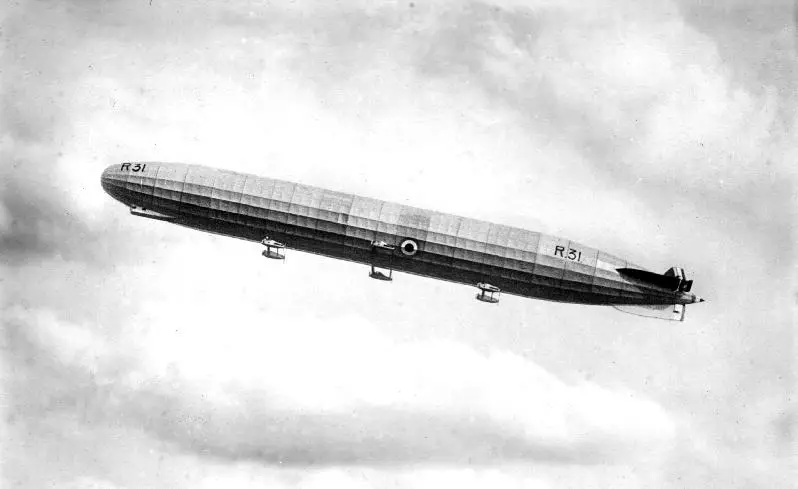
The R31 made a break in the design of the previous ships in that she and the R32 were the first rigid airships the British produced without swivelling propellers. However, moving away from traditional designs, the control cabin had dispensed with the gondola being held underneath the body of the ship; instead, it was fitted well forward, flush under the hull. This gave the crew much easier access to a walkway along the keel inside the ship, to the tail.
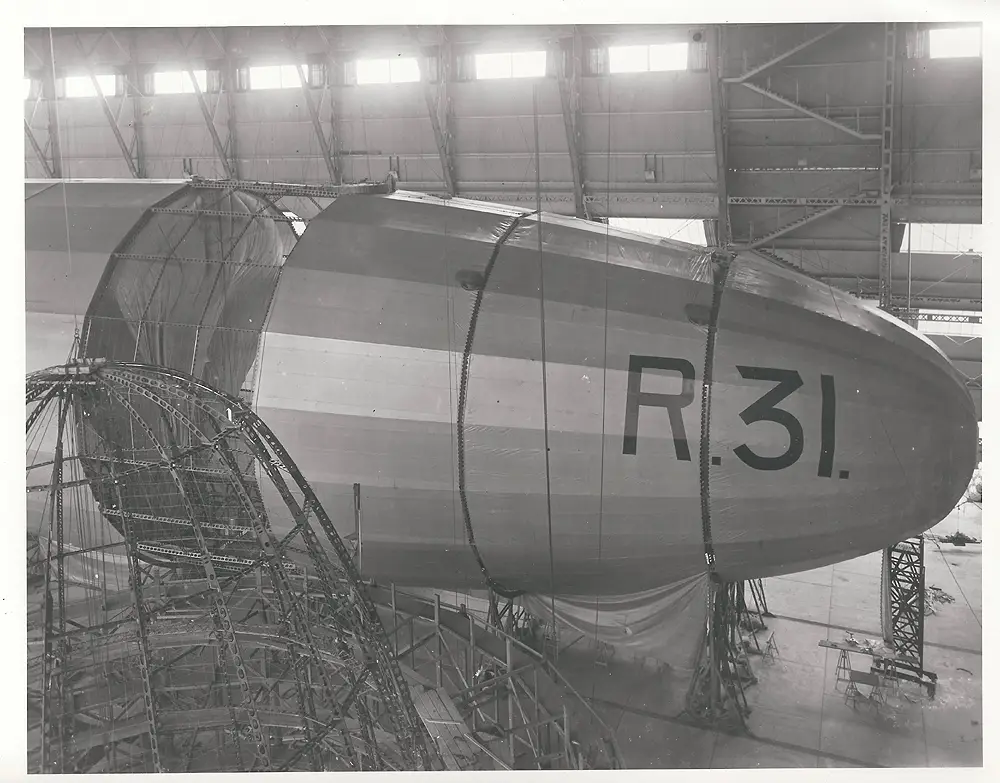
The ship was composed of reinforced spruce plywood girders, varnished and fireproofed. Each one was 10 10-inch equilateral triangles by 10 feet long. Every girder was braced with diagonal wiring and every ring with a diametrical and cordial wires, all of them solid piano wires, tensioned upon assembly.
The 21 gasbags were constructed of rubberised cotton lined with goldbeaters’ skins. There was an internal corridor which at the bow, contained the control car with its navigation and W/T, and officers and bunking compartments.. The amidships engines were fitted with reversing gears. Each engine had an electric starting motor and generator, which supplied power for a complete lighting system and for an internal telephone service. Cooling the engines was in the form of shuttering on the engine cars. Unlike the German ships, parachutes were provided for the crew, and another comfort was provided in the form of hot food, as the rations could be heated and cooked on exhaust-gas heated stoves.
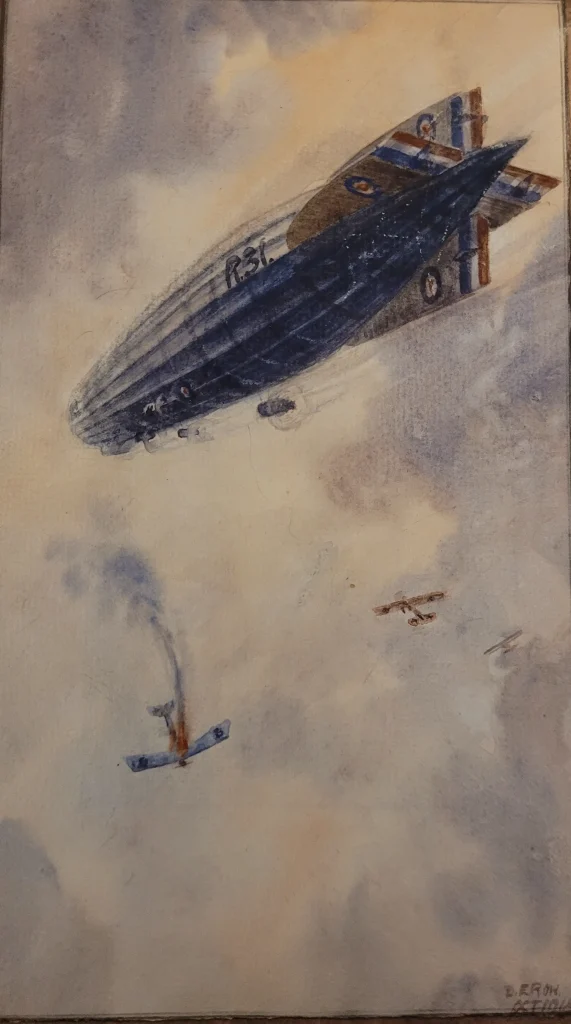
For defence of the ship, a metal ladder from the control car led to machine gun positions on the top of the hull, with more gun positions under her tail cone, in gondolas, and along the walkway. The Chief of Naval Ordinance agreed that the ship would carry a 12-pounder semi-automatic cannon for use against U-boats. This would be mounted in a special car 20 feet aft of the control car, along with the ship’s other fitments of anti-aircraft machine guns. A bomb load was decided as two 520-pound bombs and four 230-pound bombs. Unfortunately, the turn of events with the war ensured that these would never be fitted to the R31.
The R31 was half as large again in volume compared to the R23X class ships, and a disposable lift of some 16.5 tons compared to the 23X class of 9 tons. This was seen as a large jump in British design techniques and innovations. The only problem which came out of the initial test flights was the lack of automatic petrol pumps, and hence, when the ship was in the air, the fuel had to be manually pumped to keep the ship in trim. The service and main tanks were designed to be “slipped” overboard in case of emergency.

First Flight
The R 31 made her first trial flight in July 1918 around Bedford under the command of Squadron Commander W.C.Hicks for 2 hours. The first trial saw that she surpassed all expectations as she reached an impressive top speed of 70mph. The design expectations were to be an improvement on the 50-55mph on the 23X class but the design team was very surprised at the actual speed attained.
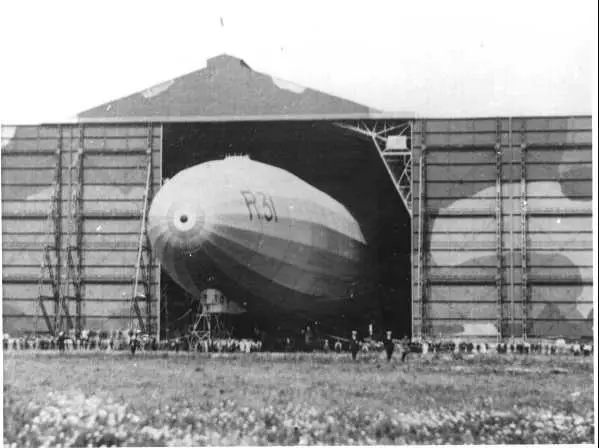
She was faster than any other airship flying. Powered by six 275 hp Rolls-Royce Eagle engines, she was a true greyhound. On this flight, it was also noted that a rare phenomenon occurred in the behaviour of the wooden structure, which flexed to an extent sufficient for two men, posted at opposite ends of the keel, to lose sight of each other during turns.
During her initial trial, it was found that the R 31’s fuel consumption was unexpectedly high, and it was therefore decided to remove one of the six engines. However, surprisingly, this resulted in a reduction in speed of only some 5mph, yet saved considerable weight.

Second Trial Flight
On her second trial flight on October 16th 1918, the R31 returned to Cardington with her upper fin and rudder laid flat over to the starboard side along the afterbody It appears that her wire-braced fins and rudders were shorter and more effective than those of previous ships, and were probably insufficiently stressed. An eyewitness account by Stephen Payne, an Admiralty Observer, recorded his account on the flight as follows:-
“I had climbed up to the top of the Ship where we had a gun platform. I remembered feeling the absence of wind and notice, when suddenly a frightened face appeared on the top of the two foot diameter tube with a rope ladder in it, and Hicks’ First Lieutenant told me that the top vertical fin had collapsed – this explained why I felt t hat the nose of the ship was well up.
Hicks had realized that the top vertical fin was acting as a kingpost supporting the two horizontal fins and it was the downward air passage on the horizontal fins that proved too much for the girder in the vertical fin. Hicks immediately dropped ballast to trim the ship 15 degrees at he bow.
This enabled the air pressure at 40 knots to hold the horizontal fins in position, and so it allowed the horizontal rudders to function. The accident happened near Cardington and many people saw crewmen on top of the airship tearing away great areas of fabric fouling the operation of the rudders and elevators. When the ship arrived back at Cardington the engines were stopped, the horizontal fins naturally collapsed, due to the absence of air pressure”.
The ship was taken back into the shed, and the simple repairs were completed. It was agreed that modifications would be made to the tail assembly, the dimensions having been too great and the controls too powerful. One other modification was the amputation of the tail cone and the sitting gun post with a wide arc of fire at that point, superior to that of the German Zeppelins of the time.
Commissioning
The airship was finally commissioned on 6th November 1918, having logged a total of 4 hours in her flying trials. She left Cardington for her new home of East Fortune in Scotland, where she was to join the R29. On the journey up the country, she flew into a torrential storm, and it was noticed that some of her girders were beginning to show signs of failure, possibly due to her earlier flying with oversensitive controls. Squadron Leader Hincks has therefore decided to abort the delivery and that the ship would dock in Howden in Yorkshire for repairs. The R31 landed safely at Howden and was put in the large double shed, which had recently suffered fire damage when the R27 had burnt in the shed. The roof repairs had not been totally completed, and temporary repairs were made to the roof, and so the ship was moved into a shed in poor condition to hold her. The crew were sent to Edinburgh to continue to East Fortune, where they were commissioned to return to the ship at a late date, and fly her back up to East Fortune.
Water Damage
Some 5 days later, on November 11th 1918, the end of the War was signalled. The decisions on the whole wartime airship programme would then have to be reevaluated. A decision was reached to leave the R31 in the shed until further resources and decisions could be made for her future. Unfortunately, the roof leaked and the water permeated into the ship and joints. This caused the gelatin glue, which held the wooden girders together, to deteriorate.
Early in the New Year of 1919, a Court of Inquiry was held to determine who was responsible for her being out of condition. Unfortunately, nobody could be found, and Lord Ventry even commented that no one knew why exactly she was still at Howden. The Admiralty later discussed the status of the ships, and it was deemed that the R31 was beyond the state of economical repair. In February 1919, she was deleted and dismantling commenced.
Even though she was an innovative design and concept for the new class, the first ship out of the new Cardington Factory only had a life of 4 hours of flying trials and 4 hours 55 minutes commissioned. A total of life of some 8 hours and 55 minutes. With hindsight and had the war continued long enough for the R31 to be reconditioned, it is agreed that the R31 would have provided the Grand Fleet with a suitable scouting airship capable of accompanying the Fleet during its sweeps and fast enough to have a reasonable chance if engaged against the Zeppelins.
No Smoke Without Fire
The R 31 was sold for scrap to a coal merchant for £ 200. The merchant thought hewould make a profit selling the remains as firewood, but following complaints by his customers, he discovered that the wood would not light as it had been treated with a fireproofing chemical.