
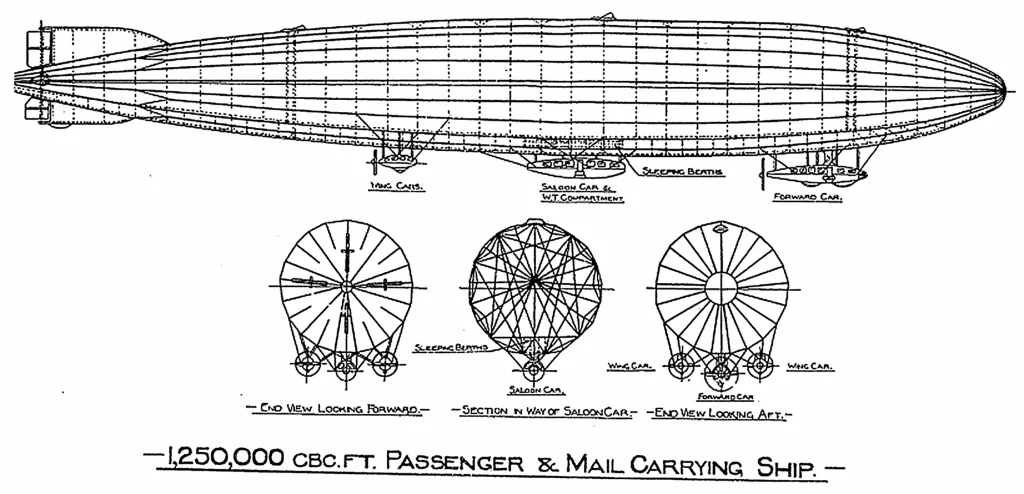
The R80 was in the process of being constructed when, in October 1919, plans were submitted regarding the use of the ship. The war was over, hostilities silenced for a year, and the peace treaty had been signed. With the uncertainty over future operations of the ship, Vickers’ plans were expanded in detail for modifying the existing R80 and the basis of commercial operations was formed.
Intercity Connectivity to London – Paris – Rome
It was envisaged that there was a viable commercial aerial route to link London, Paris and Rome, via a southerly route. The London-Paris route is a straight 220 miles, then from Paris south through the Rhone Valley, and curving via Toulon and Nice, then down a coastal route to Rome, some 770 miles further. The proposed timetable would allow a 7:00 pm departure from London, landing in Paris, some three hours later. Leaving Paris at midnight, and arriving at approximately midday. The total trip to Rome was estimated at 18 hours and 30 minutes, the return journey taking 17 and a half hours. It was timetabled that a return service could be run twice a week from London. Evening departures were scheduled to take advantage of cooler times of the day, to take advantage of the ability to gain more lift in cooler denser air, especially in warmer climates.
To accommodate passengers, it was envisaged that a “saloon car” could be built below the hull to accommodate 30 passengers. Inside the hull along the keel corridor, provisions for overnight accommodation would be made for up to 15 passengers sleeping in Pullman-style sleeping berths, could be arranged along with passenger washrooms.
The following details have been sourced from documents found in the National Archives in Kew (Source File AIR 11/161)
Modifications to the ship
- Addition of a saloon car for 30 people for day accommodation
- Expectation of sleeping quarters for 15 people
Requirements for a landing ground
The rental of an area of 30 acres of level ground near London, Paris and Rome would be required.
Mooring Towers
Three Mooring towers to be manufactured, 120 feet high at each location, to aid landing and boarding of passengers. This will also reduce the need for a large landing crew.
Timetable
| Leave | London | 7.00 pm | Monday | Thursday |
| Leave | Paris | 12.00 midnight | Monday | Thursday |
| Arrive | Rome | 12.30 midday | Tuesday | Friday |
| Leave | Rome | 9.00 pm | Tuesday | Friday |
| Leave | Paris | 10.30 am | Wednesday | Saturday |
| Arrive | London | 2.30 pm | Wednesday | Saturday |
It is always recommended to leave London, Paris and Rome in the cooler parts of the day to aid with lift.
Route
The route chosen to Rome is 1,000 land miles, which is within the endurance of the ship. It is expected that the ship will fly at a maximum height of 2,000 feet. The route will carry the ship over South England, then over the English Channel to Paris on a direct route. The ship will then deliver mail and passengers, and then pass down in a continued south-easterly direction towards Lyon. Passing over Lyon, the ship will turn south through the Rhone Valley and continue to Nice. At Nice on the French Coast, the ship will turn easterly and skirt the coast and head towards Rome over the sea. The return course will be via the same route.
The route and duration of the main sections of the flight are expected to be as follows
| London – Paris | 220 miles | 3 hours 45 minutes |
| Paris – Lyon | 250 miles | 4 hours 15 minutes |
| Lyon – Nice | 200 miles | 3 hours 15 minutes |
| Nice – Rome | 300 miles | 5 hours |
| Paris – Rome | 750 miles | 12 hours 30 minutes |
| London – Rome (non stop) | 970 miles | London – Rome (non-stop) |

Crew requirements
The ship will have the following crew requirements:-
- 1 Captain
- 2 Navigators
- 4 Coxswains
- 8 Engineers
- 1 Wireless operator
- 2 Stewards
- Total: 18
Passengers
Up to 30 day passengers and 15 overnight passengers in Pullman-type accommodation
Luggage Allowance
The crew would be entitled to carry luggage weighing 30lb
The passengers would be able to carry 50lb of luggage.
Mail
It is expected that the ship will also be able to carry 500 lbs of mail
Costs
A detailed analysis was given regarding the running costs of the ship and the project in general. It was expected that the ship costs would be
£ 270,00 ship
£10,000 spares
Salaries: 2 commanders £ 2,000
4 Navigators: £ 2,400
30 crew: £ 8,000
The expected income of the operation from passengers and mail would be:-
Per Trip :
400lb of mail at 6lb per oz = £ 160
25 passengers at£ 64 per passenger = £ 1,600
The plans were never put into operation as the R80 was later used for training the US crews for the ZRII and later used for testing by the National Physics Laboratories.