
The Italian-built M Class semi-rigid was unique; she was the only semi-rigid airship owned by the Admiralty.
Introduction
In 1914, there had been a proposal to buy three Forianini airships from Italy, but the outbreak of war prevented such an acquisition. Several British airships were sold to Italy during the war, and it was possible to redress the balance that in 1918, the British Government surprisingly decided to buy a semi-rigid of the Italian M Class. The ship was designated as SR 1.
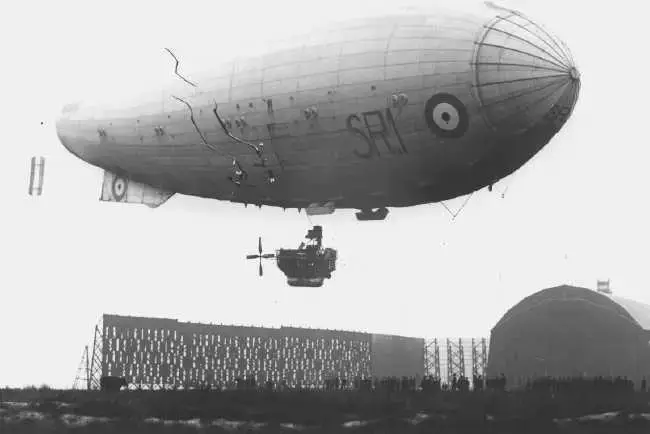
Design
The SR 1was larger than any British non-rigid, being some 270 ft in length. The envelope was supported at its base by a horizontal framework of triangular cross-section girders of tubular steel. A single car contained three engines and carried a crew of 9.

Delivery Flight from Rome
| The British Government, a British crew, went down to Rome to fly her to the UK. The SR1 left Rome in the early hours of 28th October 1918. It was agreed that a ship of this size would not be expected to fly nonstop back, so a series of stopovers was planned: |
| Depart | Arrive | Comments | ||
| 28th October 1918 | Rome | Aubagne (via Corsica, South Coast of France) | 28th October 1918 | Hanger too small to fit the ship, so moored in open |
| 29th October 1918 | Aubagne | Bron (nr Lyon) | 29th October 1918 | Refuelled moored to the back of a truck |
| 30th October 1918 | Bron | Sr Cyr (nr Paris) | 30th October 1918 | 10-hour struggle with the weather. The hangar too small to house the ship. |
| 31st October 1918 | St Cyr | Kingsnorth Airship Station (UK) | 31st October 1918 | |
| Total Time | 40 hours 35 minutes | |||
This was the first flight of any aircraft between Italy and Britain either way.
It was not an easy flight, the crew were too busy to sleep as they had to battle strong headwinds and rain for much of the trip. The ship had mechanical failures, a fractured oil line which spewed hot engine oil throughout the control car. The crew worked frantically to repair this damage but it turned the control car floor in to a slippery platform resembling a skating rink. Comical though it may sound, in an undulating control car in the air the crew had to take great precautions to avoid anybody falling overboard. To further the discomfort on the flight, at one point the exhaust manifold fell off amidships engine above the control car, burnt through on to the petrol tanks below. The red-hot manifold lay in close proximity to hundreds of gallons of high-octane aviation fuel and beneath almost half a million cubic feet of equally inflammable hydrogen. Captain Williams and Petty Officer Leach leapt up a ladder and pushed the burning mass overboard, at the same time brushing out glowing sparks with their hands.
Added to the fact that on two attempts to house the ship in France, the arrangements had not been put in to place as it was found at landing at the pre arranged stopover that the ship was too large for the French hangars which were provided. The ship had to be housed outside on both occasions. However, the ship managed to cross the Channel and landed at Kingsnorth Airship base in Kent on 31st October 1918. It was the first time an aircraft had ever flown from Italy to the United Kingdom.
Life at Pulham
On 6th November, the airship was flown to Pulham Airship station, where the unreliable SPA engine was removed. The crew were very aware of the shortcomings of the power units and had difficulty in keeping all three units operational on this flight. With only 5 days left of the war, the SR1 was never used operationally with the exception of watching U-boats surrender at Harwich.
London Publicity Flight
She flew over London on 2nd July 1919 as publicity for the war loan and to take part in a peace procession with the R33. Whilst over London, the SR1 suffered a malfunction which deprived the ship of all power. The crew were well versed in the erratic behaviour of the ship, and carried out urgent repairs whilst floating motionless above the cheering crowds. Then suddenly the SR 1 was caught up in turbulence and shot upwards into the clouds and to where the R33 flew. By good fortune, control was suddenly restored and an accident averted. Power was restored, and the ship returned to Pulham after the 10-hour flight.
A similar flight over South Wales followed on the 6th and 7th July. A final demonstration flight was given in August for the benefit of visiting regiments from India.
It was agreed by September 1919 that the SR1 was to be deleted due to her being inferior to contemporary British airships. The ship was housed and dismantled