
Introduction
With the outbreak of the war, the threat to British shipping became apparent to the Admiralty. It was realised that with airships, they had an instrument which could protect the shipping by spotting submarine threats.
An order for the construction of a fleet of small “blimps” was put forward, and for their completion to be made as soon as possible. Early exploration and use of airships were sporadic in the early years of the 20th Century. Experimental craft were used by the Army, and often, continental ships were purchased for evaluation and review.
However, funding for the fledgling craft was often not forthcoming and also the usage of the ships had not been proven to either the Admiralty or the Army.
When the Great War broke out on 4th August 1914, Britain’s airship fleet consisted of the four former Army airships (now known as Naval Airships numbers 17,18,19, and 20 when transferred to the Admiralty) and two continental ships, and a small Willows training craft. Seven ships in total.
Of airfields possessing hangars capable of housing airships, there were only 4, at Farnborough, at the Vickers production facility in Barrow, at Wormwood Scrubs in London and at Kingsnorth near Hoo on the Medway.
The pre-titled Naval Wing of the Royal Flying Corps was formed into the Royal Naval Air Service on 1st July 1914, where only 198 men of all ranks were transferred under the command of Commander E A D Masterman. This was later known as the Airship Section.
It was decided, as hostilities grew worse in the latter part of 1914, that airships would be useful for Fleet observations following the loss of many ships to submarines in the months of October and November.
The First Sea Lord, Lord Fisher, realised that the situation had become critical and rapid short-term measures were required. In a meeting on 28th February 1915, he called Cmdr Masterman, and representatives from Vickers and Airships Limited attended.

Requirements
A new, smaller ship was required with the basic requirements that it should have a speed of between 40-50 mph, carry a crew of two, 160lb of bombs, wireless equipment and fuel for 8 hours flying. They should be able to reach an altitude of 5,000ft and their design should be simple in order to both ease production and to facilitate training of the crews.
The main requirement was that the new airship, designated the Submarine Scout class, had to be in the air within weeks rather than months.
The Prototype

Evaluation tests on the first SS craft, the SS2, were made in March of 1915, some 5 weeks after that first meeting. The ship was 70,000 cft and 140ft in length. The ship was effectively an aeroplane fuselage without wings slung below an envelope.
There were eventually 3 types of “SS” or submarine scout class ships after the initial prototype was built. Each was quickly and cheaply assembled by attaching the wingless fuselage of a B.E.2c aeroplane beneath a simple envelope. Minor modifications were made to the original design, namely the placement of the blower to fill the ballonet in the envelope, and on the 18th March, less than 3 weeks after work began, the new airship was entered into service. Admiral Fisher commented on his approval with the famous comment, “Now I must have forty!“
The production SS ships differed from the prototype in that they carried two ballonnets instead of the original one, and a larger envelope. The main production problems which the contracted manufacturers had were the supply of envelopes, as they were tied up with aeroplane orders. 26 SS-type ships were based on the original production ship, SS1.


Manufacture
At this time, the rigid airship programme also started production. More air stations were also planned, with Longside near Aberdeen, East Fortune on the Firth of Forth, Howden on the Humber, Pulham in Norfolk, Mullion in Cornwall, and Penbroke in South Wales. Together with those already commissioned, they were soon to provide a chain of bases strung around the coast from which airship patrols flew out regularly to combat submarines. Wireless and ground bases were also key to this chain, with the cooperation between air and sea being vital. Patroling airships were required to transmit their callsign every hour, enabling their positions to be tracked and plotted. It meant that an airship commander can call his exact position when the call for help, to the precise spot; a vital element in the anti-submarine strategy.
As soon as the SS airship programme was rushed into operation in early 1915, the work of construction was transferred from the Farnborough facility to Kingsnorth, which was soon joined by a manufacturing centre in Barrow and Wormwood Scrubs. At the same time, new air stations were set up at Capel near Folkestone, Polegate near Eastbourne, Marquise near Boulogne on the French coast, Luce Bay near Stranraer in Scotland, and in Anglesey. A new training station was set up at Cranwell.
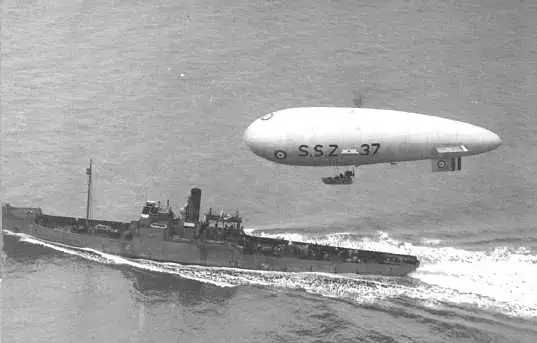
The co-operation was essential between air and sea forces in that no airship could carry more than a tiny fraction of the armament available to a destroyer or even an armed merchantman ship, yet no surface ship could approach the speed of an airship or command the same wide vision. The airship was primarily to call for and find the submarine, then call for help.
The advantage was that in the clear waters of the Mediterranean, a submerged enemy could often be seen as deep as 120ft (20 fathoms), but in northern waters, the direct detection was more difficult. The advantage, though, was that periscope moving through the water made a distinctive feather wake, and there were often signs which gave the presence of a submarine. Small amounts of oil frequently leaked and could be spotted as a trail on the surface of the water. Also, a damaged submarine would leak more and be easily spotted.
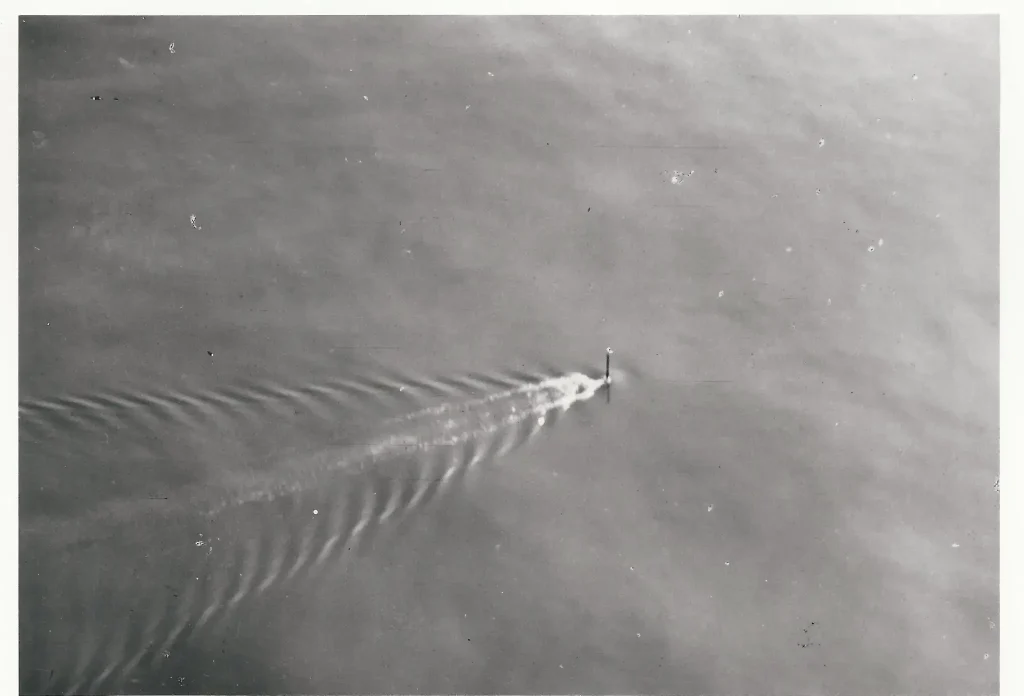
The “submarine scouts” with the prefix of “SS”, were to be so successful on coastal patrols that the Admiralty wanted bigger and better ships, fast. Three further classes, “Coastal”, the “C*” and “North Sea” class ships were developed. Each having larger engines, envelopes and crews than the previous class ships, the patrol duration increased.

Equipped with small bombs, these ships proved to be not only “observers” but also active participants in the fleet’s battles. It was common that a U-Boat on patrol, once spotted by an airship, had a choice of either moving away or engaging the airship in a race. The battle was between the U-Boat surfacing and being able to mount his gun and try to bring down the airship, whilst at the same time the airship would be signalling the location of the U-Boat to the fleet, and preparing to drop its bomb, before the U-Boat could take a shot at the ship.
New Classes of Ships
The demand was so great for these Scout ships that various versions were constructed. The following designations were given: SS / SSP/ SSZ (Zero’s)/ SSE/ SST(Twin). The SS Zeros were fitted with machine guns. 77 of this class were built and were very popular with the crews. The last class to be designed were the SS Twin’s which could carry a crew of 5, with a top speed of 57mph and stay airborne for up to 2 days.
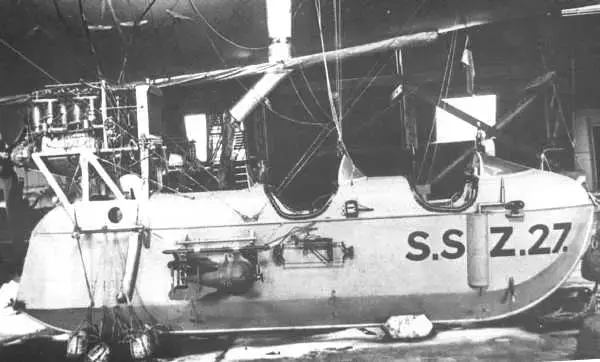

In total, 158 “SS” Class ships were built
Despite occasional tragedies, the first SS ships proved invaluable. They only cost £2,500 each, and the proof of their usefulness is that production only ceased when something better became available.