
Introduction

1951 saw the airship revival by the Airship Club, with the creation of the little-known airship named “Bournemouth” and her brief career in reviving the interest in lighter-than-air travel
Belonging to the little-known category of British-built “private” airships, the “Bournemouth” was constructed by the Airship Club, launched in 1951.
In 1948, Lord Ventry posed the idea to a small group of his friends, and together they formed a small fund-raising society which they called “The Airship Club”.
The Airship Club
The objective of the club was to create the first airship in Britain for over twenty years. The renowned author of “Airships Cardington”, Geoffrey Chamberlain, was a founder member of the club. As part of the club, Lord Ventry, Squadron Leader T.P. York-Moore, and a small group of enthusiasts wanted to prove that airships could still return after the closure of the British Airship programme in 1932

The project was funded largely by private enthusiasm; however, as Lord Ventry lived on the south coast resort, he was able to canvas the Bournemouth Corporation who in turn made a substantial grant from its “Festival of Britain” funds to assist with the completion of the craft and for it’s first flight.
This is how the British south coast resort managed to have an airship named after it. The idea being that the completed ship would play a part in the local celebrations of the Festival of Britain year.
To keep costs down, the Bournemouth was not to have a home “base” and the following quote from “Flight Magazine” 1950
One of the most expensive items in the construction of an airship must be a hangar and at the present time it is one which, in a private venture, would be virtually impossible of achievement. Surprisingly, however, an airship is quite amenable to being tethered in the open, and we are assured by Lord Ventry that, with the aid of a protective screen of trees, a small non-rigid can safely ride out a 70 m.p.h. gale if properly picketed. This, therefore, is the plan for the Bournemouth—she will be kept inflated, and out-of-doors, during all spells of operational activity that promise to be fairly continuous.”
Having someone to fly the ship was to prove an interesting issue for the Civil Aviation Authority (CAA) as the idea behind the project was to give members of the Club an opportunity to fly in the ship and of learning to pilot it
Again, an issue noted in “Flight” magazine as
“At present anybody who aspires to pilot an airship must hold a 1st, 2nd or 3rd class Airship Pilot’s Licence (according to the size of the craft)—having first qualified by securing a private or commercial Balloon Pilot’s Licence—and a Navigator’s Ticket. There is, it seems, no lighter-than-air equivalent of the Provisional Pilot’s Licence, so the eager pupils of the Airship Club are, clearly, going to present the Ministry of Civil Aviation with some new problems when the time comes.”
Design and Construction

A surplus of the type originally envisaged was purchased from the Air Ministry and dated to the R.F.D company in Guildford, where its original length was increased from 92 feet to 108 feet. The diameter of the envelope remained unaltered and so this provided a gross volume of 45,000 cft. A control car of some 15ft by 4ft was built at Hurn Airport, just outside of Bournemouth. A French radial engine of 60hp was fitted along with a four-bladed propeller. All the control surfaces were also constructed at Hurn Airport. In the spring of 1951, all of the component parts of the airship were ready and taken to Cardington for erection in shed No. 2.
The ship was re-constructed at Cardington, and with a band of experienced former airshipmen, Gerry Long and Ralph Deverell from the R100, and the R. R101 survivors, Arthur Bell and Joe Binks. Leaking gas valves delayed the inflation tests, but eventually, the trim and lift trials began in July 1951. The lift trials meant that the ship could carry a crew of four plus 260lbs of ballast.
First Flight
The first test flight of 25 minutes was made on 19th July by Captain Jack Beckford Ball, a newcomer but having piloted the other early British private airship the AD-1, based out of Cramlington near Newcastle in 1929.
A second flight was made on 28th July, but a forced landing was made after 25 minutes. Main road traffic had to be held up whilst the airship was walked across the main road the the shed.
Flight 2 and Crash

The third flight was not overly successful, on 17th August, when Lord Ventry took the controls of the ship, but when flying back to the base, the ship flew too low over some army huts and the trail rope fouled on an obstruction, which brought the ship down on a roof, causing damage to the windows and tearing the envelope. The propeller broke, and thankfully, none of the crew were injured during this crash landing. The film clip, interestingly, shows optimism and the spirit of the day.


Flights 3-11
Having a gross lift of 3,060lb and a useful lift of 13,000lb, the Bournemouth managed 3 flights in 1951 and then put in for repairs and a chance for improvements for stability following the crash landing. Notice the upper stabiliser has been removed.

A further eight flights were managed in 1952. It was found that the first set of steering planes was too small and made her unstable, and she had a top plane on the first two testing flights in 1951; however, this was removed.
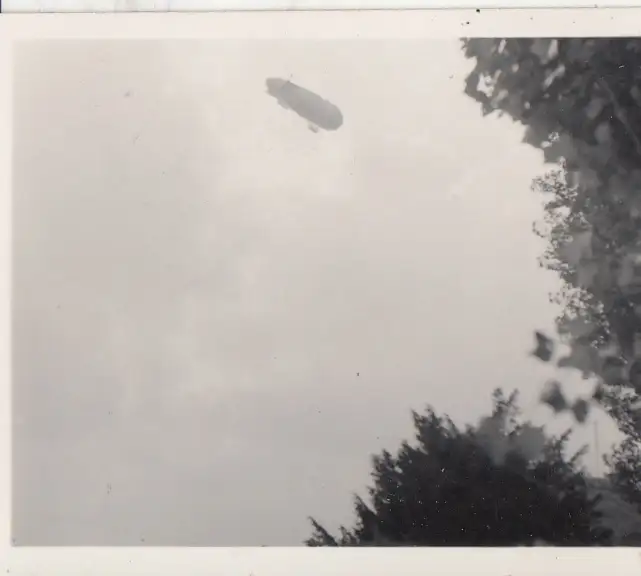
The photo above was taken by Godfrey Hebdon showing the Bournemouth over Northill in Bedfordshire.
In 1952, a larger set of de Havilland planes was fitted and making the ship quite controllable. Only eleven flights were made through lack of funds, the last flight made on 16th August 1952, Battle of Britain Day, where a flight of 1 hour 55 minutes over Bedford was taken.
Final Life
The ship was stored away and plans were made for improvements to the ship; however, the Bournemouth’s end came on 24th April 1953, in Number 2 shed, when some netting slipped. This tore the envelope badly, and the front portion of the ship reared up into the roof, as the rear of the envelope collapsed on the floor. This, along with other damage, made the repair work impractical, and sadly, the ship bearing the name Bournemouth was never able to fly over the town bearing its name.
The photos of the Bournemouth crash are attributed to Marion Sweeney and the Conder family.
The photos were taken by her grandfather, who worked at the Cardington Camp. Marion shared these photos and commented:
“My father and grandfather with their associations with Cardington loved anything to do with aviation, and would have been thrilled that their photos were of wider interest. Incidentally, Conder Boulevard in Shortstown was named after my grandad!”
If you have any personal memories or photos you would like to share of this little-known ship, then please contact the webmaster, and we’ll be happy to add them to the site for you