
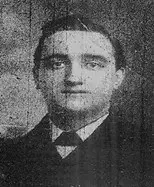
Flt Sergeant Frank Smith
The article below and photograph of Sgt Frank Smith is show with kind permission of local Halifax historian David Glover.
“THE R38 AIRSHIP DISASTER OF 1921 AND HALIFAX
In Stoney Royd Cemetery stands the gravestone of a little-known Halifax serviceman, killed in a memorable airship disaster, just 100 years ago.
Born in 1893, Frank Smith was the eldest son of James Smith, grocer, and his wife Catherine, nee Murphy; he was raised in the back streets of Haley Hill, and educated at Akroyd Place School. Later the family moved to Alma Street. Having left school, Frank served an apprenticeship with woodworking machinery firm J. Sagar & Co. Ltd. in Water Lane, to qualify as an engineer. At that time, he worshipped at St. Thomas’s Church, Claremount, where he helped in the Sunday School.
At Christmas 1914, in the early months of The Great War, Frank joined the Royal Navy as an engineer, being initially stationed at Chatham. Later he would see service on various vessels, including destroyers, rising to become Chief Petty Officer. In due course this talented man transferred to the Royal Flying Corps (later Air Force), experiencing flying in France, and reaching the rank of Flight Sergeant. After the War, he was stationed at RNAS Howden (East Riding), and at RNAS Pulham (Norfolk), where he helped with construction of Airship R34, and took part in its test flights. He went on to assist in the construction of Airship R38, particularly working on the engine-rooms.
On 27 December 1915, at Halifax Parish Church, Frank had married Edith Ellen, daughter of John and Anna Skipper, and they settled at her home, 8 Lock Street, Caddy Field. They had one daughter, Evelyn, born in 1916. One of Frank’s brothers, John, was killed during The Great War, and another had a leg amputated after being wounded.
Still serving with the RAF, on 24th August 1921 Frank was one of the servicemen on board Airship R38. The aircraft was an early, experimental airship; the original design contract was for a high-speed, high-altitude airship for military use. Short Brothers oversaw the contract, and construction took place at Cardington, Bedfordshire. The largest aircraft until then built by the British she was completed in June 1921, then being based at RNAS Howden. On the first flight of R38, certain faults were found, including some buckling of girders; but these problems were seemingly rectified.
It had only been possible to complete the R38 because the Americans wished to purchase her. Because of earlier problems, experts advised that 150 hours of test flying must be undertaken before she was allowed to fly across the Atlantic. The Air Ministry said 50 hours would be enough; but trials were hurried through. American officers came over to Britain take her back, and R38 was renamed ZR-2. On 24th August 1921, with both US and British passengers were on board, manoeuvres simulating sharp turns at speed were being carried out by the airship over Hull and the Humber. The stress proved too much for the structure, and the whole craft broke in half. In the front section the fuel tank burst, causing an explosion that shattered hundreds of windows in the city below. The fuel also ignited, and both parts of the airship fell into the river. Forty-four British and Americans were killed in all, among them, Frank Smith. Those who survived thought it probable he had been trapped in the engine-room when the explosion took place. Frank’s body was recovered from the Humber, and returned to his family at Halifax; large crowds joined them for the funeral at Stoney Royd. I understand his daughter was still alive at a great age about ten years ago.
Another Halifax man was on board the R38 during its final flight: Harry Bateman, aged 24, a physical laboratory assistant, originally from Long Lover Lane, Pellon. He was one of only five survivors, remarkably having suffered only superficial injuries. He died in Bedfordshire in 1969. – David C Glover August 2021.
With grateful thanks to David.