
The home of the first rigid airship, R1 – “Mayfly”, and home to the Vickers company construction facility.
Barrow in Furness in the county of Cumbria, and especially, Barrow Island, was home to the Vickers Company, made famous for their history of shipbuilding and submarines. Vickers had won the contract for the construction of the first rigid airship, the R1 or what became commonly known as the “Mayfly”.
The original construction in 1908 followed the line of the Zeppelin company technique, at Lake Constance. In 1901, The Zeppelin Company had constructed a wooden construction shed, which floated on Lake Constance, but moored opposite the town of Friedrichshafen.
The principal for a floating shed, would be that it would allow easy entrance and exit by the ship, as the shed would float, in to the wind, and thus easier for the ship to be removed. The fist Vickers constructional shed was built along the side of the site at Cavendish dock at Walney island.
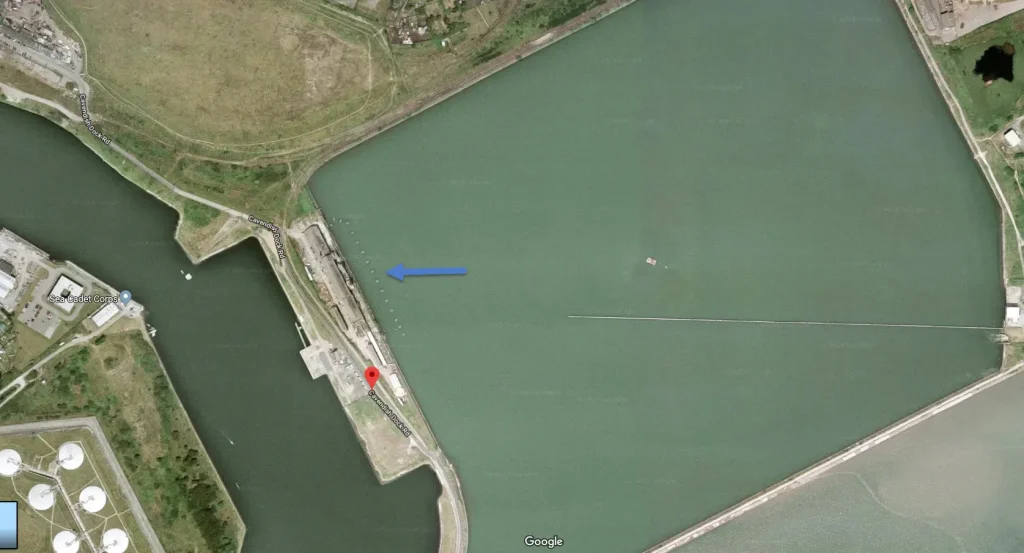
During the time of construction and testing of the R1, Mayfly, the shed was affixed on pilings along the dock wall, and was not free floating as had been the Zeppelin design The R1 “Mayfly” was unfortunately destroyed during some mishandling during the mooring process, and broke her back, whilst Naval crews were trying to put the ship back in to the shed. Even though she was not successful, a lot of experience and testing data were gathered and used on future airships.

Barrow Constructional Shed
The original plans for the second rigid Airship had been agreed between the Admiralty and the Government. However, this was a time of turmoil in that the political situation in Europe had darkened, and also, there were quarrels within the Government as to whether a replacement for HMA No. 1 would be required. The non-rigid programme was proving to be more successful than the rigid at this stage. With the Dardanelle fiasco already making the situation in Europe more uncertain, a conference was called with the Admiralty on June 19th 1912, to consider the programme again.
At this meeting, it was not only agreed to expand the non-rigid programme, but also to recommence Airship HMA No. 9. It was agreed that Vickers should be asked to design an improved class of ship incorporating all that was then known about the Zeppelins. There was only one restriction with this order, which was that the proposed classes would have to be built in existing facilities. This meant that the ship would have to be limited to the size of the Zeppelins on their cradles in Germany.
The reason behind this decision was that the technology was based on the German Army Zeppelin Z IV, which accidentally landed in France on 3rd April 1913. Her design was already 3 years old, but there was little else to go on except the information on what the designers in Germany had planned. It must not be forgotten that some of the refinements made were better than those of contemporary Zeppelins.
Vickers had disbanded its airship department after the failure of the Government to keep it supplied with work following the Mayfly project. A new department was therefore constituted in April 1913. They reassembled its original design team, including H. B. Pratt and the young Barnes Wallis. Design work started on the No. 9 in April 1913. Work proceeded slowly at first as specifications were required to follow the Zeppelin lines.

As the existing shed had been over water, the idea of the construction site was changed, and a new nearby location was sourced. A second construction shed was later commissioned on the site of what is now the golf course and West Shore Road
The new shed had internal clearances of 450 feet long, 150 feet wide and 98 feet high. It also incorporated an innovation having a 6-inch concrete floor with handling rails embedded in to it that extended some 450 feet out into the adjacent field. Also new were the eight fire extinguishing jets linked to a special reservoir to deal with the possibility of fire. A gasbag factory with 100 employees was set up beside the shed.
The streamlined R 80 in 1920 was one of the last to be constructed before the facility was closed in 1921.

Barrow Borough Council investigated the possibility of developing a civil flying site for the town in 1935. In 1937, officials visited a number of potential sites that were suitable for the construction of an aerodrome. These were areas of Hawcoat, Rampside and Walney Island. The land between Gleaston and Leece was also considered but Walney Island was considered the best place to situate the new airfield. 600 acres of land were purchased on the northern area of Walney Island for £8,050. Before the airfield was constructed, the Second World War began, and an RAF airfield was constructed at the chosen site.
Air Gunnery School
Away from the more operational airspace above the eastern part of the country, the western side of England was a more suitable location for flying training stations. The West Coast in particular, was favoured for the siting of air gunnery schools and their attendant air-to-air gunnery practice ranges.
The site was used extensively during the Second World War, but then, like many British military bases, it was eventually mothballed and fell into disrepair.
1980’s airport use
In the 1980s, airlines began to utilise the airfield for scheduled passenger services, the first commencing flights in March 1982. Scottish airline Air Ecosse operated services between Liverpool, Blackpool, Barrow, Carlisle, Edinburgh and Aberdeen, using De Havilland Twin Otter aircraft.
This airline ceased services into Walney after around a year of operations. The next was a new venture named Air Furness, which was based at Walney and had a fleet of Britten Norman Islanders as well as a number of other aircraft. In April 1984, the company began flying into Manchester and other major UK airports, linking south Cumbria with the world’s airline schedules. Operations continued for four years and ceased in July 1988. The final air service from Barrow began in late 1991 by Telair, again using Islanders, and only lasted for a few months before this too ceased in March ’92.