
The site was chosen later than the original commission lead by Gp Cpt Fellowes in 1926. The Canadian Government had agreed to be part of the airship demonstration flights, so Herbert Scott and A R Gibbs sailed to Canada on April 22nd 1927. Their task was to find a possible mast and landing site in Canada.
Location
After landing at Montreal, the Air Ministry officials travelled to Ottawa on 3rd May and met with J L Ralston, the Canadian Minister of National Defence and other department officers. The next day, they visited two possible sites, one being the Connaught Rifle Range, 10 miles west of Ottawa and Rockliffe, 3 miles east of the city.
Again, the standard requirements of some 600 acres of level well well-drained land were required, along with accommodation for a mast, gas plant. After some 5,800 miles travelled by rail and 1,300 by road, the commission finally found a landing site. Many other areas along the eastern side of Canada were seen as options; however, they finally agreed on a flat area, in the parish of St Hubert, some 7 miles from Montreal. Unlike the earlier Connaugh Riffle Rangers, it required no special and expensive levelling or clearing. The site was a triangular-shaped property, some 590 acres, which was privately owned and was acquired.

Mast Order and Construction
The Canadian Government then placed the order for the mooring mast head, along with a head for the proposed South African mast, in July 1927. Standardisation of the telescopic arm and mooring coupling was seen as essential. English manufacturers had only built similar structures, and so Canada and the other dominions would have to use the same experience. The tower head equipment had been ordered from Babcock and Wilcox of Lincoln, and a 2% saving was made on the order as the South African mast had been ordered at the same time.

The mast foundations had begun, and work continued in 1928. The mast was erected with the mooring mast head on delivery from England, leaving on 11th August, awaiting arrival in Canada by Vickers (Canada) Ltd.
With the mast nearly complete, a problem had arisen as the Air Ministry had not sent drawings of the airship traveller gangway or platform to the ship, therefore handicapping the design of the remote control winches. They decided to proceed without the plans as any errors could be corrected at a later date. This did impede passenger embarkation to and from the ship onto the mast, as the lip of the boarding ramp did not meet up with the passenger embarkation ring on the Mast. There was a 2 ft (60cm) gap, which does not seem much, however, it was daunting as it was over 200ft in the air. When this error was realised, and before the R100 departed England for the flight to Montreal, a special set of wooden steps was constructed to connect the boarding ramp and the embarkation ring. This difference would have been corrected as planned in future flights.

The Canadian mast was again different in structural design from the Karachi and Cardington masts in that the base buildings were of a different but colonial design, and the lift shaft was enclosed as part of the structure, and not open as the other masts. A proposal was made on the plans of the airship station to have an airship shed, which was to be constructed following further advancement of the airship programme.
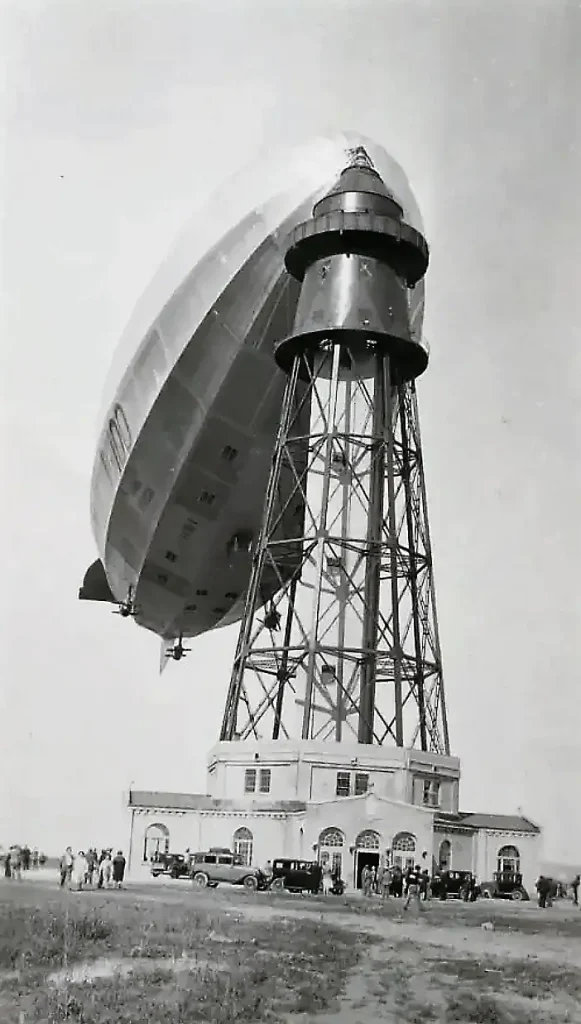

R.100 Arrival
The R100 made a successful trip and local flight to Canada and returned to England in 1930. Preparations were also made to handle the huge crowds, 600 000 people
or more, which were expected to flock to see the R.100. In anticipation, the Canadian National Railway (CNR) ran an extra siding into St Hubert; elaborate traffic regulations were prepared and published in the papers; special flights in and out of the airport were duly planned; and a special camp was established for the six hundred troops needed for traffic and crowd control.
Demolition of the Mast
St. Hubert Airport became the centre of civil aviation in eastern Canada. It was the first airport lighted at night; the first with a radio range; the first with a control tower; and the first with snow removal.
The airship mooring mast was dismantled in January 1938, as it was deemed a hazard to aircraft, and St. Hubert became a military airport after Montreal’s Dorval Airport opened on 1st September 1941.
In 2007, Montreal aviation historians located many of the 24 concrete airship mooring blocks on the airport property, as well as a tether ring, which is now part of a collection of the Montreal Aviation Museum. The 438 Tactical Helicopter Squadron at St. Hubert has a 10-foot (three m) wooden propeller made in Montreal to replace a damaged R-100 propeller, but it was never used.