
Location
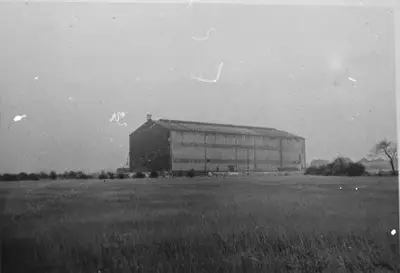
RNAS Cramlington was chosen as a stand-alone operation base located north east of Cramlington Station, and adjacent to the existing aerodrome. A single Coastal class airship shed was constructed which was 358 feet long and 110 feet wide. There was a small hydrogen gas-making plant in a building behind the shed. It was intended to eventually base four non-rigid Submarine Scout Twin airships here
RNAS Cramlington’s coastal shed was unusual as it was painted brown to blend in with the local countryside. Also, unusually, there were no windbreaks fitted to the shed, despite its exposed position
Armistice
The station was not completed by the time of the Armistice, but work continued on the construction of the planned airship shed, which measured some 300 x 100 x 70 feet on a NE-SW axis that aligned with the prevailing wind.

Four SST airships were operational from the Coastal shed, with some twenty officers and 281 men stationed at the airship station. Further airships were to be stationed here, however, the armistice came in November 1918, and so the station was no longer used. Like most other airship stations in Britain, it was hastily abandoned.
Future Plans -Airship Service to Norway
In the early 1920’s a company considered using the facilities to operate an airship service to Norway, but nothing came of this plan. Some of the buildings were used as a hostel for miners. The closing years of that decade saw a revival of its fortunes. A small enterprise, which went by the name of British Airships Ltd., which later changed its name to the Airship Development Company, thought it could revive the fortunes of the small non-rigid airships. They constructed an airship designated the A.D.1 in the airship shed at Cramlington. The machine was 138 feet in length and had a maximum diameter of 29 feet.

Airship Developments AD 1
It was advertised as being suitable for private flying, passenger flights, instruction, advertising, aerial photography and surveying. The main revenue was anticipated to come from advertising, and for this role, it had panels on its side measuring 76 feet by 24 feet.
Based on the SS design with a 75hp Rolls-Royce “Hawk” engine. It was designated the “AD.1” and registered G-FAAX. Its primary role was for advertising and aerial photography,and it made its first flight on 13th September 1929, followed by an appearance at the Newcastle Air Pageant held at the Cramlington Aerodrome on 5th October.

During 1930s, the work continued, including flights over London. Unfortunately, on 5th October 1930, while flying in Belgium advertising a cigarette company, the airship was destroyed in a storm. The salvaged remains were later sold at auction the following year on 18th June.
The two envelopes, which had cost £1,000 each, sold for £22 10s, the engine for £13 10s (the new owner planning to use in a motor boat) and the Gondola with all instruments fetched £2.
The Airship Development Company, however, was liquidated at the end of 1930, having overestimated the demand for its services. Britain at the time was in deep recession. The two airship envelopes were sold to be made into dust sheets for furniture, and the airship shed at Cramlington was vacated, never to be used again by airships.
Use by Concrete Utilities and demolition
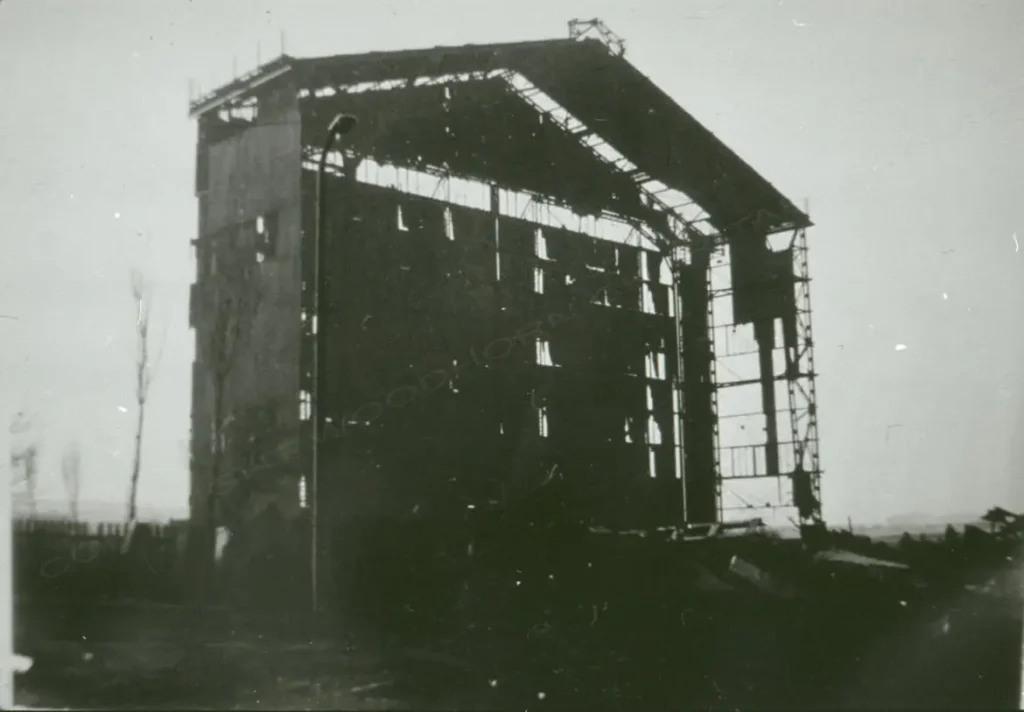
Towards the end of its days, the airship shed was used by a firm called Concrete Utilities Ltd to make concrete lamp posts. It was eventually demolished in 1967, having outlived its contemporaries by many years. Most other airship sheds had disappeared by the outbreak of World War II.