
Location
Edinburgh was a strategically important location, and the creation of the large Naval base in Rosyth saw this confirmed by the Royal Navy.
In 1912, it was proposed that an airship base with one shed should be established near the new base.
To protect Edinburgh and Rosyth from Zeppelin attacks, priority was given to establishing an aerodrome that could house fighter aircraft. East Fortune, close to the mouth of the Firth of Forth, was chosen.

The name “Fortune” refers to “Fort Town” and makes reference to the farms which were sited there to serve a fortress which was sited there in earlier times.
At the beginning of the First World War, responsibility for the air defence of the British Isles was the Royal Naval Air Service.
By August 1915, a site for an aerodrome and airship station had been selected, and approval had been granted in September. The main purpose of the base was the defence of Edinburgh and the Firth of Forth against attack by the German forces. In the autumn of the same year, aeroplanes arrived and were stationed there.
At the time it was assumed that the main threat would be from night air attacks coming from the southeast, and the first Commanding Officer, Fl Lt Beauman, proposed that defence be provided by three aircraft. Two of the planes on patrol at 6-8,000ft whilst a third would be kept ready on the ground. The two airbourne machines would be guided by two searchlights, one at East Fortune and the other near Edinburgh.
Shed Construction
In the beginning, there were no hangars, and the planes were housed in a Piggot Tent; however, with the wind off the North Sea, this was blown down very quickly. The aero station was soon started, and an airship station was soon commissioned on 23rd August 1916, and a Coastal Shed was quickly constructed, and a second was almost completed.
Work commenced on the large, rigid shed and was completed in the summer of 1917. A siding was laid into the northern part of the airship station, taken from the main East Coast Mainline, from Edinburgh to London, which skirted the northern perimeter of the airship station

East Fortune’s first airships were of the Coastal Class, capable of long-range patrols.
| Airship | Arrival Date | Historical Summary |
| C 15 | 23rd August 1916 from Kingsnorth via Howden | Recorded pilots Fl D-Ltf Sugden, Fl Lr Thomas, Fl Lt Wann, Fl Lt Johnston, Lt McColl, Fl S-Lt Drew Recorded duties include fleet spotting practice, bomb mirror practice, patrols, towing and refuelling trials with HMS Phaeton. Anti-submarine patrols. Wireless transmission tests. Wrecked with battle cruiser fleet, 16th July 1917 – no casualties |
| C 16 | 23rd August from Kingsnorth via Cranwell and Howden | Lost at sea 28th August due to a magneto failure – no casualties |
| C20 | 22nd September 1916 from Kingsnorth via Howden | Recorded pilots Fl Lts Thomas, Drew, Johnston, Waneford, Irwin, Fl S-Lt Butcher Recorded duties include drouge towing for dummy bomb dropping by aircraft, air firing at balloons, towing operations with HMS Phaeton, partols. 15 June – 19 August 1917 grounded at Longside engine trouble. 16 September – 25 November engine trouble 22 December 1917 fuel feed problems, forced down on to the sea. Crew saved and ship sunk by gunfire. |
| C24 | 23rd October 1916 from Kingsnorth via rail | Recorded pilots Fl Lt Wann, Pritchard, Drew Irwin, Sugden, Turner. Recorded duties include drouge towing for dummy bomb dropping by aircraft, air firing at balloons, towing operations with HMS Phaeton, and patrols. Mine Searches and practice for Edinburgh anti aircraft defenses, and patrols for cine photography. Deflated 12 December 1917. Envelope rigged o C25 car and replaced by C*3 |
| C25 | 26 October 1916 from Kingsnorth via rail | Recorded pilots Cpt Hopperton, Fl Cdr Johnston, Fl Lts Waneford, McColl, Collins 2 Lt Scroggs. Recorded Duties include drouge towing for dummy bomb dropping by aircraft, air firing at balloons, towing operations with HMS Phaeton, and patrols. Mine Searches and practice for Edinburgh anti-aircraft defences, and patrols for cine photography. Deflated 11 August 1917 – 3 November due to envelope inspection. Deflated 26th December 1917 when the propeller went through the envelope. Car rigged to C24 envelope. Car damaged entering shed 27 March 1918. Flew to Longside on 29 July. Lost 60 miles east of Aberdeen, 31 July 1918, with no survivors. |
Although C16 was lost at sea soon after arrival, it was soon replaced by C20 and the airships were used at first for convoy escort and training duties.
The Coastal airships were later supported by the new North Sea class airships, which had a longer range and endurance than the Coastal class ships.
| Airship | Arrival Date | History |
| NS 3 | 22 July 1917 from Kingsnorth | Grand fleet patrols, convoys and escorts, practice flights for anti-aircraft defences in Edinburgh. Grounded 16th September 1917- 1st October 1917. Deflated East Fortune 16 January 1918 for rigging alterations. Redesigned NS 3 car rigged to NS 4 envelope. 20-22 April, a record 55-hour flight. Experimental flight tests with water ballast recovery system. Towing tests with HMS Vectis. Lost in bad weather 22 June 1918 – crew of 5 lost. |
| NS 1 | 6th September 1917 from Kingsnorth | Grand fleet patrols, convoys and escorts, practice flights for anti-aircraft defences in Edinburgh. Bomb dropping practice. 16th September 1917 landed Longside with engine trouble. Grounded until 19 October Deflated early November and ready 30 November. Badly damaged after engine breakdown 11 December 1917. Did not fly again. |
| NS 4 | 15 October 1917 from Kingsnorth via Howden | Grand fleet patrols, convoys and escorts, practice flights for anti-aircraft defences in Edinburgh. Bomb dropping practice. Exercises with Balle Cruiser Fleet. Photographic flights. Envelope rigged to NS 3 late February 181. Old NS 3 envelope rigged to NS 4 car after repair. Ready 5 June 1918. Transferred to Longside 17 June 1918 |
| NS 5 | 12 December 1917 from Kingsnorth | Damaged beyond repair at Ayton after engine trouble. Did not fly again. |
| NS 7 | 29 June 1918 from Kingsnorth via Pulham | Grand fleet patrols, convoys and escorts, practice flights for anti-aircraft defences in Edinburgh. Bomb dropping practice. Exercises with Balle Cruiser Fleet. Photographic flights. Deflated 20 September 1918. Ready 25 October 1918. Attempted to fly of Ireland 17 March 1919, but the flight was aborted due to bad weather . Left East Fortune 4 February 1920 for new base at Howden. Used as a Training ship for the US Navy crews during June – September 1920. Last non-rigid in service when the Airship Section was disbanded in August 1921 |
| NS 8 | 29 July 1918 | Grand fleet patrols, convoys and escorts, practice flights for anti-aircraft defences in Edinburgh. Bomb dropping practice. Exercises with Balle Cruiser Fleet. Photographic flights. Grounded Johnshaven 5th August 1918. Ready 15 September. Took part in the War Loans flight in July and September 1919 with NS 7 |
This was later followed by rigid airship operations out of the double rigid shed. The first rigid airship to land at RNAS East Fortune was No. 9. and commanded by Sq Crd Scott. It arrived unexpectedly on 7th August 1917, having run out of fuel and encountered a thick mist. It flew over the Grand Fleet on 12th August 1917, and returned to its base at RNAS Howden on 13th August.
The first rigid airship to be permanently based at RNAS East Fortune was No.24, which arrived at the end of October 1917. The No.24 undertook two more trial flights before the end of 1917, and in early 1918 was assigned to convoy escort duties.
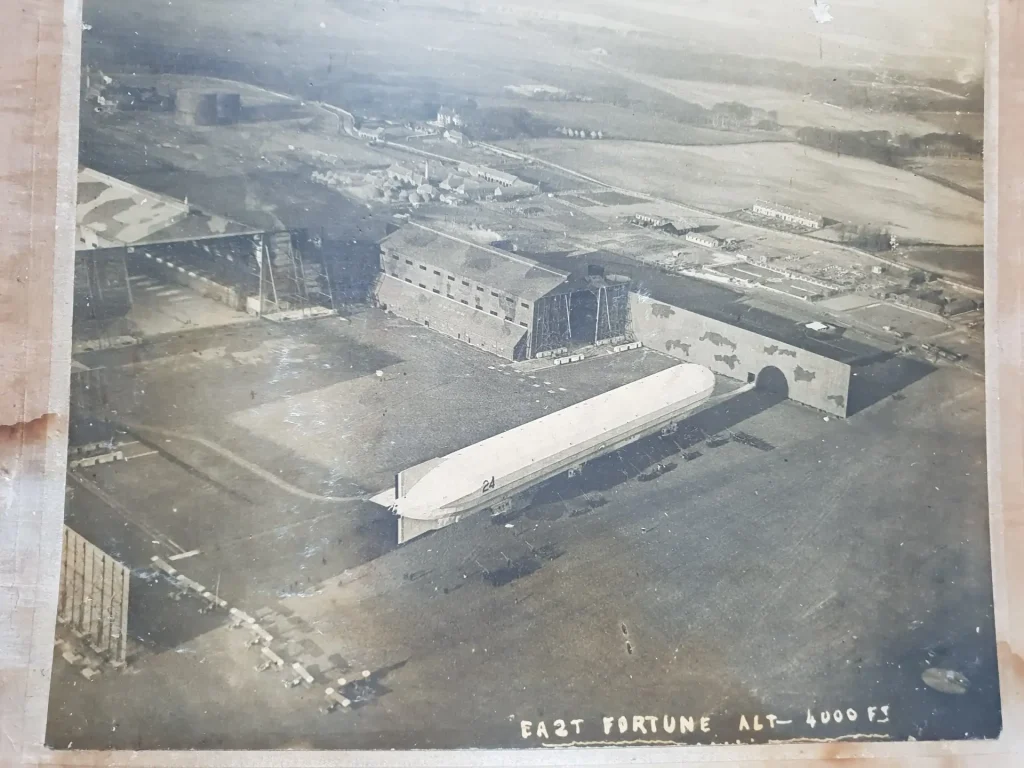
On one occasion,it encountered headwinds on returning to base and could not make any headway, as one engine failed, and it had only a poor top speed of 30mph on both engines. It managed to land but was damaged whilst being taken into the shed. It was later flown to RNAS Howden for repairs.
June 1918 saw RNAS East Fortune take delivery of the R 29, and on the evening of 3rd July 1918, the R29 made an endurance escort duty of 32 hours over sea. Both the rigid and non-rigid ships put in sterling effort during WW1 coastal patrols and as submarine lookouts. By the end of 1917, RNAS East Fortune had a complement of thirty-two officers and 580 men. There was also a sizable force of aeroplanes housed in canvas hangars. Royal Navy pilots were also trained here and acted as a depot for machines normally based on warships.

One of the most notable events at the end of the war was when, in late November 1918, the rigid and non-rigid fleet photographed and filmed the surrendered German fleet anchored in the Firth of Forth, before the ships proceeded to Scapa Flow. Unlike many other RNAS stations, the rigid and non-rigid airship fleet continued airship operations and flying into 1919, whereas many other bases were closed down after hostilities ceased.
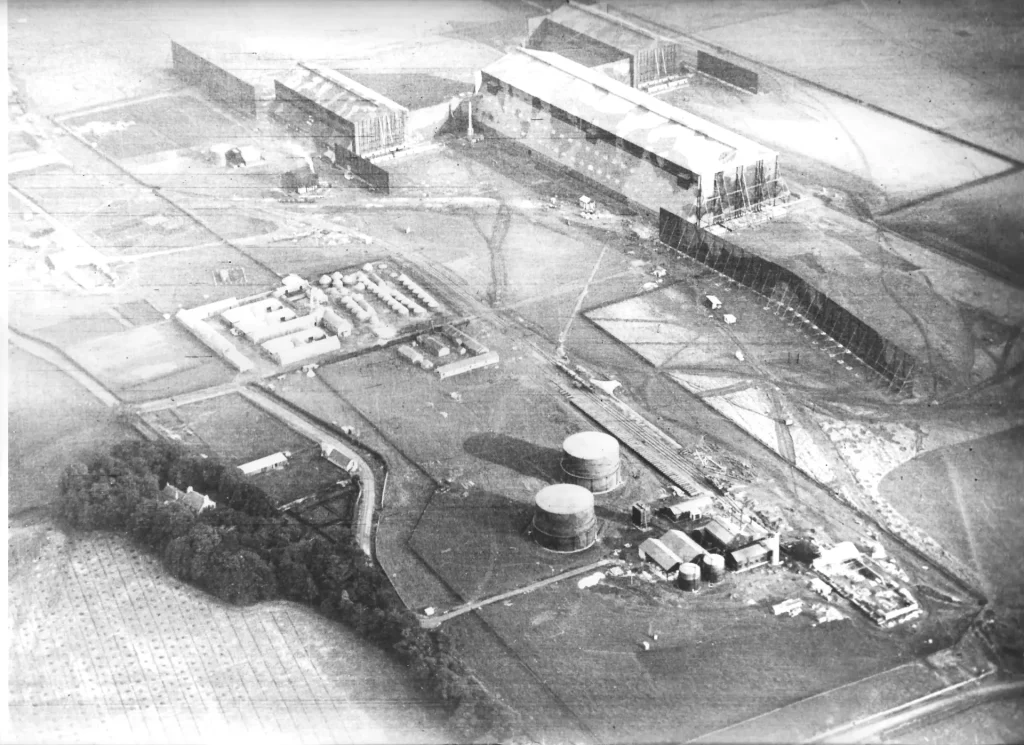

By the end of 1918, East Fortune had had six operational airships, the R29, NS.7 & NS 8, Coastal C3 and C8 and the smaller Submarine Scout SSZ 60.
With the arrival of the R34 from Inchinnan in March 1919, the ship later made a flight over Germany armed with machine guns as a statement of British air superiority, at this point, the Germans had still not signed the Treaty of Versailles. In July of 1919, the R34 left East Fortune for its transatlantic voyage, only to be ordered to return to Pulham in Norfolk, instead of East Fortune.
Shortly after the success of the R34’s record-breaking double crossing of the Atlantic, came the unexpected announcement that the East Fortune base would be closed. The R29, which was based there, was scrapped in the shed in October 1919. There was hostility in Scotland as it was at the time losing its only airship base, and questions were raised in the national press and in the Houses of Parliament.
Closure of the Airship Base
The final death knell came for East Fortune on 4th February 1920; the R34 and NS7 were the last airships to leave the base. A care and maintenance detachment remained on the site, continuing the radio station operations and maintenance.
The Airship sheds were used for storage and also for the recycling of ammunition. After this work was completed, the work began on dismantling the 3 sheds.
The land of the airfield was sold off, and the base buildings were later used to establish a tuberculosis hospital.
Second World War
East Fortune with it’s large area of flat ground, was requisitioned in June 1940 as a satellite field of Drem No 2. Training depot station nearby. At the end of 1940, East Fortune was developed in to the airfield with hard runways and buildings as seen today. The Tuberculosis Santorium was removed to Bangour by early May 1941.
During the rest of the Second World War, East Fortune was the base for Operational Training Units. The personnel on the station soon swelled to 1500, including WAAF and aircrew under instruction.
East Fortune was transferred to Coastal Command under no. 17 Group on Saturday, 24 November 1942. For the rest of the war the station was devoted to strike training and the number of personnel grew to 1730.
By the end of the war the station had begun to be run down and the personnel had been reduced to 900 officers and men.
After the war, when all the units had been disbanded from the site, the land was returned to the Sanatorium Board, and the Tuberculosis Hospital was returned from Bangour by August 1949.
The Cold War years
With the outbreak of the Cold War, it was decided that the airfield should become a United States Airforce base and although the runway was extended to take jet areoplanes, the Americans never used it.
In December 1955, East Fortune passed back to Air Ministry control/
During April and August 1961 East Fortune became the main airport for Edinburgh, whilst the runway at the Turnhouse airport was being resurfaced. During the four months of Operation East Fortune handled 2640 civil aircraft movements carrying 96,000 passengers.
Just before the airfield closed for the last time, there was a nostalgic meeting between the last two surviving members of the crew of the R34 on it record breaking flight of the Atlantic. Crew members Powell and Gray flew out on the last Vickers Vicount aircraft to leave East Fortune.
New life as the National Museum of Flight Scotland
The land was later returned to agriculture, but the buildings on the south side of the airfield were preserved and are now the home of the Museum of Flight.