
Location
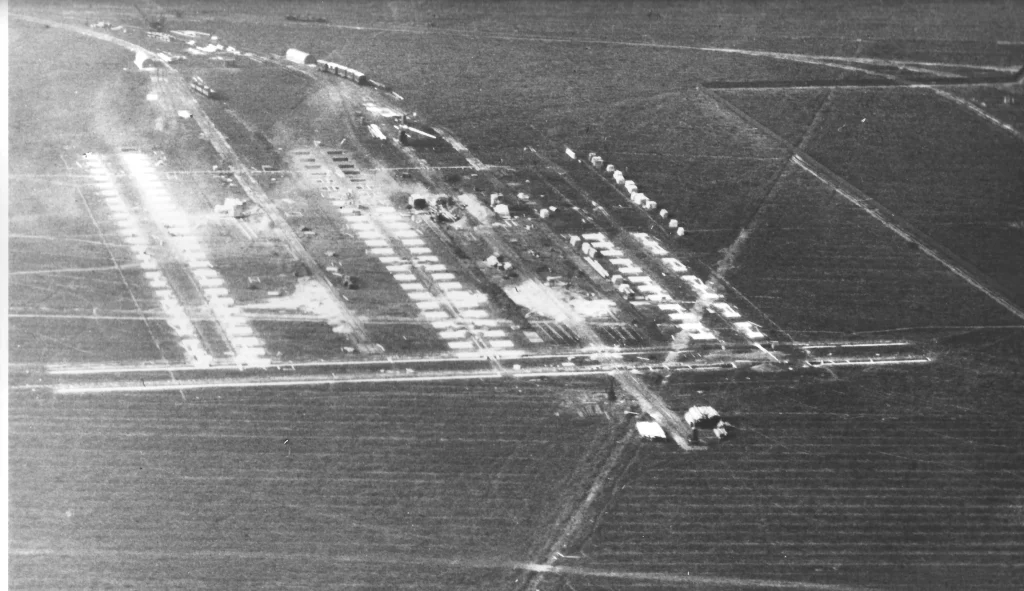
The Royal Naval Air Station Howden was constructed and opened on the outskirts of the town during the First World War, to cover the East Coast ports shipping from German U-boat attacks.

The station consisted of: Living accommodation for the Officer and other ranks, a chapel, YMCA, post office and a pigeon loft, the latter housing the carrier pigeons which were carried, two per airship.
One casualty of this redevelopment was Brindcommon Farm, which was demolished to clear the approach to the landing field. Besides the living accommodation, there were the office blocks, technical area, a large hydrogen gas works, an electric powerhouse, stores, a fuel dump and workshops. All are built on the left side of the approach road. On the right side of the road were the three airship sheds.
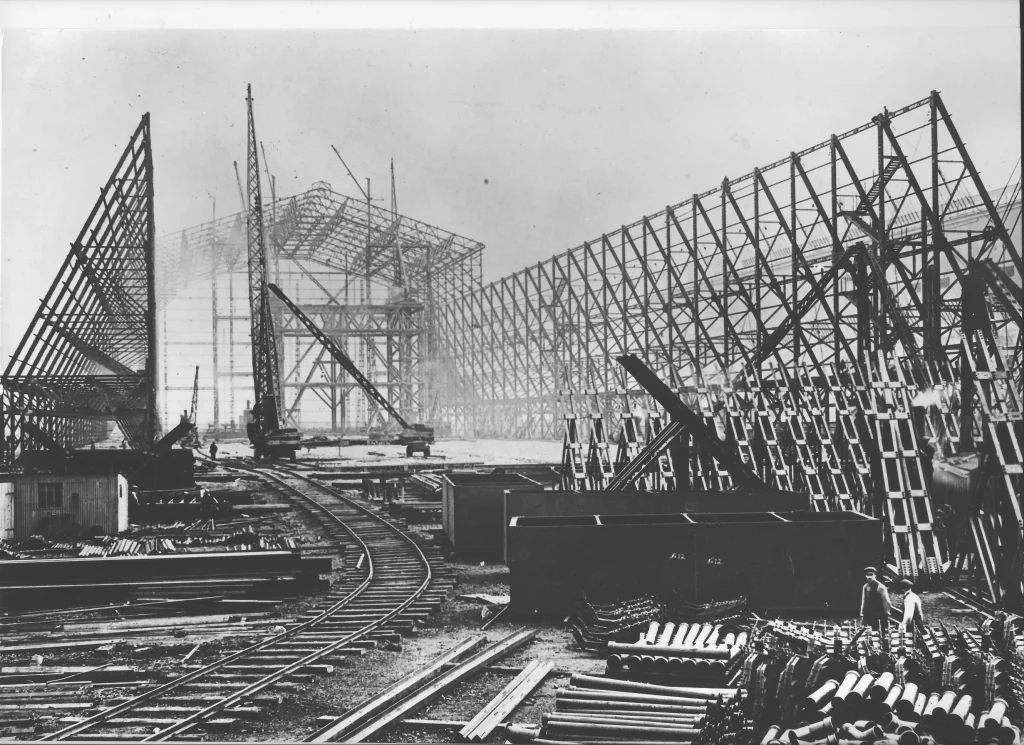
One shed for the rigid type airship flanked by two smaller sheds, which housed the non-rigid type airship and provided a wind break for the larger shed.
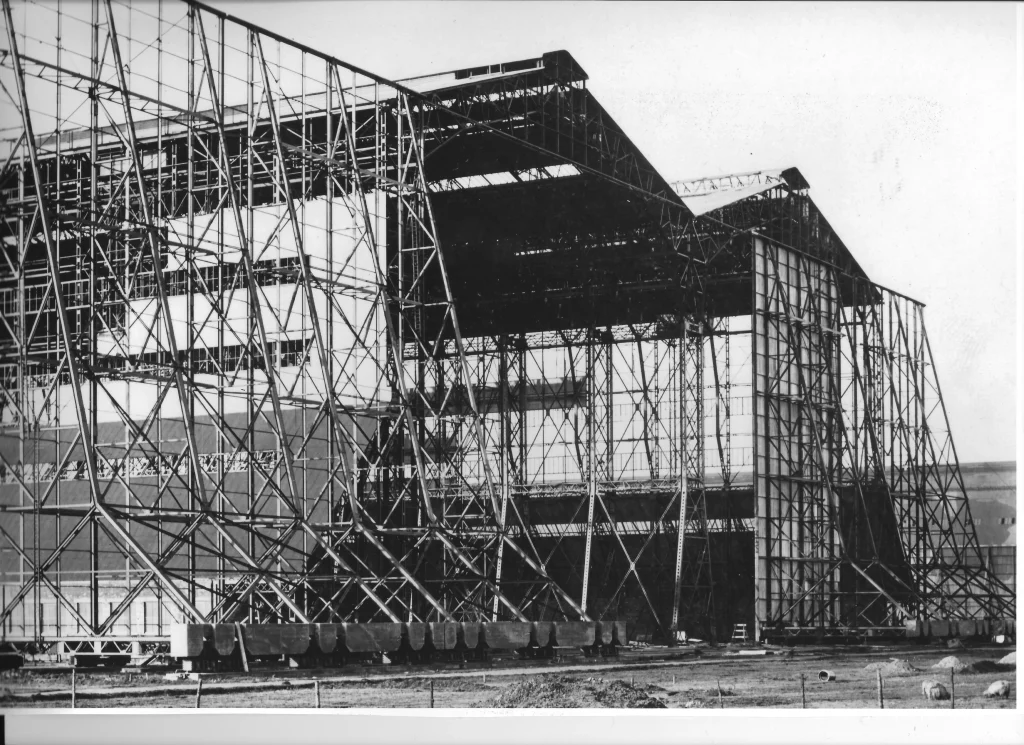
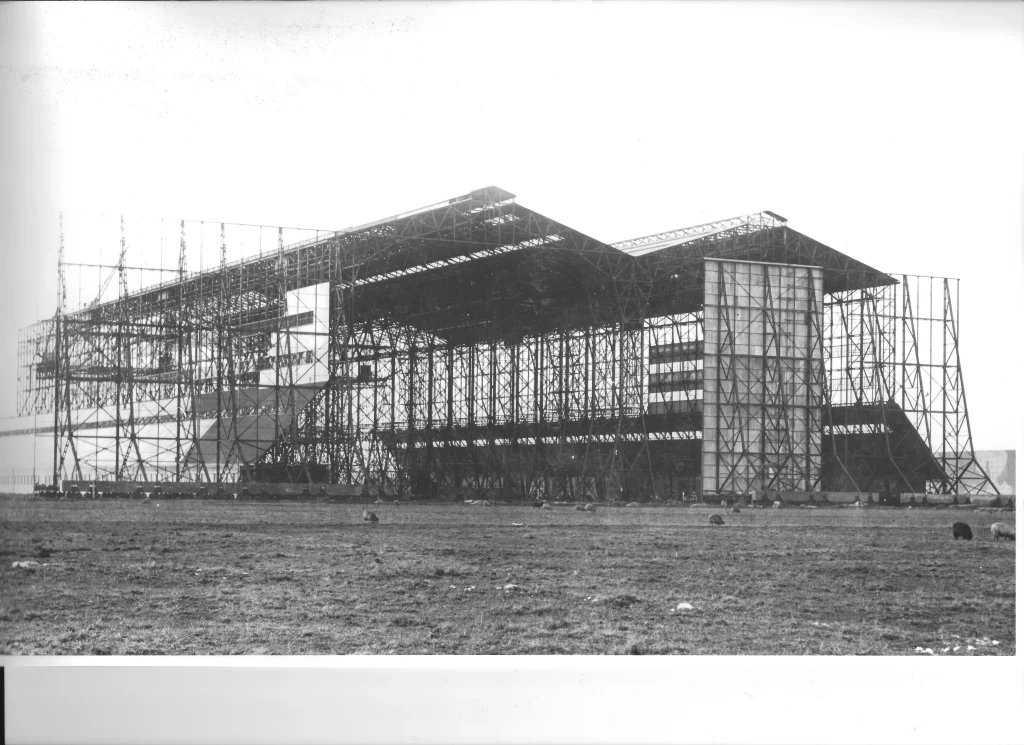
Double Rigid Shed
By 1919, Howden was to boast the largest airship shed in the world. The No.2 Double Rigid Shed measured 750 feet in length and 130 feet clearance height at the doors, it could have housed six Howden Ministers inside.

Howden air station formally opened on 26 June 1916. The first airship flight into and the last airship flight out of Howden, some 13 years later, was to be piloted by the same man, Sub-Lieutenant Ralph Booth, who in 1929 was to fly the R100 on its maiden flight.
Although only one airship, the R100 (designed by Barnes Wallis, later to be Sir Barnes Wallis, was actually designed and built at the Howden air station between 1926 and 1929. It was as a training and antisubmarine station, which was to be the station’s main role, in the years between 1916 and 1920.
The Howden Detachment
The Americans had been so impressed by the British-built R34’s flight across the Atlantic and back in July 1919 that they decided to buy a British airship. In 1920, the American Navy sent over a party of officers and other ranks (nicknamed the Howden Detachment), for flying training and familiarisation on British airships, in readiness for them to collect and fly back to the States the R38 (to be called the ZR2 by the Americans) airship. The station was used by many famous airships, including the R34 and R38. As with all the cuts in the early 1920s, the R.N.A.S. closed in 1921 and was then reopened a few years later for construction of the R100, as part of the Imperial Airship Scheme..

Airship Guarantee Company
The Station reopened when the Airship Guarantee Company, a subsidiary of Vickers Ltd., built another airship, the R100, to the same contract specifications as the Royal Airship Works in Cardington.
The Airship Guarantee Company decided to build the R100 at Howden. Vickers brought back, from abroad, Barnes Wallis. In 1924, the Airship Guarantee Company sent a working party to Howden to put the now neglected airship station back into service.
The massive shed still stood surrounded by debris of the wartime airship sheds. The owners had abandoned the shed in the face of falling scrap metal prices. The shed’s door clearance of 130ft had to be increased by 10ft to accommodate the R 100.

The local town of Howden was back on the airship map. The towns fortunes took an upward turn as a large labour force, mainly recruited locally (60% of the labour on airship construction was female) was needed not only to rebuild and run the station, but to construct a giant airship, which was to measure 709 feet in length, 133 feet in diameter, a 5,000,000 cubic foot displacement and powered by six Rolls-Royce engines, producing 4,200hp.
Over the following six years, the airship took shape.
The R100 was completed as per the contract and once completed, flew down to Cardington, which was to become its base of commercial operations. The R100 flew successfully to Canada and back.
After the demise of the R101 in October 1930, Howden Air Station was left to run down, and the town’s fortunes with it.
Today
The town still survives, but the airship station is no more. It is noted that a few mooring out blocks still survive in an area near a local golf course, and one is on display, as with other R100 memorabilia at the Elvington Air Museum near York.