
The Beardmore Company was a famous Glasgow industrial company, producing a range of products from bullets, helmets, to ships and planes. In 1916, they were given the Government contract to help build airships. With the revival of the rigid airship programme, the armaments firm Beardmore bid successfully to build them.
Based at Dalmuir on the western side of Clydebank, the company was the Scottish equivalent of Vickers, specialising in building warships and armaments. Although it had experimented with aeroplanes as Shorts and Armstrong Whitworth had done, the company had no previous experience in building airships.
Glaswegian armaments company, William Beardmore and Sons, an established ship and armaments company, known as the Scottish equivalent of Vickers Company, began negotiations, along with Armstrong and Whitworth, and Vickers, to build large rigid airships.

Location
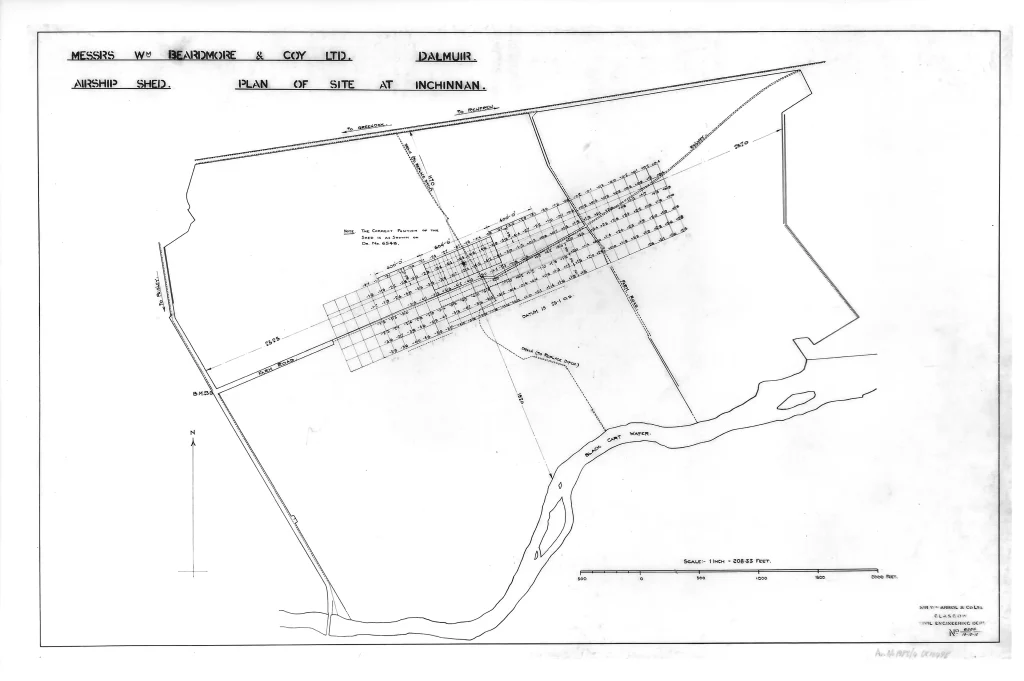
October 1915 saw the company awarded the contract to build HMA No.24 and began working on manufacturing some of its parts in its seaplane sheds in Dalmuir, on the north side of the River Clyde. There was no room for an airship shed in the currently built-up area; however, the land on the south bank of the river was sparsely populated, and areas of open countryside.
The original idea was to build a shed on land opposite to Beardmore’s existing works at Newshot Island; however, a site some 1.5 miles south of Dalmuir was selected. The land was requisitioned under the Defence of the Realm Act. Some 413 acres were purchased as the site of the new airship construction site.
Beardmore was successfully awarded a grant from the Treasury towards the cost of the new airship works. Work began on the site in January 1916, some two years into WWI. The construction company Sir William Arrol & Co. started work on the airship shed.
Some 2,300 tonnes of steel were required. The glazed shed windows were tinted and fitted with blinds so that it could be blacked out at night. At both ends, the sheds were fitted with large sliding doors, counterbalanced with several hundred tonnes of concrete to stabilise when open.

As with all of the earlier sheds, the doors were manually winched open by capstans and a team of manual workers. It was estimated that it would take the men some 13 minutes to winch open the doors. Both ends of the shed were sheltered by large steel windbreaks. Construction was almost completed by August of 1916.
A larger hangar was later built almost opposite to the south of the shed, which was used for the construction of Hawker-Page V/1500 bombers assembled. A second airship shed was planned for construction but never put into place. Even though the Inchinnan Airship Works were not far from Dalmuir, it was on the opposite side of the River Clyde, and not easily accessible for the workers.
Workers Housing
Many of the workers had to be driven each morning from Renfrew. Similar to the Shorts Brothers works at Cardington, the Beardmore company built fifty-two houses for it’s key workers on the site of the airfield. The idea of a model village was created, and it gave the workers the comfort and convenience of self-contained houses with very moderate rents.
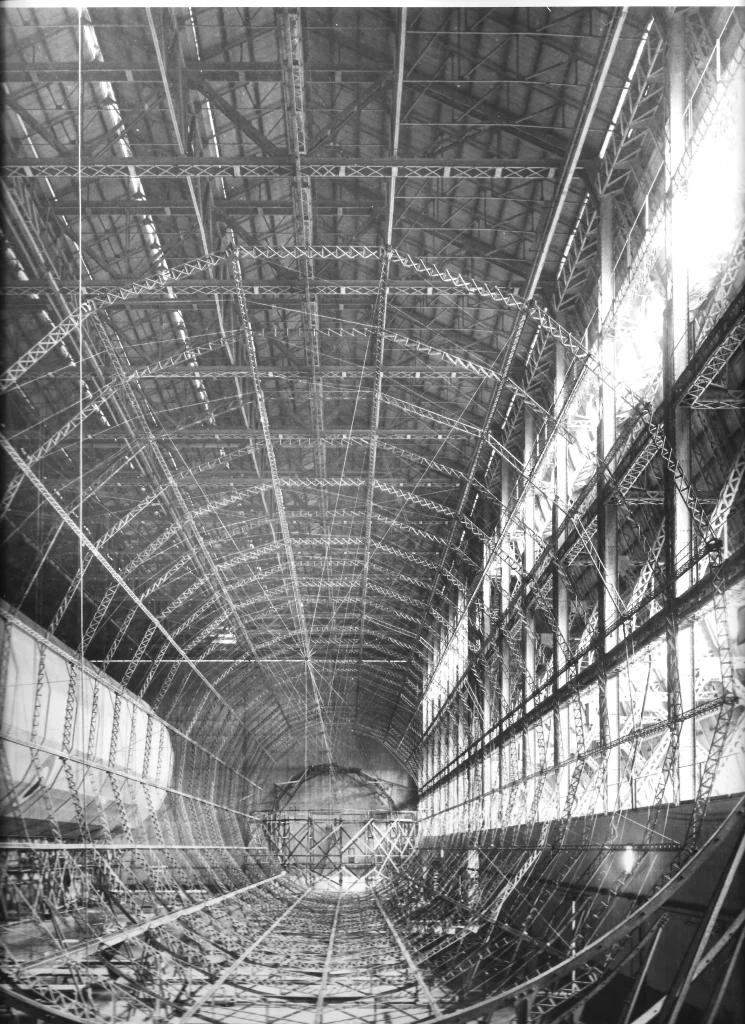
Before the shed was finished, the first frames of the new airship, the R24, had been moved into the shed for assembly.
On 27th October 1917, 200 naval ratings from the Barrow-In-Furness naval base arrived to act as ground crews. The R24 was taken out of the shed on 28th October, but the ship spent some 6 months testing mooring techniques outside. With the ship outside, there was space inside the shed to complete another two ships side by side. Work on the R27 commenced in March 1917 and was completed, with a first flight in June 1918. The Inchinnan constructional shed’s most famous occupant was the transatlantic R34.
The R34 was completed in the shed and was walked in December of 1918, just after the armistice in November 1918. It was returned to the shed after ground trials and was going to undertake its first flight; however, bad weather confined the ship to the shed for the rest of the winter and didn’t re-emerge until 14th March 1919.

At the end of its second trial flight, some of the ballast bags iced up and froze. The crew were unable to drop enough water ballast on landing, and the ship came down for a heavy landing. A propeller and some of the girders buckled.
When the R34 was first walked out of the shed, some of the women workers pinned a black cat soft toy to the forward gondola for a good luck mascot. On the evening of the bad landing, the mascot was removed and burned. By the end of May 1919, the damage had been repaired and the ships were ready to be delivered to the operational airship base at East Fortune, outside of Edinburgh.
After the war, there were many ideas for commercial airship operations. Sir William Beardmore, the owner after whom the company was named, was quoted as saying that in his opinion, “airships were the most interesting developments of all”.
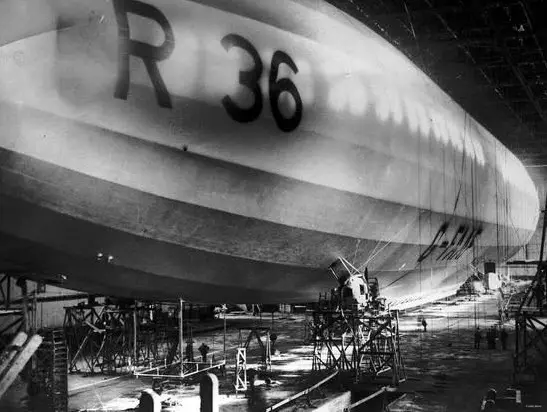
The R36 was the last airship ordered and constructed in the Inchinnan constructional shed. The work had begun on the ship as a “stretched” R34 class military ship, but it was later decided that the ship would be converted to a civil role.
This decision delayed the first flight as the ship was converted to a passenger-carrying ship, with a large external gondola fitted, with accommodation for up to fifty passengers, in both day and night configurations. The R36 took flight on 1st April 1921, displaying its civil registration of G-FAAF.
Final Days
The ship was then flown down to the Pulham experimental station and initially used for mooring trials. It was in September 1921 that the Air Ministry announced that the Inchinnan aerodrome was to close, and in the autumn of 1922, the buildings and land of the Beardmore Airship Works were handed over to the Disposal and Liquidation Commission.
During April 1923, the works were sold to Murray McVinnie & Co, ship chandlers and metal merchants. Later that year, the airship shed was demolished.
The giant Hadley Page Hangar that stood close by fared a little better, by being purchased by the India Tyre Company, and remained until 1982, sometimes confused as the “airship shed”. Like the houses at Shortstown, Bedford, the Beardmore workers’ houses remain, and the site of the Glasgow Airport is close by, on the edge of the original land for the airship station.
Today
The connection with aviation construction still stands to this very day, with Rolls-Royce opening a new factory in 2004 for repairing its aero engines on the same site as Beardmore’s original aviation site on the south side of the River Clyde.
Resources:
For more information about William Beardmore and the airship construction of some of the most famous First World War airships, the history of Beardmore Aviation and Clydeside Aviation: Volume One (The Great War) is available from Charles Mackay Books