
Location
With the Royal Naval Dockyards based at Chatham in Kent, on the river Medway, it was seen as a high priority to establish an airship base close by at the mouth of the Thames.
As early as October 1912, negotiations by the Admiralty were commencing with local landowners to buy land. In January 1913, estimates were being drawn up for the costs of the construction and operational airship sheds needed.
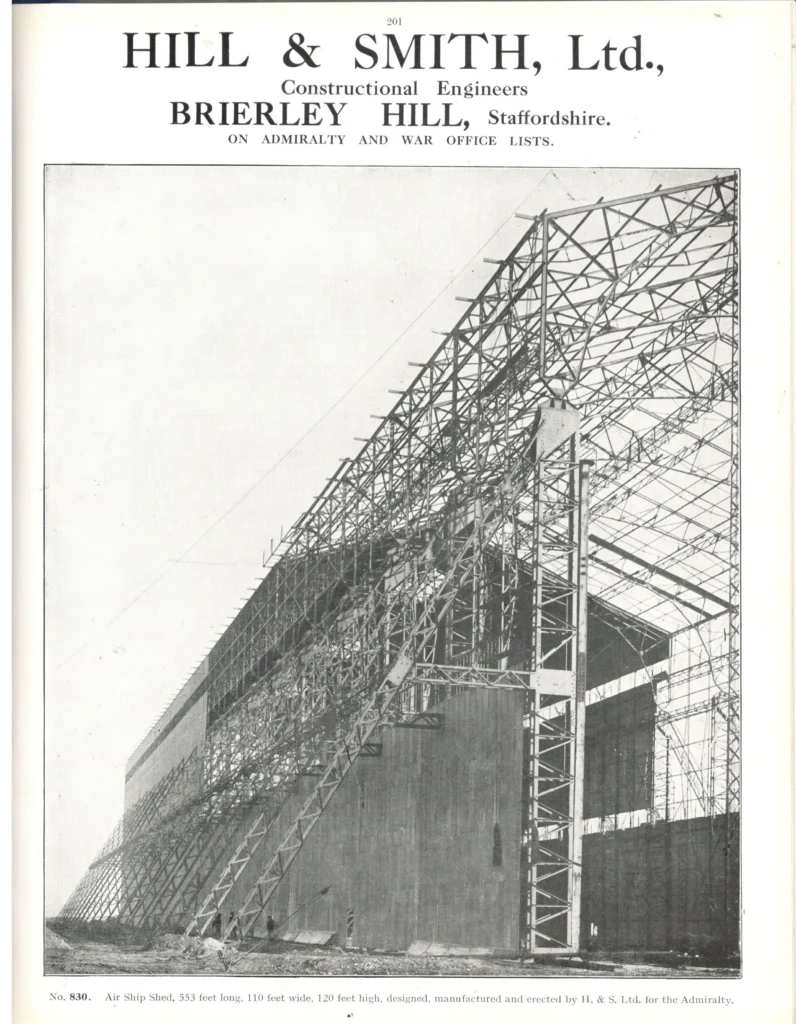
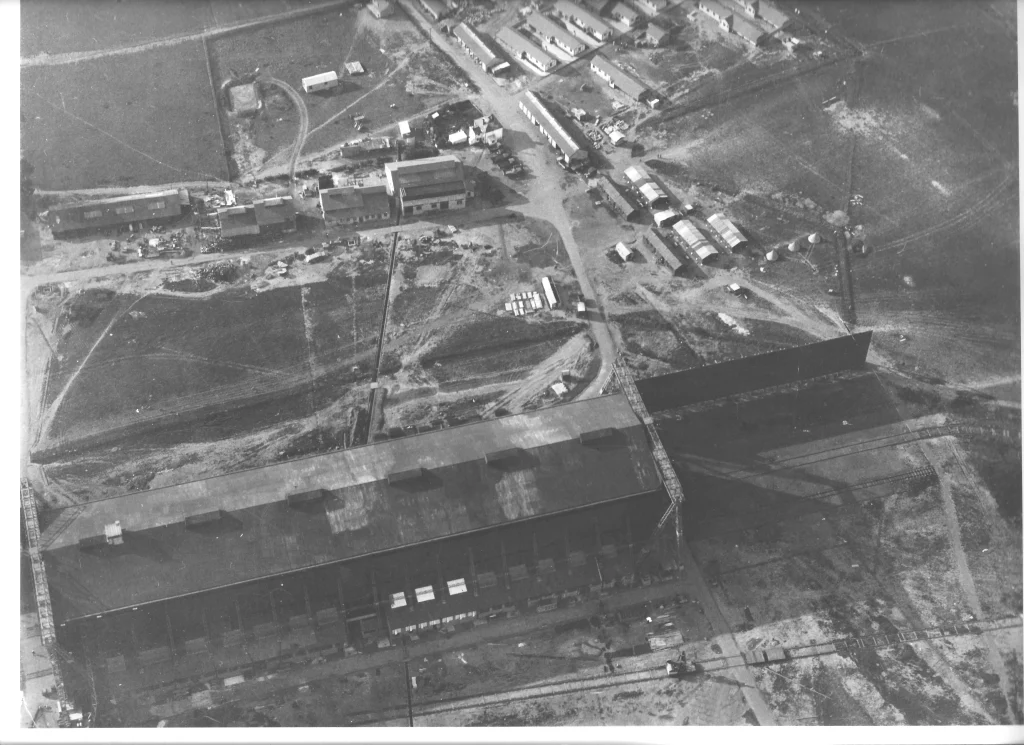
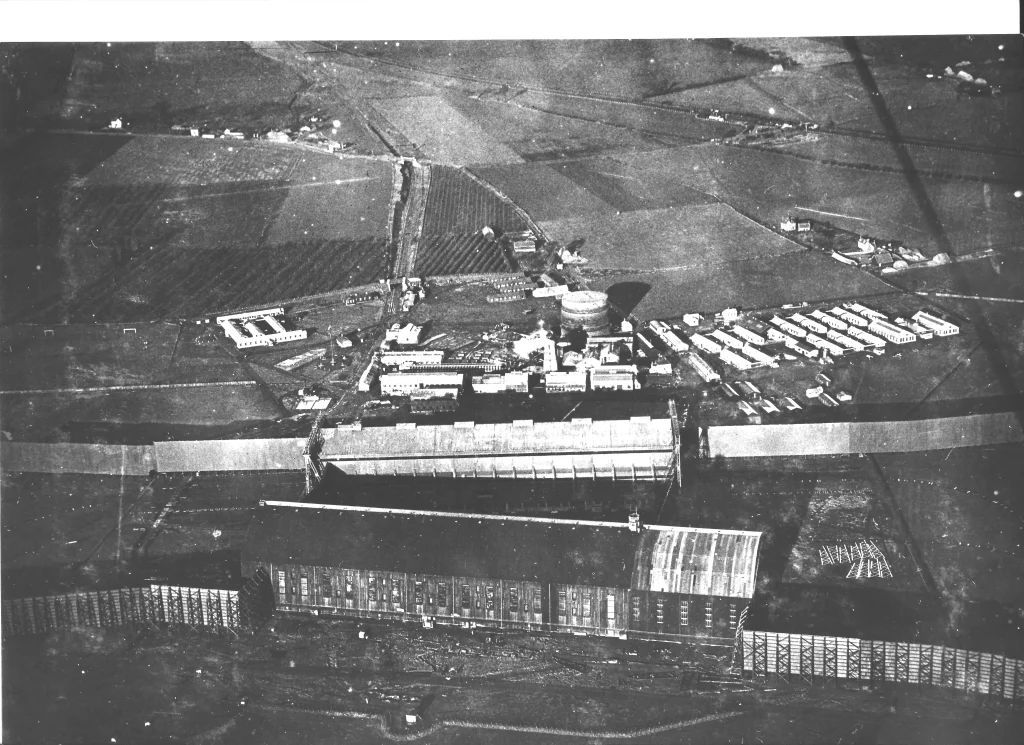
The Kingsnorth project was ambitious from the outset. Messrs Hill and Smith of Brierley Hill, Staffordshire, commenced work on building the steel-framed shed in April 1913. In July of 1913, Vickers had been awarded the contract for the second shed, but this was to be built out of prefabricated materials, which were imported and assembled from Germany. Vickers had also been awarded the contract for the construction of the hydrogen plant. A network of roads was created over the wet marshlands of Northern Kent, along with a small power station, stores, an engineering workshop garage, a blacksmith’s forge, and an explosive store. A housing block was also erected for the officers and men.
Operational Life

Officially commissioned in March of 1914, the large timber and metal sheds were nearing completion at this time, but work was still remaining to be completed on many of the other buildings. Over the next 4 years, up to 1918, a large-scale programme continued with the expansion of the station. In August of 1914, a further 81 acres were annexed from Barton Farm nearby to ensure there would be enough land for airship operations.
With the looming threat of the German air force, a set of anti-aircraft guns was positioned on the base, close to the officers’ quarters in November 1914.
The first two airships based at RNAS Kingsnorth were used to escort troopships carrying the British Expeditionary Force to France during the summer of 1914. Astra Torres No.3 and Parseval No.4 were based and used Kingsnorth as their patrol base for the outer reaches of the Thames and the English Channel
At the end of August 1914, the Astra Torres No.3 was deployed to Ostend. The ship was sent back as the General in charge claimed to have no use for it; however, it proved so useful in directing the guns from the Royal Navy ships for locating the enemy fleet vessels, the General wanted to do nothing else but scout for them. However, the airship was extremely vulnerable to enemy fire, so it was decided to return it to Kingsnorth. An additional Astra Torres ship was later diverted to Kingsnorth to be used for patrolling the English Channel approaches
As the war continued, and furthermore, more local airship bases at RNAS Polegate and RNAS Folkstone, with the new submarine scout class of airships, the function of RNAS Kingsnorth for guarding the Thames approaches began to diminish.
The local Commander in Chief wrote to the Admiralty requesting three additional SS-class airships to be based at such a strategic location; however, the request was turned down by the Director of the Air Service on the grounds that it was not considered practical.
The main reason behind this decision was that the sheds at Kingsnorth would be used for the building of the new Coastal Class airship class. Despite the request being turned down, there was always an SS Class ship at Kingsnorth to be called upon for patrol duties.
Despite the rush to create and build the new Submarine and by 1915, the new enlarged ship, the Coastal Class patrol ship, in the early part of 1915, there were only less than one hundred British men who could actually fly an airship. It was then decided that the role of RNAS Kingsnorth would be to use the station as a training station. The pupils who had completed the free ballooning courses and ground instruction at RNAS Wormwood Scrubs would then be passed on to RNAS Kingsnorth for immediate instruction at an operational airship station.

Intensive training was given to the pupils, and due to the requirements for qualified pilots, the initial stage was omitted, and pupils found themselves on the immediate instruction course at an operational airship base. Intensive training was given in both theory and practice at Kingsnorth. The pupils could find themselves on courses learning aeronautics, navigation, metrology, engineering, and, of course, flying lessons. Instruction would be given in Submarine Scout ships, which were perfectly suited for instruction as they had a two-seater configured fuselage. The instructor would sit in the Captain’s seat in the rear, and the pupil in the front seat. The instructor would initially fly the ship, and the pupil would observe and feel the ship. After a few takeoffs and landings, and if the instructor felt the pupil worthy enough, then they would swap seats and the pupil would take the controls.
In the summer of 1916, mid-war, Submarine Scout ships SS.14 and SS.31 were used on patrol, and Coastal Ship C.1 was used for training purposes.
RNAS Kingsnorth was often used for experimental ships, for example, where new engines were fitted to ships. The Submarine Scout S.S. 31 was retained for training and also doubled up as an experimental platform. In 191,7, RNAS Kingsnorth, as it had done with its use as a patrol base, lost its role as an instructional base, and the pupils were transferred to the newly opened RNAS Cranwell, instead.
RNAS Kingsnorth retained its experimental work up until the end of 1917, and the airship A.P.1 was constructed there. The A.P.1 was an experimental “fighter airship” which was the envelope of a Submarine Scout ship, which was used to lift the B.E.2 aeroplane into the air. The plane would then detach itself from the envelope at high altitude, and then fight approaching Zeppelin bombers. The first such flight was meant to be carried out in the summer of 1915, but some faults were discovered, and the first test was postponed until the first flight on 21st February 1916. Wing Commander Neville Usborne and Sqn Leader de Courtney of Ireland, were volunteered to test fly the “fighter airship” As an experienced airship pilot, Osborne was responsible for the takeoff, and Ireland would handle the landing.
The liftoff went as planned; however, at the moment of the aeroplanes’ release, some 4,000ft above Strood, something went wrong. The envelope began to deflate, and the ship began to descend, and whereas three independent hooks which were holding the aeroplane below the envelope were meant to disengage simultaneously, one failed to disengage, and the plane’s fuselage became entangled in the descending envelope. In an attempt to disengage the aeroplane’s body, Ireland tried to crawl along the fuselage; however, he lost his grip and fell to his death. Usborne was still strapped into his seat in the fuselage and fell to the earth. His body was later recovered. A second experimental ship, A.P.2, had been completed, but after this tragedy, never flown. It was two years later that the idea of launching an aeroplane from an airship was successfully accomplished by the R33, launching a plane at RNAS Pulham. Although the loss of Usborne and Ireland was indeed a tragedy, accidents involving experimental flights from RNAS Kingsnorth were very rare.
In November 1914, airship No.3 was used for towing experiments behind a Royal Naval Vessel. Later in March 1916, the same experiment was undertaken using the larger Coastal airship to see if their range could be extended by this method. To help with planning this, a large area of the landing area of RNAS Kingsnorth was marked out to represent the afterdeck of a destroyer. A Coastal crew practised their skill by accurately dropping a trail rope onto the mock ship and attaching it. On May 12th 1916, Coastal C.1 flew into Harwich harbour where it attached to a cruiser before being towed out to open sea. The Commander of Harwich Naval Force, R.Tyrwhitt, declared his approval at the handling of airships and the skills of the pilots.
RNAS Kingsnorth saw other experiments; the SS 14 was used to test a new grappling hook. When dropped from 250ft, the hook could penetrate hard turf to a depth of 12 inches, and in soft ground, to a depth of 6 feet. Mooring experiments were undertaken, and more importantly trial using a mooring mast. Various trials were also carried out with bombs, and different types of machine guns were fired from the experimental ships.

With the expansion of the constructional side of the airship station, a new branch line was added in 1915 connecting the station to Hoo in the south and then on to the main line to London.
RNAS Kingsnorth became a design base, with the Coastal Class, North Sea Class being designed and all prototypes being constructed here. The design office grew from only one draughtsman at the onset of war, which rapidly grew to a team of forty-nine by 1916. The sheds became a construction station, with parts commissioned and arriving from many different sources. There was an engine test house to check the performance of the engines which arrived, a chemical research laboratory, and a miscellaneous instrument and experiment workshop.

At the turn of 1918, Kingsnorth and its extensive facilities had focused purely on airship assembly. With the exception of test flights by newly assembled airships, there was very little flying from the station.
In 1919, despite a large investment in the site and the extensive facilities, which had been extended to and added to the RNAS station since 1914, it was rapidly demobilised. Due to its location, it became a repository for live mines; some 4,400 of them were stored in the “iron” shed and deactivated mines, of unknown quantity, were stored in the wooden shed. In March 1919 came the decision was made to close the RNAS station, and by August of the same year, the drawing office was closed. It was reviewed and discussions made, due to its proximity to London and the lower Home Counties, to convert the base to a civilian base, for the future plans for civilian airship services; however, this was later scrapped. In 1920, it was decided to put the site, the buildings and laboratories, the two airship sheds and 107 other buildings up for sale.
Post-war use
In the late 1920’s the sheds and some of the technical buildings were used for wood pulping. The accommodation blocks were converted into workmen’s houses. One of the two airship sheds was still standing in 1939.
In the second half of the 20th century, an oil refinery sited close by took the last of the original buildings. Today, the site on the estuary is home to two other power stations, and a large coal-fired station, with a 600-foot chimney, marks the site of the old RNAS Kingsnorth airfield. The coal-fired power station stopped generating electricity in 2012 and is planned for demolition. The site also forms part of a North Kent nature reserve.