Document transcribed from “The World The Air The Future” – Sir Dennison Burney 1929
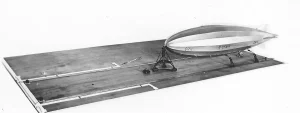
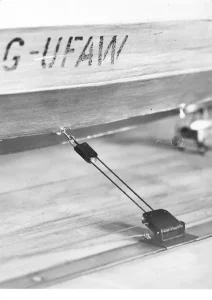
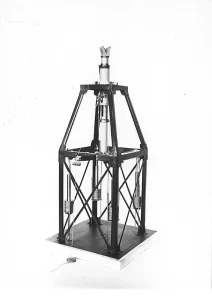
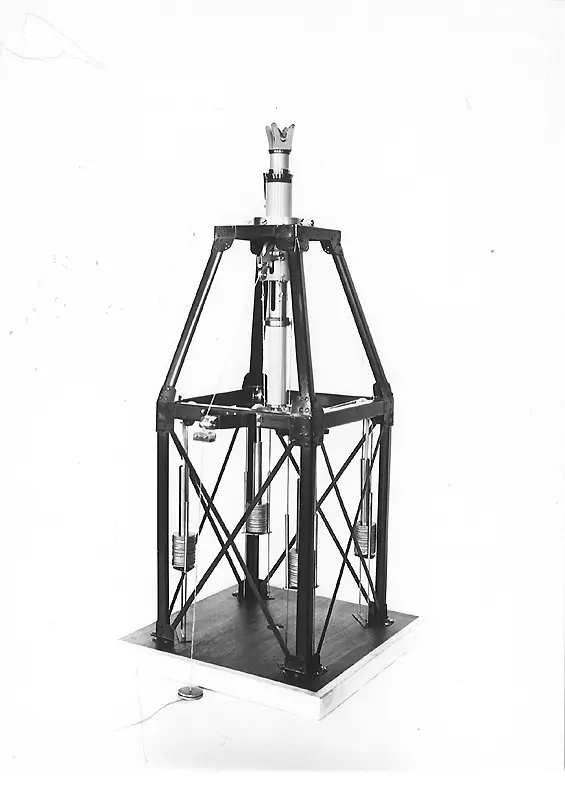
Note: Some recent photos uncovered from the AHT collection have been added to highlight plans which were being undertaken for the docking of airships, and how close these plans were progressing in mooring techniques.
Mooring and Docking Raft Advancements
In the same way as a liner requires tugs and capstans to manoeuvre her into a dock, so does an airship, which presents as great an area to the wind as a liner, want some mechanical equivalent. During our investigations into this problem, many suggestions were made, but each proposal was tested by this question: Can the scheme proposed main- tain a ship in safety, if at any stage of the operation of taking the ship from the mast and placing her in the shed, a 40-45 m.p.h. Wind shifts 5° in 10 seconds?
So far, the proposal I shall now describe is the only one that has passed this test. The general idea underlying it is simple. The ship is moored at a mooring mast in the usual way, and as soon as this has been done, a number of claws are mechanically operated and clasp the ship firmly about the centre line. When the ship is securely held in these claws, the whole structure embracing the mast, claws, and ship, is run into the shed on rails.
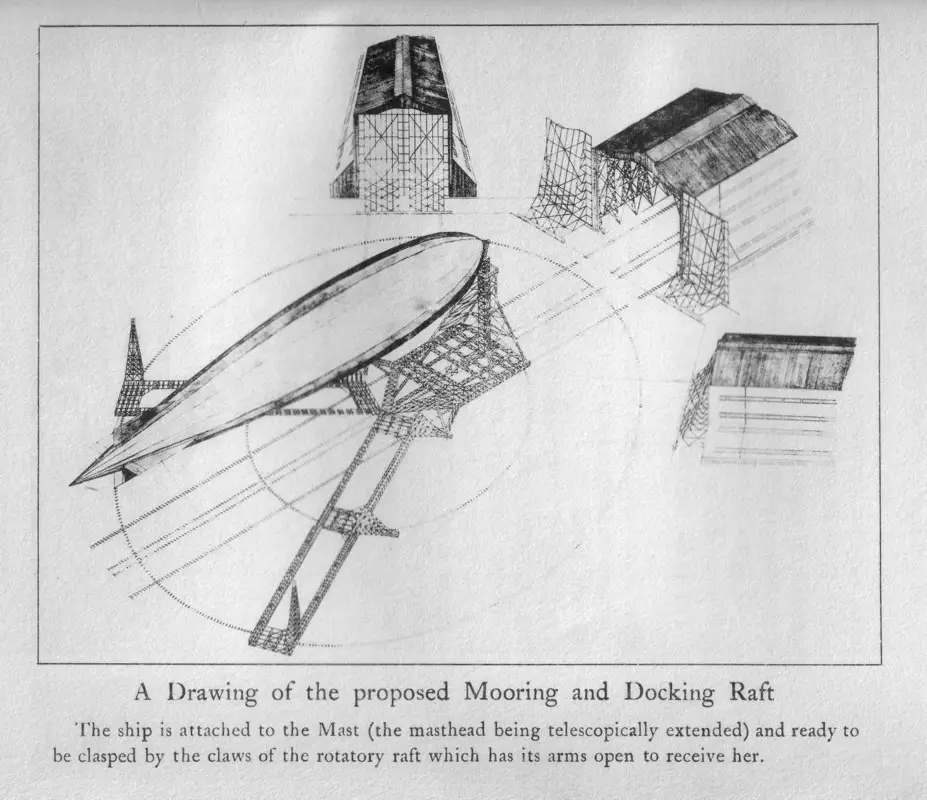
Several details have to be elaborated. The mast must be high to receive the ship, and low to enter the shed. Therefore, it is made telescopic. The manoeuvre of clasping the ship by the claws must be carried out when the ship is lying head to wind. Therefore, the claws are mounted on a raft which is capable of rotation, and because the ship is held by the mast, it follows that the mast must be attached to the raft.
The next question for consideration is, at what part of the ship should the claws be attached? Again, it is obvious that they must be attached at that part of the ship that will prevent rolling in the event of a side gust. The claws are attached to strong points along the horizontal of the ship.
The next problem to be considered is in connection with the claws. How are they to be operated? If they are high enough to reach the centre line of the ship, and if they are mounted on a raft which is rotated so as to lie in the same fore and aft line of the ship, it is obvious that, unless precautions are taken, the claws will poke a hole in the ship’s underside.
Therefore, the claws are made to rotate about the horizontal axis and lie down flat on the ground, and they only become vertical when the ship is so restrained that she cannot swing into the claws when upright. Not only is this done, but a further precaution is taken. The raft itself carrying the claws is made to open like a pair of scissors, so that the ship can come to the mast between the arms of the raft, and be restrained in that position by ropes running from the claws to the ship.
Once the ship is securely clasped in the claws, she can be treated in one of two ways. Either she can be left in the claws in the open, the raft being rotated so as always to keep the ship head to the wind, or the raft can be rotated until the ship is in line with the shed, and then the ship, raft, mast and claws, can be run as a unit in to the shed. Furthermore, since the claws can be finally balanced prior to emergence from the shed with a minimum employment of personnel. To take the vessel out of the shed will, therefore, require but few men, as nothing has to be done beyond opening the doors and operating the levers controlling the transporting mechanism of the raft.
It will be realised, of course, t hat although we have a solution in the mooring and docking raft for putting the ship in into a shed, we are still faced, in the initial stages of the operation, with havin to attach the vessel to the mooring point under those conditions already discribed, in which the vessel has little or no dynamic control.
The provision of tail engines enabling rapid longitudinal control to be provided in the place of the ordinary elevator control, which cannot, of course, function under static conditions, should, however, render the operation of picking up the mooring point much easier than under existing conditions.
The weight of the necessary fittings carried in the ship to which the claws are attached will amount to three tons or so, and will involve an increase in the size of the ship to obtain the same performance as that of a vessel not so fitted.

A series of photos have been uncovered showing models of the planned docking of an airship