
It was as far back as 1912 that the land for the airship station in Pulham was purchased. The Admiralty had decided that an airship station was needed, and so Thomas Gaze and Son, surveyors and land agents, were given secret orders to acquire land for the establishment of an Air Station.
Location
The orders were that the purchasers of the land were to be kept top secret. In Pulham St. Mary and Rushall, 500 acres were bought, including Upper Vaunces Farm, Brick Kiln and Home Farm. Civilian contractors with the aid of the Air Construction Corps, cleared and levelled the site for the 100 R.N. personnel to move in by 1915.
By the end of World War I, they numbered over 3000.
The site, after clearing, was set and the sheds were erected during 1915, and the site was commissioned during February 1916. However, the first operational coastal airship was not delivered until August of 1916.

These became known as “Pulham Pigs” from their yellowish-buff envelope, and this nickname later included all later ships. Their patrol area extended between a line from Margate to Dunkirk in the south and from Mablethorpe to Holland in the North, with the smaller SS types patrolling closer inshore mid-1916. German floatplanes operating from occupied Belgium shot down two of Pulham’s Coastal, and this patrol area was handed over to aeroplanes. The coastal original shed at Pulham was a wooden structure which was suitable for the smaller non-rigid class ships, of Submarine Scout Class, and larger Coastal Class airships.
In 1917, although a naval base, Pulham was commanded by Colonel Edward Maitland. Pulham was the H.Q. for a specialist unit dealing with the construction of airfields. Parachute Experimental Staff were also stationed there, and Colonel Maitland, already the first man to descend from an airship, made a successful drop from the “C17” at 1000 ft. over Pulham.
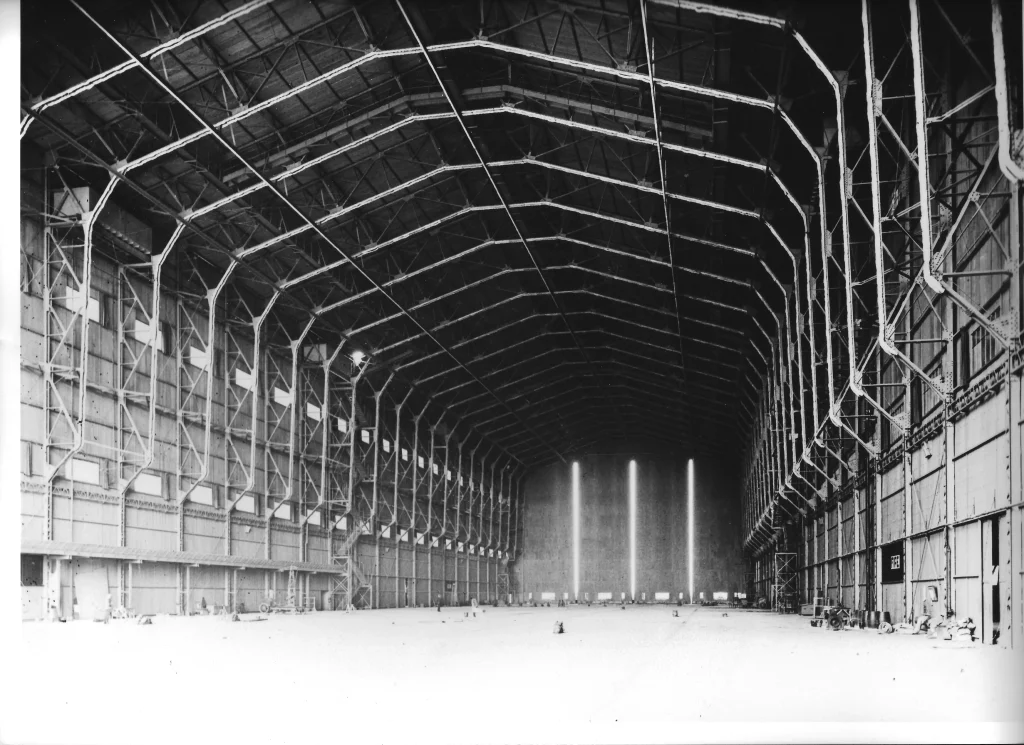
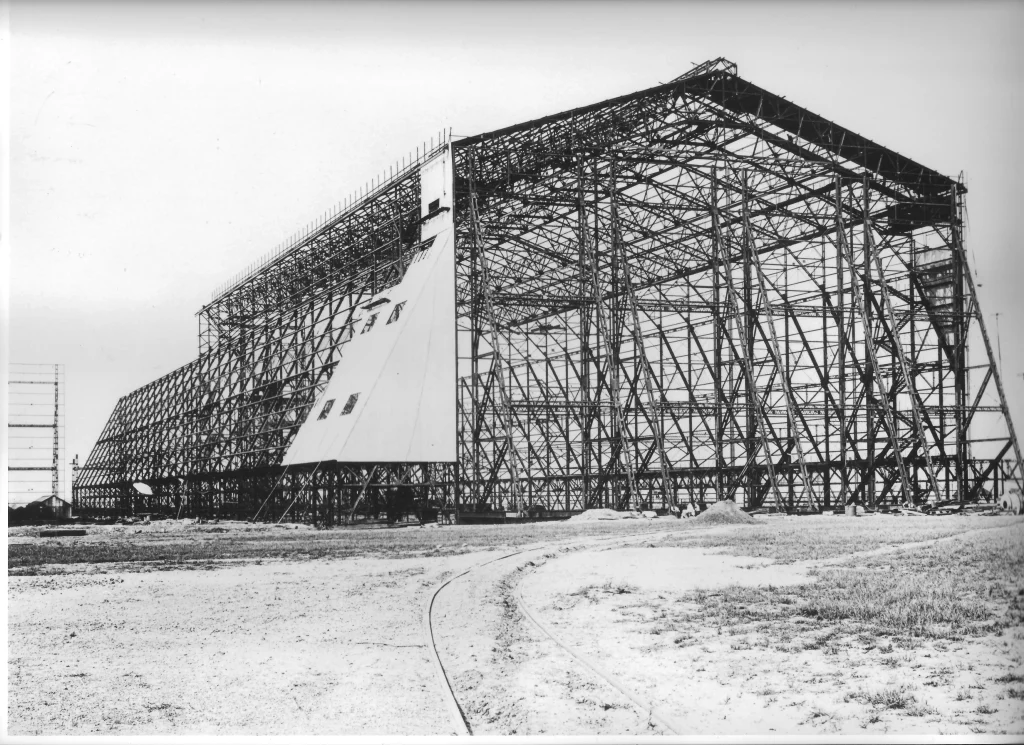
Pulham next became an experimental station and received two much larger steel-framed sheds to house the new “rigid” ships. It also functioned as a staging post for airships shuttling between the construction at Kingsnorth in Kent and the more northerly stations.

In September 1917, the No.23 and R26 arrived at the station. Pulham had only just received its earliest rigid airships, No.9 and No.23, when one of the latest German Zeppelins, the L33, was brought down relatively intact in North Essex. Colonel Maitland immediately camped out at the site, directing a team of naval architects and engineers to record every detail of her construction. From their drawings, Britain’s first really modern “rigid” airship was built at Selby bearing the number R33. The first high mast was developed in Pulham, where a mast was erected and an airship was able to dock, the crew could alight the ship, and also be refuelled and ballasted at the same time. The advantages of a high mast were that an airship could be moored both day and night, along with the fact that a craft could take up moorings in windspeeds of up to 35 knots.

The first mast was a lattice mast constructed by Vickers, with the intention that it should be erected at Barrow-in-Furness, but in May 1918, the decision was made to erect it at Pulham. The Vickers mast was a comparatively short tower, 120ft high, and was capped by a mooring attachment which allowed the moored craft to swing through a full 360 degrees so that it would face the wind at all times. A fundamental advantage of the new system was that only a dozen or so men were needed to secure the craft, instead of the large ground handling party required earlier. This was of particular importance during a period of austerity and financial restrictions.
Vickers Prototype Mast

As the new mast was deemed a prototype, it had no lift to enable the ship’s crew or passengers to reach the top in comfort. Instead, they had to climb the many steps up the outside of the tower to reach the rotating cap at the top. Entry to the ship was gained by means of a circular platform encircling the cap, from which one clambered up through a hatch in the nose of the ship
HMA No.24, the second ship of the 23 Class, was flown from Howden to Pulham on 31st May, 1918, with the intention that she would be used for mast mooring trials, but is was not until March 1919 that the mast was set up at Pulham. No. 24 was fitted with a modified nose cone, a bow coupling which and additional ballast tanks, and her midship gondola was removed before trials could begin.

The No.24 was moored at the mast for the first time on 11th June, remaining on the mast until 30th June. The ship was taken from the mast for inspection and minor modifications, but was back on the mast from 1st September to 15th October, and again from 7th November until mid-December. In these experiments, the mooring cable was attached to the mast while the ship was on the ground, and no “yaw guys” were used to steady the ship’s nose as she approached the masthead. Two men remained on duty in the control car and one below during her sojourn on the mast, so that water ballast could be taken aboard by hose if she became light and began to ride up. Gas could be fed in if she became too heavy for a discharge of ballast to be beneficial. During the ship’s total of sixty-two days on the mast, in all weathers, the ship coped with wind speeds of 45mph without trouble.
Whilst at Pulham, No.24 tested a system involving the use of ropes to guide the ship down; this was not found to be satisfactory, though it did lead to the development of a more functional system some time later. H.M.A No.24 was deleted before the end of the year, and it was left to R.33 and R.36 to carry on the mooring trials at Pulham.
The revolving masthead was later fitted with an attachment designed at Cardington. Named the Bedford-Pulham mooring attachment, it comprised an elaborate arrangement of cables intended to facilitate the linking of an airship to the tower. One ran from a winch at the base of the tower, through an attachment at the top and then out at a downward angle to another attachment set in a large concrete square on the airfield some distance from the tower. At the end was a quick-coupling device.
Airships equipped to use this mooring arrangement carried a similar cable and coupling attachment in their bow section. To moor, the airship slowly approached the concrete square at a low altitude and in line with the cable running up to the top of the tower. The airship’s cable and coupling attachment were lowered, and a member of the ground crew, positioned adjacent to the concrete square and lower attachment, prepared to receive the cable. Great caution had to be exercised at this juncture as the airship’s passage through the air had generated considerable static electricity, which would earth itself as soon as the cable was close to the ground. To save himself from an almost fatal shock, the ground crew member had to ensure that the cable had touched the ground before he attempted to retrieve it.
When all was safe, the airship’s cable was attached to the ground cable, and the cable was gradually wound up towards the top of the tower. Eventually, the nose of the airship reached the mooring attachment on the tower and fastened securely to the tower. As the top of the tower revolved, it allowed the airship to ride into the wind, or weathercock, in airship terminology. Advantages of this system were that a craft could take up moorings in wind speeds up to 35 knots.
The new mast was used a great deal and over several months, some fifty successful moorings were made by the R.33 under the supervision of Captain Williams, which involved some 171 hours of flying. On surprising fact which emerged from these trials was that the craft could be brought up to the mast and attached in very bad weather conditions. One report stated that the R.33 was successfully moored when the wind was gusting at 80mph. The R.33’s stint on the Pulham mast proved that the design was sound and efficient, and that a great step forward had been taken in ground handling of airships. Many local residents recall the impressive sight of the R.33 siding the mast at night, with floodlights shining on her silver-coated hull; the lights on board gave the impression of an ocean liner lying in dock.
During her many days on the mast, the R.33 proved neither rain nor dry snow posed a problem, but following the destruction of R.26, it was recognised that wet snow certainly did. Captain F.M. Thomas at Pulham devised a snow-clearing gear which consisted of an endless wire atop the ship between frames 7 and 34, which dragged lengths of 2.5-inch hemp rope fore and aft along the ship’s cover, to clear the snow which had accumulated on the top of the hull.
On 3rd June, 1921, a heavy rain squall forced the tail of the ship to the ground, despite a release of ballast. It was thought to be the dynamic pressure of the raindrops rather than their actual weight that did this. Fortunately, the tail fin was submerged in a pond, and on that occasion, the airship escaped damage.
The Pulham mast was used for a number of years by many of the ships stationed there. All British rigid airships were fitted with bow mooring gear and crew/ passenger access. Later development of the mast led to a higher mast of some 200ft, which also contained a lift for easier access for crews, passengers and goods.
Her sister ship was the R34, which arrived at Pulham after the armistice of 1918. By then, Col. Maitland had been succeeded by Maj. A. D. Cunningham and Major G. H. Scott functioned as chief experimental officer.
An army of maintenance staff included large numbers of women employed on the station, many living locally, but others cycling long distances to get to their duties. They acted as messengers, cleaners, cooks, gardeners and clerks.

Of the two giant sheds, Shed 2 was dismantled and re-erected at Cardington, where it was enlarged and can still be seen in use today. The wooden shed’s timbers were reused for the Firs Stadium in Norwich.
The airship station continued to play a role in the Imperial Airship scheme with the housing and reconditioning of the R36 and also the R33, which were both to be used for experimental purposes, the results to be passed on to the new ships.
However, with the R101 disaster, the station was moved on to a care and maintenance basis only.
After the Airships
The RAF again took it over for Maintenance Unit work and also aircraft storage and salvage. The area suffered a number of strafing and bombing attacks in World War II, without serious casualties.
Dismantling of the Shed
It was not until 1948 that the last huge shed was dismantled, the landmark on the Norfolk skyline since 1917. The work was carried out by the Norwich firm of Harry Pointer (Norwich) Limited. However, the second shed can still be seen today as the Number 2 shed at Cardington. The RAF used Pulham for storage and Maintenance Unit work until closure in 1958
Now cultivated and brought back into farming, there is little evidence above ground of the intense activity of the self-contained airship station
Today
The foundations of all three sheds are intact, and the sites of the mooring mast, the silicol plant building, the steam-raising plant and the foundations of the gasholders have been located.