
Introduction
The LZ-129 Hindenburg was the largest and most technologically advanced passenger airship ever built, and for a brief period in the 1930s it represented the pinnacle of luxury air travel.
Constructed by the Luftschiffbau Zeppelin company at Friedrichshafen, the Hindenburg was the first of a new generation of enormous hydrogen-filled airships designed to provide a fast, comfortable and prestigious transatlantic service.
Entering service in 1936, the Hindenburg quickly became an international symbol of the Zeppelin age, joining the LZ-127 Graf Zeppelin in scheduled service. Her spacious passenger accommodation, dining room, promenades and remarkable long-distance capability offered a glimpse of what the future of intercontinental air travel might become. During her career, she completed 37 flights across the North and South Atlantic, carrying hundreds of passengers and demonstrating the potential of commercial airships on scheduled international routes.
During several of her flights between Germany and the Americas, she crossed British airspace, providing a spectacular reminder that the great airships were still an important part of international aviation.
Yet the promise of the Hindenburg was to be tragically short-lived. On 6 May 1937, while attempting to land at the United States Naval Air Station at Lakehurst, New Jersey, the airship caught fire and was destroyed within seconds. Thirty-five of the 97 people aboard died, together with one member of the ground crew.
The disaster was one of the most dramatic events in aviation history and effectively brought the era of large-scale hydrogen passenger airships to an end. The Hindenburg had completed only fourteen months of commercial service, but her size, sophistication, achievements and spectacular destruction have ensured that she remains one of the world’s most famous aircraft.
Concept and Design

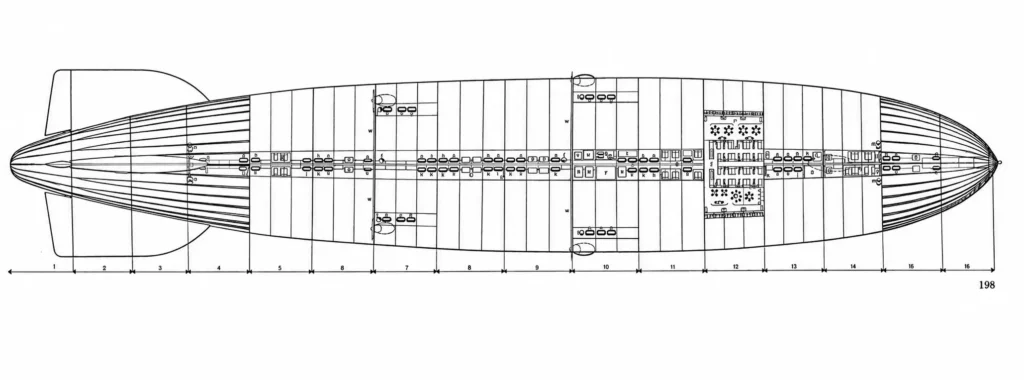
The design evolved from the experience gained with earlier Zeppelins, particularly the successful LZ-127 Graf Zeppelin. Rather than simply producing a larger version of the existing airships, the designers sought to create a new generation of aircraft in which greater size, improved aerodynamics, increased payload and passenger comfort could be combined with long-range capability


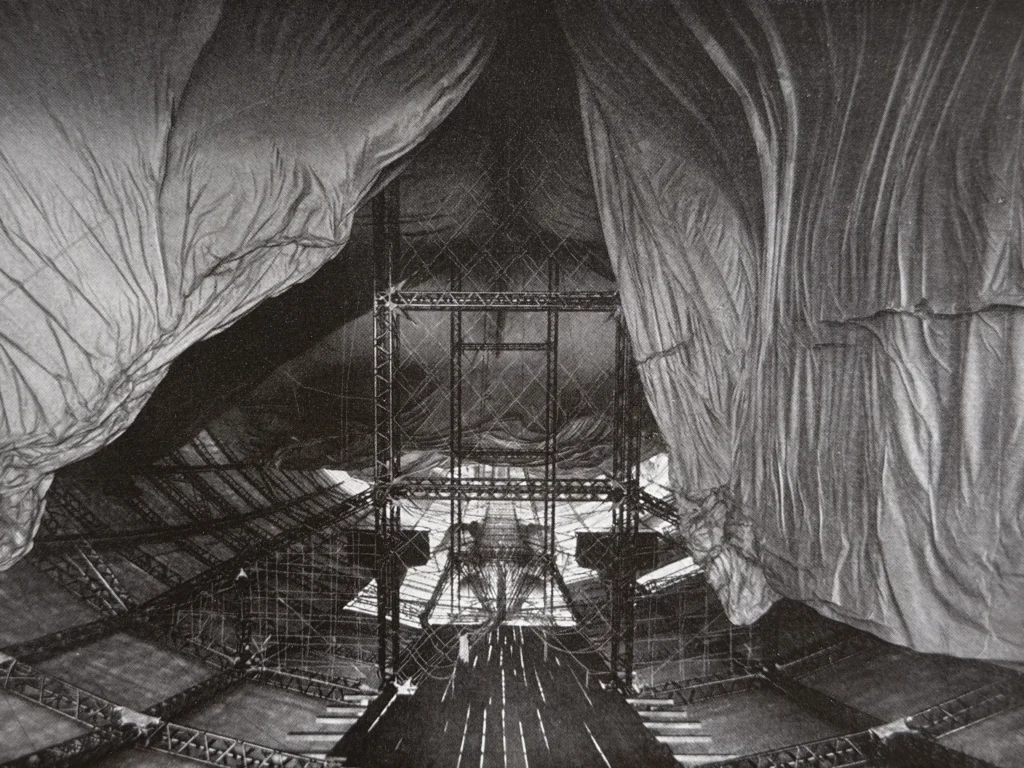
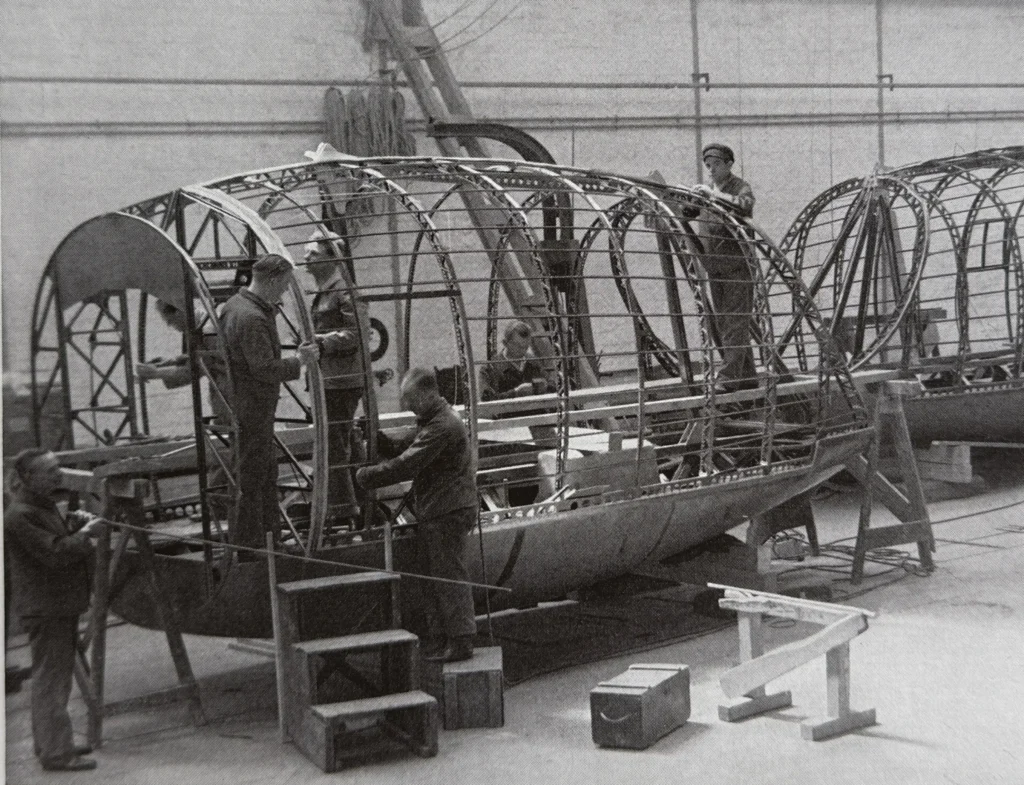
At 248 metres (814 feet) long and with a maximum diameter of approximately 41 metres (135 feet), the Hindenburg was an enormous aircraft. Her rigid structure consisted of a series of lightweight duralumin frames connected by longitudinal girders, forming a strong internal skeleton. The hydrogen gas was contained in 16 separate gas cells distributed throughout the hull, allowing the lifting gas to be carried safely within the rigid framework rather than forming part of the external shape of the airship.

The enormous volume of the hull provided the lifting capacity necessary to support not only the structure itself, but also the engines, fuel, crew, passengers, provisions and baggage. Hydrogen was chosen because of its lifting efficiency, although the decision was heavily influenced by the fact that the United States controlled the world’s principal supply of helium and had prohibited its export to Germany. The Hindenburg was therefore designed from the outset to operate with hydrogen.
Dürr and the lessons of R.101

Ludwig Dürr was by then one of the most experienced rigid-airship designers in the world. His career stretched back to the earliest Zeppelin experiments, and the Hindenburg represented the culmination of decades of experience.
The proposed predecessor, LZ-128, had been conceived as a large hydrogen-filled airship. The loss of R.101 caused the Zeppelin organisation to reconsider this approach. The crucial lesson was not simply that hydrogen could burn, but that a relatively survivable structural accident could become catastrophic when followed by a hydrogen fire. R.101’s impact itself was comparatively survivable for some occupants; it was the subsequent fire that caused most of the fatalities.
The response was radical: LZ-128 was abandoned and the project was redesigned as LZ-129, initially intended to use helium and thus needed a larger ship due to the decreased lifting capacity of helium compared to hydrogen.
The change to helium
This had major consequences for Dürr’s design.
Helium produces less lift than hydrogen, so an equivalent payload requires a larger volume of lifting gas. The new airship therefore grew substantially. Early plans envisaged an airship of 248 metres long, but the design was shortened by 36ft to fit within the existing hangar at Lakehurst, New Jersey.
Unfortunately, the intended helium supply never materialised. The United States effectively controlled the world’s commercially available helium, and export restrictions prevented Germany from obtaining the quantities required.
What Dürr changed beyond the lifting gas
The redesign also incorporated the enormous amount of experience accumulated by Zeppelin since the LZ-127 Graf Zeppelin.
The Hindenburg retained the fundamental rigid-airship architecture that Dürr knew extremely well, but it was considerably more refined. Its duralumin framework consisted of major transverse rings connected by longitudinal girders, with 16 individual gas cells contained within the structure.
The gas-cell construction was also modernised. Instead of the traditional goldbeater’s skin used in earlier Zeppelins, the Hindenburg used a new laminated material incorporating gelatinised latex. The outer cotton fabric was specially treated and waterproofed with Cellon, including reflective aluminium powder intended to reduce the effects of superheating by the sun on the gas cells.
There was also a fundamental change in passenger accommodation. Rather than relying primarily on a gondola beneath the hull, Dürr’s new design placed the passenger decks within the lower part of the hull itself, similar to those designed in the British R.100 and R.101 designs. This allowed considerably more space and produced what was effectively a luxury hotel inside the airship. The accommodation included more space than the LZ-127 Graf Zeppelin, with some 25 double cabins, a dining room, society room, bar and smoking room
Propulsion and Performance
Four Daimler-Benz DB 602 diesel engines provided the Hindenburg with propulsion. Each engine drove a four-bladed wooden propeller manufactured by Heine, and was installed in an individual streamlined engine car positioned outside the hull. Each engine car was angled at 4 degrees away from the hull to ensure the propeller wash was drawn away from the ship.
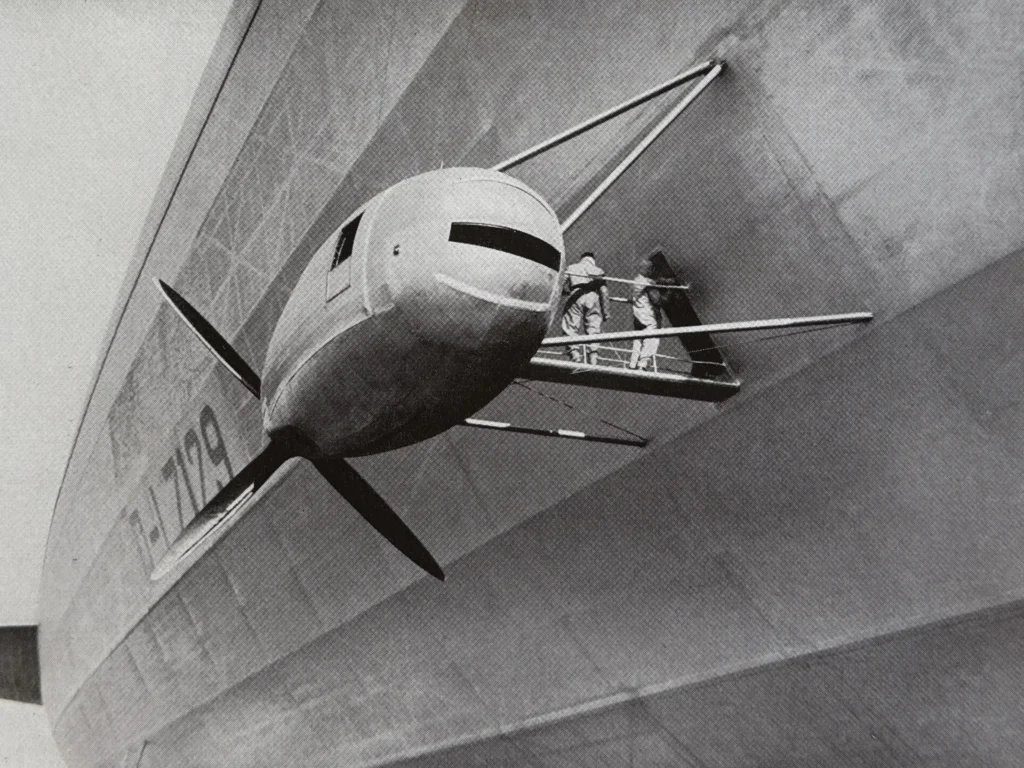
The use of diesel engines was particularly important for long-distance operation. They offered good fuel economy and could be shut down and restarted when required, allowing the crew to manage fuel consumption during lengthy flights.
The Hindenburg was capable of cruising at around 125 km/h (78 mph), giving her a significant advantage over contemporary ocean liners. A transatlantic crossing could be completed in around two and a half days, depending upon weather and routing — an extraordinary improvement over sea travel at the time, which took between five and seven days.
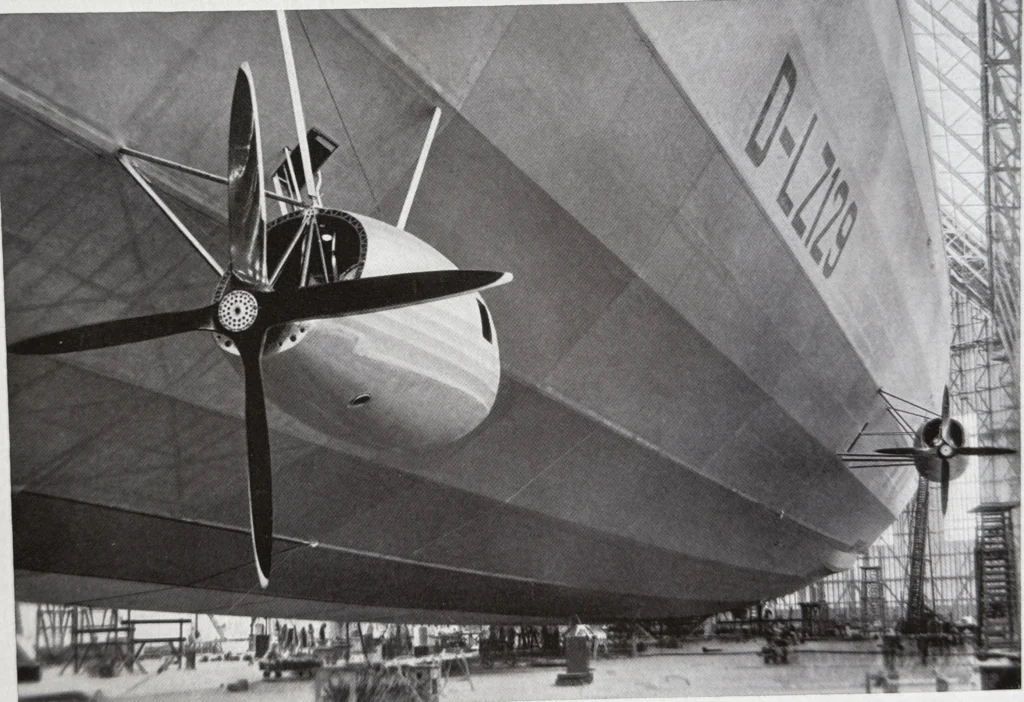
The rigid airship concept also offered an important advantage: the aircraft’s weight was largely independent of its volume. By increasing the size of the hull, designers could increase lifting capacity faster than they increased the structural weight, allowing progressively larger airships to become more practical. With 7,062,000 cubic feet of lifting gas, this gave a huge increase in lift available.
This principle had already been demonstrated by the LZ-127 Graf Zeppelin, but the LZ-129 Hindenburg took it to an entirely new scale.
Passenger Accommodation – A Hotel Inside the Airship
Passenger Accommodation Layout

One of the most remarkable features of LZ 129 Hindenburg was the decision to place the passenger accommodation inside the hull of the airship itself. This represented a significant departure from earlier passenger Zeppelins such as LZ 127 Graf Zeppelin, where the principal passenger spaces were contained in the gondola beneath the hull, and followed on from the British designs of the R.100 and R.101.
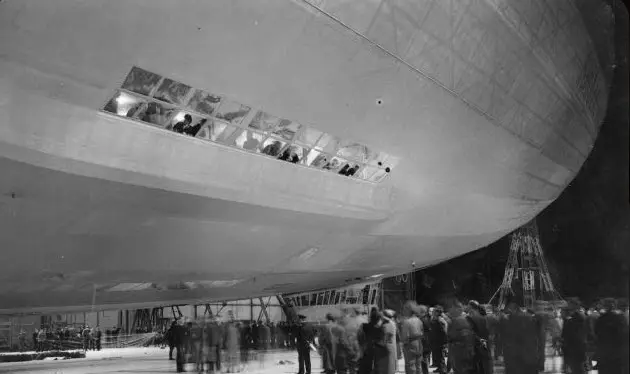
Unlike earlier Zeppelins, where passenger spaces were concentrated within a relatively small gondola beneath the hull, the Hindenburg featured a large passenger deck built into the lower forward portion of the hull. The accommodation included cabins, dining and writing rooms, promenades and other facilities intended to make long-distance travel as comfortable as possible.
The arrangement had both practical and aerodynamic advantages. By incorporating the passenger decks into the hull, the external gondola could be made considerably smaller, reducing drag and leaving the airship’s smooth outer envelope largely uninterrupted. The concept also provided the designers with a much greater volume in which to create passenger accommodation.
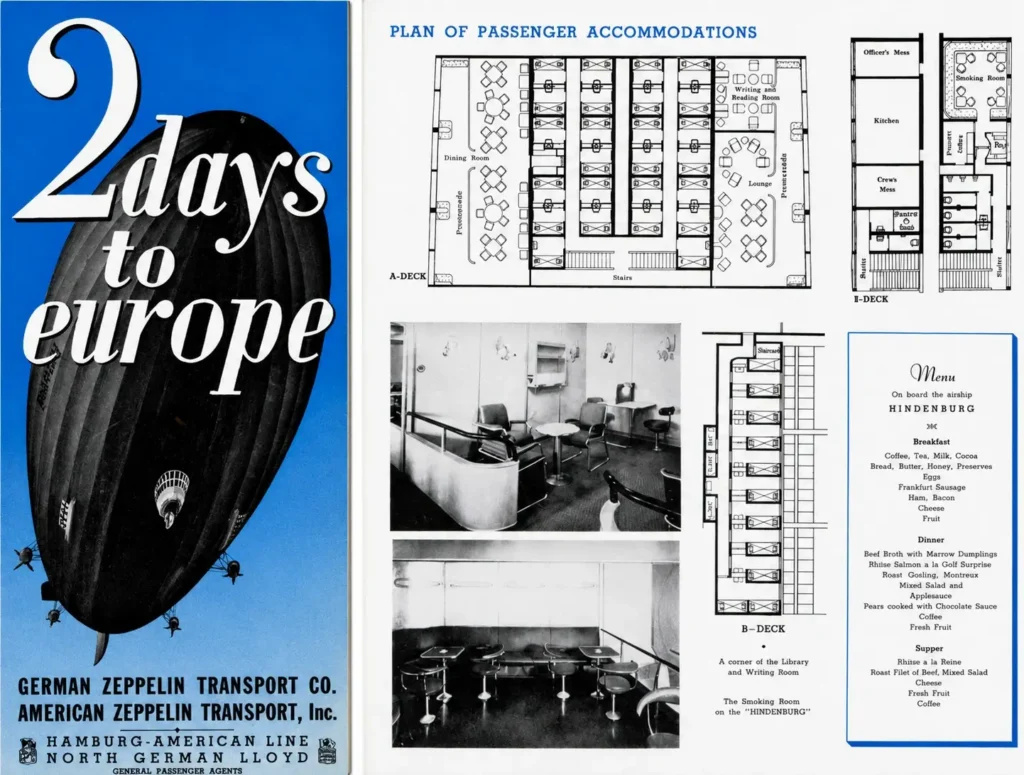
The passenger area occupied approximately 400 square metres and was arranged over two principal levels, known as A Deck and B Deck, situated amidships in the lower part of the hull. The interior was designed by the German architect Fritz August Breuhaus de Groot, whose experience included the design of luxury railway coaches and ocean-liner interiors. His brief was to create an environment that was modern, comfortable and elegant, but also exceptionally light in weight.
The result was a combination of engineering and interior design: a lightweight structure carrying what was, in effect, a small luxury hotel inside a rigid airship.
A Deck – The Principal Passenger Deck
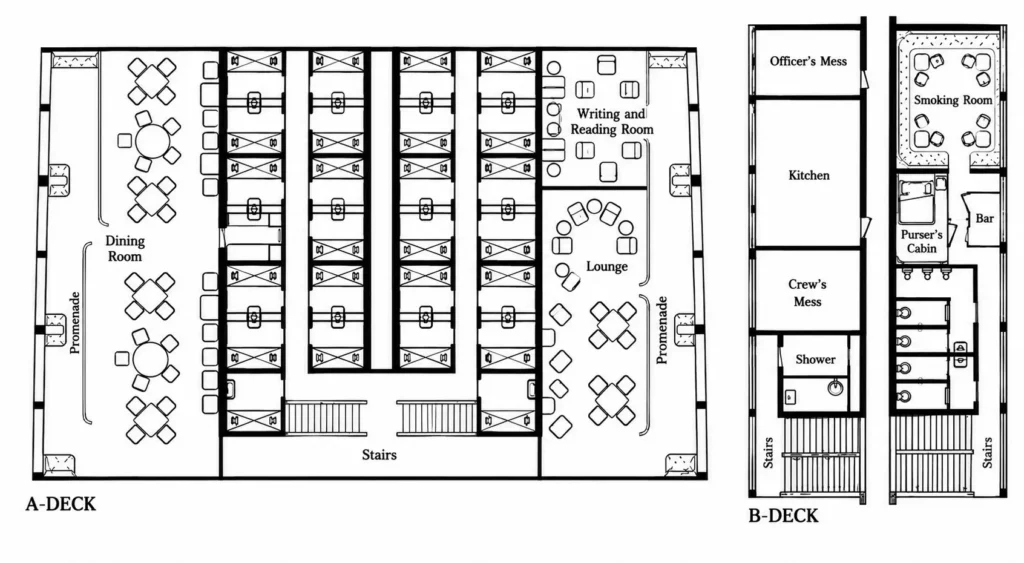
A Deck was the main passenger level and contained the majority of the accommodation and public rooms.
At the centre of the deck were 25 passenger cabins, each designed for two people, providing 50 sleeping berths in the original 1936 configuration. The cabins were arranged in four rows amidships, with the public rooms surrounding them.
The cabins were small by today’s modern standards, measuring approximately 78 by 66 inches (198 × 168 cm). They were comparable in size and character to railway sleeping compartments rather than hotel bedrooms. This was a deliberate consequence of the weight restrictions imposed upon an aircraft that had to carry everything aloft. Also, as experienced with the Graf Zeppelin and the R.100’s flight to Canada, passengers spent most of their time outside the cabins and in the ship’s public areas.
Each cabin contained two berths arranged one above the other. The lower berth was fixed, while the upper berth could be folded upwards against the wall during the day, transforming the small sleeping compartment into a more usable daytime space.
A small folding washbasin was provided with hot and cold running water, together with a small folding table or writing surface, a call button for the steward or stewardess and a compact wardrobe hanging space behind a cloth curtain. The cabins were finished in several colour schemes, including light blue, grey and beige.


The absence of windows in the original A Deck sleeping cabins was one of the few disadvantages compared with the Graf Zeppelin. Passengers could not lie in their berths and watch the world passing below. Instead, the spectacular views were enjoyed from the promenades and public rooms, which had larger windows than the earlier Graf Zeppelin.
The Promenades
Running along both sides of A Deck were the port and starboard promenades.

These were among the most memorable spaces aboard Hindenburg. The windows were large and sloped out at a 45-degree angle. They ran along the sides of the lounge and dining rooms, providing passengers with an extraordinary view of the landscape and sea below.
The windows could be opened during flight, allowing passengers to stand beside the openings and look directly out over the countryside, ocean or cities below. The airship normally flew at a comparatively low altitude, making the experience remarkably different from travelling in an aircraft.
The promenades were therefore not simply passageways. They were social spaces in which passengers could sit, talk, read or simply watch the world passing beneath the airship.
The Dining Room
The large dining room occupied the port side of A Deck and extended for almost the entire length of the principal passenger area.
It was designed to accommodate all 50 passengers from the original configuration at the same time. Six square tables, each surrounded by four lightweight tubular-metal chairs, were arranged within the room, with additional tables along the wall. The tables could be joined together when required for larger parties by the addition of three specially designed inserts.
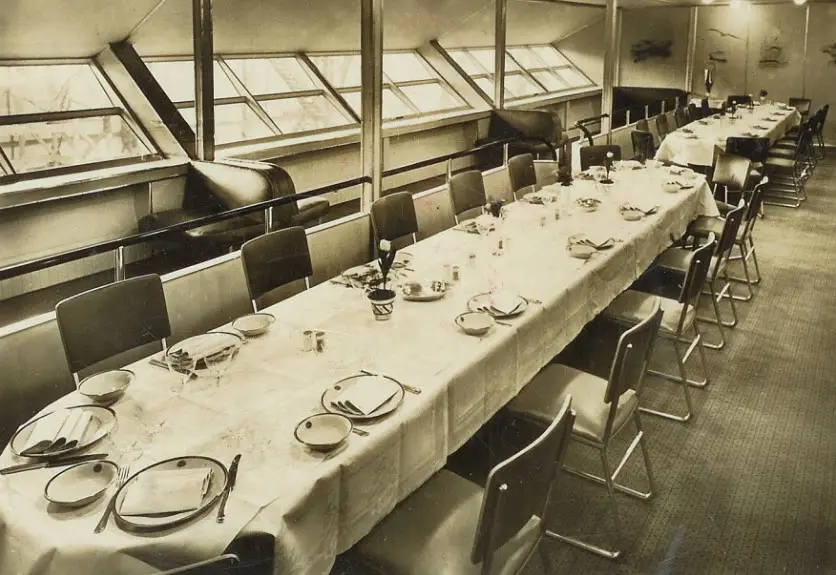
Despite the restrictions imposed by weight, the dining room was intended to convey the atmosphere of a first-class ocean liner. Tables were laid with linen, fine tableware and glassware, while the walls were decorated with artwork by Professor Otto Arpke depicting scenes from the Graf Zeppelin’s South American voyages.
The room also benefited from the large promenade windows alongside it, giving diners an extraordinary view during flight.

Meals were prepared in the galley on B Deck and brought to the dining room using a service lift. Several chefs and a pastry chef were employed to provide the elaborate menus expected by passengers travelling on an international luxury service.
Lounge and Writing Room
Opposite the dining room, on the starboard side of A Deck, were the lounge and writing room.

The lounge was intended as the principal social gathering space. Comfortable seating was arranged beside the promenade windows, while the walls featured decorative artwork and a stylised world map.
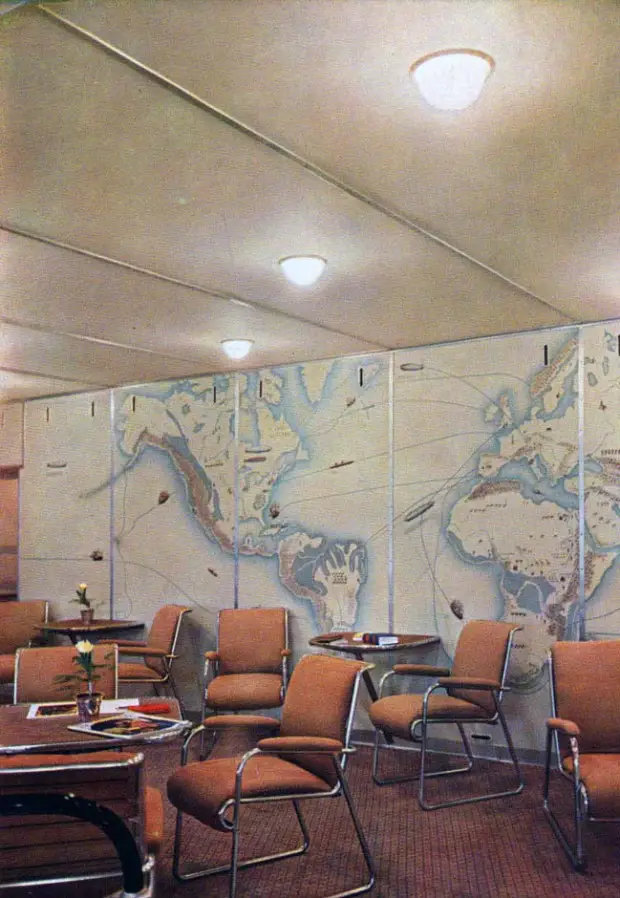
During the 1936 season, the lounge also contained a specially constructed lightweight aluminium grand piano.
The piano had been produced by Blüthner and was constructed with an aluminium frame to minimise its weight, and covered with pigskin leather. It became an important feature of the passenger experience during 1936, although it was removed during the winter refit to save weight and was therefore not aboard during the final 1937 flight.
The adjacent writing room provided a quieter environment where passengers could write letters, read or attend to business while crossing the Atlantic.

B Deck – Services, Crew and the Smoking Room
Immediately below A Deck was B Deck.
Alongside passenger facilities, it contained the kitchen, crew and officers’ messes, passenger toilets, a unique item for an airship, namely a shower.
It was also home to the bar and the smoking room.
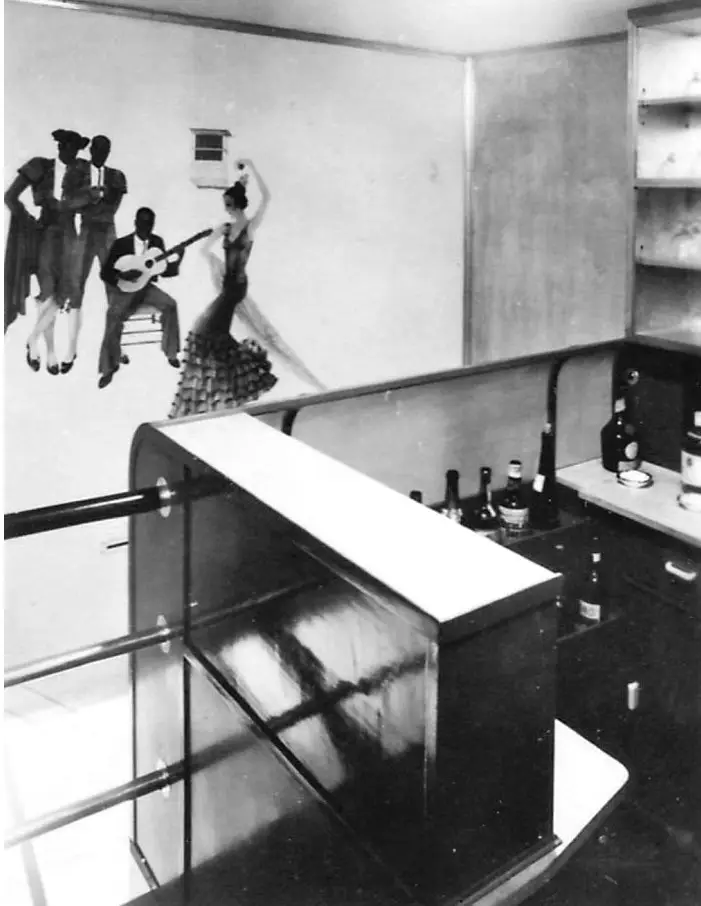
Entrance to the smoking room was through a small airlock which was controlled by the bar steward. The room was maintained at a slightly higher pressure than the surrounding areas so that any leaking hydrogen would be prevented from entering. Access was through the bar and an airlock arrangement, and passengers were not permitted to carry matches or other sources of naked flame into the ship as lighters and matches had to be surrendered on embarkation of the ship, to be returned after landing.

The inclusion of a smoking room aboard a hydrogen-filled airship might seem astonishing, but the designers took considerable precautions. Smoking was considered an important part of the passenger experience, and the company believed it could safely be accommodated even aboard a hydrogen airship. The R.101 had pioneered the use of a smoking room in the bottom of the ship, whereby it would be furthest from the gas, and used non-flammable materials in it’s construction and decoration.
Instead, a specially installed electric cigarette lighter was provided.
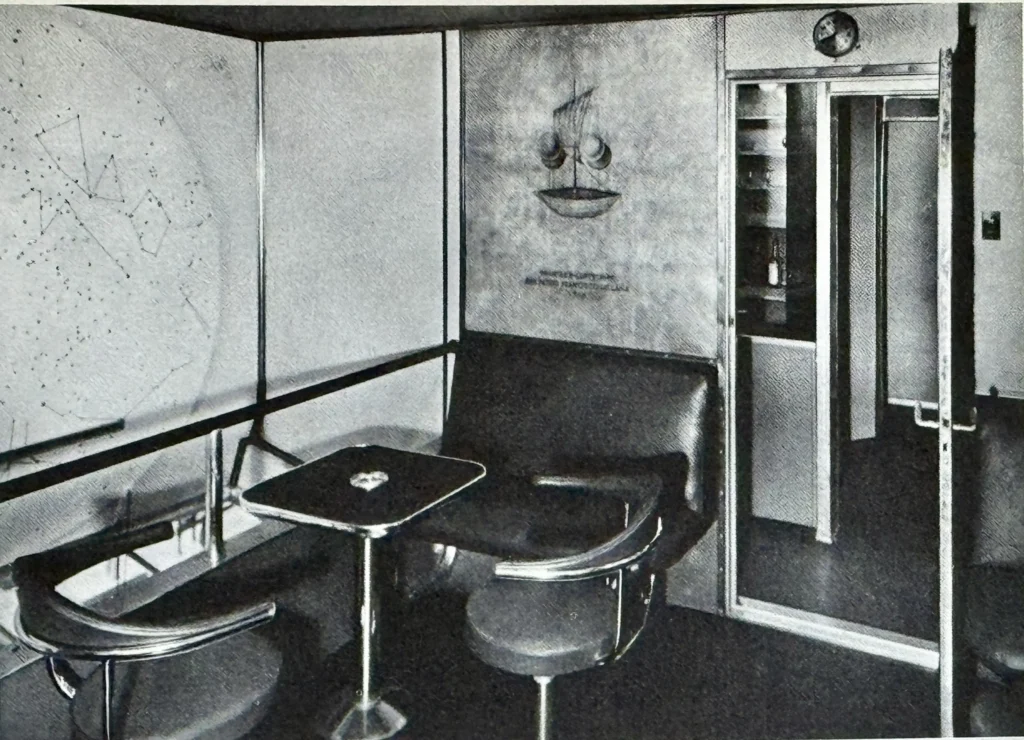
The smoking room was furnished with black leather seating around the edge, along with small tables. The choice of leather was important as it’s difficult to burn. The seating was a fixed arrangement to the floor. For smokers, a small ashtray was contained in the centre of each table with a push-down lid, and so the ash could be collected and sealed. The room was decorated with artwork illustrating the history of lighter-than-air flight. It also had windows through which passengers could look down towards the ground or sea.
The presence of the smoking room illustrates the confidence with which the Zeppelin company regarded its safety arrangements.
Heating and Ventilation
The passenger accommodation was considerably more sophisticated than that of the earlier Graf Zeppelin.
The cabins and public rooms were heated, an important improvement for long-distance flights. Warm air was generated using heat recovered from the engine cooling systems and distributed through the passenger areas.
Ready for Flight
By late 1935 the project was approaching completion.
The outer covering was fitted, the gas cells installed and the engines and control systems completed. The passenger accommodation was furnished and the countless details necessary for a commercial aircraft were progressively installed.
The aircraft was registered D-LZ 129.
Although the Zeppelin company had already decided that the ship would be named Hindenburg, the name was not painted on the hull before the first flight. Instead, the aircraft initially carried its registration and the Olympic rings associated with the 1936 Berlin Olympic Games.
The decision to name the aircraft after Paul von Hindenburg, the recently deceased former German President, had been made by Hugo Eckener more than a year before the aircraft flew.
The First Flight – 4 March 1936
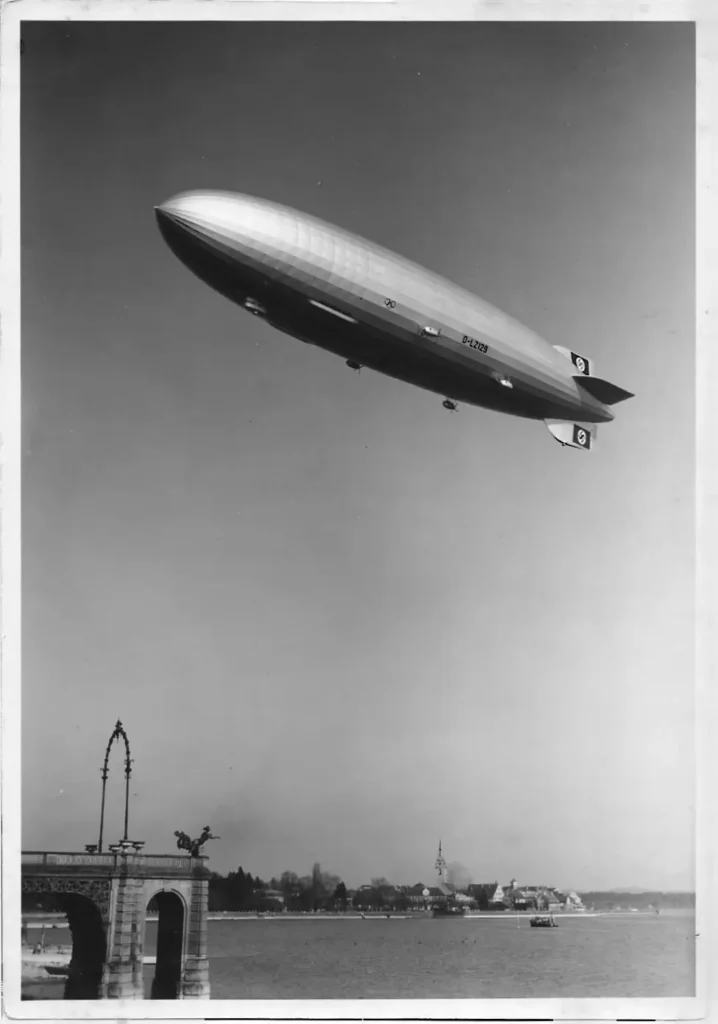
On the afternoon of 4 March 1936, the completed LZ-129 emerged from the construction hangar at Friedrichshafen.
The aircraft was carefully manoeuvred into the open air by its ground crew. After several years of construction, the moment had arrived when Dürr’s design would finally be tested in flight. The weather had originally caused the planned morning departure to be delayed. Hugo Eckener, who was to command the flight, was unwilling to risk the first flight in unsuitable conditions.
At 15:08 pm, LZ-129 was eased away from its hangar. A few minutes later, at 15:19 the airship lifted from the ground and began its first flight over Lake Constance and the surrounding countryside. Among those aboard was designer Ludwig Dürr himself.
For the chief designer, this was an extraordinary opportunity to experience his creation in the environment for which it had been designed. He was able to observe the behaviour of the structure and assess how the airship responded to the controls, manoeuvres and changes in speed.
The command was given by Dr Hugo Eckener, one of the most experienced Zeppelin commanders alive. Other senior Zeppelin captains and engineers were also aboard, together with members of the construction and dockyard staff.
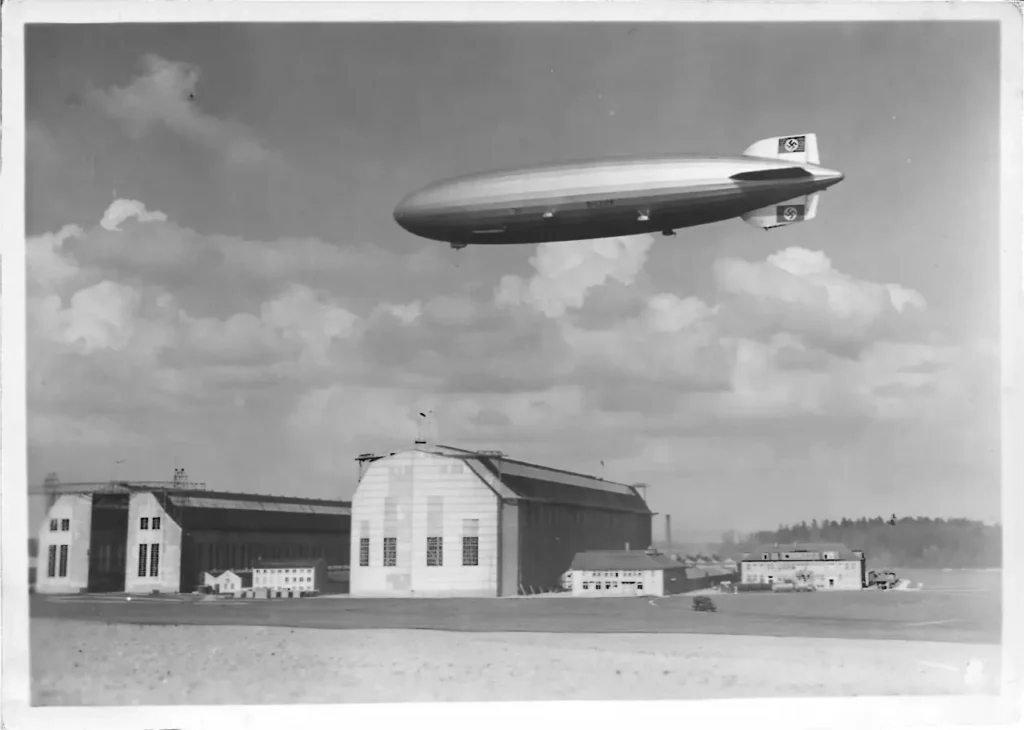
There were 85 people on board, comprising 55 crew members and 30 additional people aboard the test flight.
The first flight lasted approximately three hours and six minutes, flying over the city of Friedrichshafen and the Zeppelin works, followed by a cruise over the Bodensee, covering around 180 kilometres.
During the flight, the crew tested the airship’s steering, manoeuvrability, speed and other systems. The behaviour of the enormous structure was carefully observed and recorded. There was no dramatic unveiling or triumphant public spectacle. For the engineers, this was first and foremost a test flight.
And that was exactly what Ludwig Dürr and Hugo Eckener needed.

After four years of construction, they finally had the opportunity to discover whether their enormous new airship behaved in the air as it had on the drawing board.
The name Hindenburg lettered in 1.8-metre (5 ft 11 in) high red Fraktur script, designed by Berlin advertiser Georg Wagner, was added to its hull three weeks later before the Deutschlandfahrt on March 26. No formal naming ceremony for the airship was ever held
The Hindenburg undertook a number of test flights before it was granted operational status for passenger carrying:
| Flight Number | Date | Route | Duration | Notes |
| 1 | 4th March 1936 | Friedrichshafen–Friedrichshafen | 3 h 06 min | Maiden Flight |
| 2 | 5th March 1936 | Friedrichshafen–Friedrichshafen | 8 hours | |
| 3 | 6th March 1936 | Friedrichshafen–Friedrichshafen | 3 h 14 min | |
| 4 | 17–18 March 1936 | Friedrichshafen–Friedrichshafen | 22 h 45 min | Extended test flight |
| 5 | 18th March 1936 | Friedrichshafen–Friedrichshafen | 7 h 49 min | |
| 6 | 23rd March 1936 | Friedrichshafen–Löwental | 6 h 23 min | First mail flight |
| 7 | 26th March 1936 | Löwental–Löwental | 3 h 16 in |
Operational History
Following the completion of the Deutschlandfahrt on 29 March 1936, LZ-129 Hindenburg entered the most active period of her career. What had begun only weeks earlier as a new experimental airship was now about to become a commercial passenger aircraft operating regular long-distance services across the Atlantic.
The remainder of 1936 saw the Hindenburg undertake a programme of international flying. Between May and December she completed ten round trips between Germany and North America and seven round trips between Germany and South America. In total, the airship made 17 Atlantic round trips during her first and only complete year of commercial operation.
Relocation From Friedrichshafen to Frankfurt

After returning from the Deutschlandfahrt on 29 March, the Hindenburg prepared for her first commercial South American service.
Her first transatlantic passenger flight departed from Löwenthal, near Friedrichshafen, on 31 March, bound for Rio de Janeiro. From this point onwards, Frankfurt became the principal European base for the airship’s commercial operations.
The move was significant: the newly developing Rhein-Main airport offered better facilities being more central in Germany and with better rail connections. One other advantage was that being at a lower elevation than Friedrichshafen by nearly 112 meters could also give the airship a useful increase in lifting capacity at take-off, especially on a colder morning.
The first South American flight took just over four days to reach Rio de Janeiro. Although the journey was not entirely trouble-free — one of the engines suffered a failure during the crossing — the aircraft completed the journey successfully. The return flight arrived back in Germany on 10 April.
After returning from Brazil, Hindenburg underwent further maintenance and preparation before beginning her North American programme.
The First North Atlantic Service

On the evening of 6 May 1936, Hindenburg departed Frankfurt on her first flight to the United States.
The destination was the Naval Air Station at Lakehurst, New Jersey, which possessed one of the few facilities in the world capable of handling an airship of such enormous dimensions.
The crossing was completed in 61½ hours, with the airship arriving at Lakehurst on the morning of 9 May. She had carried 50 passengers and 56 crew, making the flight a major demonstration of the practicality of regular transatlantic passenger service.
Among those aboard were prominent journalists and aviation enthusiasts, including Grace Drummond-Hay and Clara Adams.
The success of the flight marked the beginning of a remarkable series of North Atlantic crossings.
During May, June and July the Hindenburg rapidly established a pattern of regular commercial operation.The westbound flights from Frankfurt to Lakehurst generally took between approximately 53 and 78 hours, depending upon weather and wind conditions. The return flights, travelling eastwards with the prevailing winds, were considerably faster, generally taking between 43 and 61 hours.
The airship’s speed was one of the principal attractions of the service. Ocean liners still required several days to cross the Atlantic, whereas Hindenburg could make the journey in roughly two and a half days.
The experience was expensive, exclusive and highly prestigious.
The South American Service
Alongside the North Atlantic operation, Hindenburg also established itself on the South Atlantic route between Germany and Brazil.
Rio de Janeiro was the principal destination, with the airship operating a series of regular services throughout the year. The route was particularly important because the Zeppelin company already had considerable experience operating the LZ-127 Graf Zeppelin between Germany and Brazil.
The Hindenburg therefore combined the experience of the earlier Zeppelin with a much larger passenger capacity and considerably greater speed.
During 1936, seven round trips were made between Germany and Brazil. On some later services, the airship also operated regional flights between Rio de Janeiro and Recife, extending the usefulness of the service within Brazil.
Flights Over Britain

The Hindenburg also became a spectacular sight over Britain during the 1936 season.
The normal North Atlantic route was intended to avoid Britain. The German authorities subsequently confirmed to the British Government that the normal route selected for Hindenburg’s North Atlantic flights avoided British territory, and that the Zeppelin company had been instructed that British territory could only be crossed in an emergency.
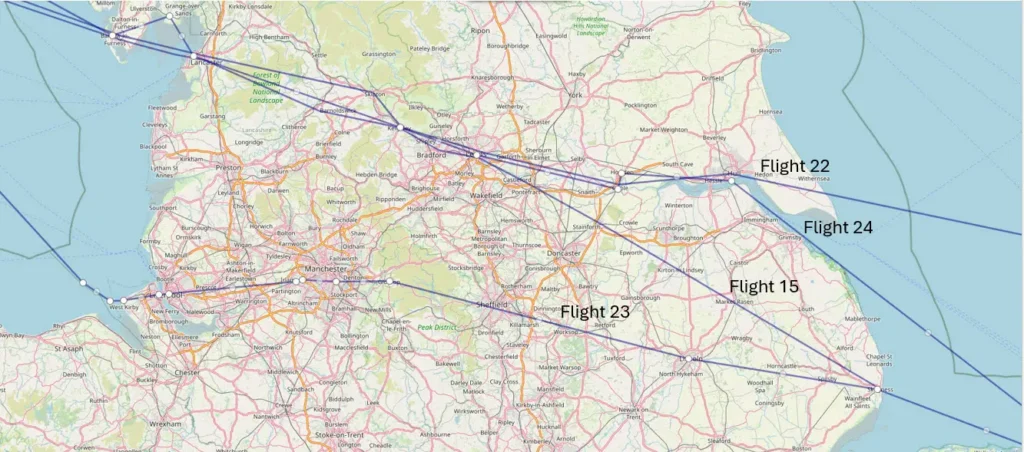
One of the most memorable incidents occurred during the return from America in May 1936, when Hindenburg flew low over the West Yorkshire town of Keighley. A small parcel was dropped from the airship and landed in the town. It contained flowers, a silver cross and a letter asking that they be placed on the grave of a German serviceman killed during the First World War. The package had been prepared by John P. Schulte, who described himself as the “first flying priest”. He asked that the flowers and crucifix be placed on the grave of his brother, Lieutenant Franz Schulte, a German serviceman who had died as a prisoner of war in the Keighley area during the First World War.
The British overflights also provide a reminder that Hindenburg was operating within the international aviation network of the period rather than simply flying between Germany and America on a direct route.
| Flight Number | Date | Direction | British area overflown | |
| 15 | 21–23 May 1936 | Lakehurst → Frankfurt | Northern England – Yorkshire / Cumbria | Northern Ireland, Isle of Man, Barrow in Furness, Morecombe, Lancaster, Keighley, Bradford, Leeds (19:13), Thorne, Skegness 20:21), Cromer (21:05) |
| 22 | 19-22nd June 1936 | Frankfurt → Lakehurst | Northern England | North Sea, Hartlepool, Tynemouth, Carlise, Northern tip of Ireland |
| 23 | 24–26 June 1936 | Lakehurst → Frankfurt | Northern England | Isle of Man, Seacombe, Birkenhead, Liverpool, Flixton, Levenshulme, Glossop, Lincoln, Skegness, Cromer. |
| 24 | 30 June–2 July 1936 | Frankfurt → Lakehurst | East Yorkshire → Yorkshire → Lancashire/Cumbria | The best documented British overflight. Because of weather, Hindenburg followed an unusually northerly route, crossing the east coast and then Hull, Howden, Goole, Leeds, Keighley, Skipton, Morecambe, Barrow-in-Furness, before continuing via the Isle of Man and Northern Ireland towards the Atlantic. The flight was specifically raised in the House of Commons. |
The Olympic Games and Political Flights
The commercial programme was interrupted by several special flights.
On 1 August 1936, Hindenburg participated in the opening of the Berlin Olympic Games, flying over Berlin as part of the spectacular ceremonies surrounding the event.
Earlier in the year, she had already been used for political purposes during the Deutschlandfahrt, and later she made another notable flight associated with the Nuremberg Party Rally in September.
These flights demonstrated the extent to which the Zeppelin had become both a technological symbol and a powerful instrument of publicity.
The Summer Peak
By the middle of the year the Hindenburg was operating with remarkable regularity.
The July and August North Atlantic services demonstrated the potential of the new aircraft particularly well. On one eastbound crossing in August, Hindenburg departed Lakehurst at 02:34 on 10 August and reached Frankfurt only 43 hours and 2 minutes later — her fastest North Atlantic crossing of the year.
The Autumn Programme
The North Atlantic service continued through September and October.
During September, Hindenburg made further crossings between Frankfurt and Lakehurst, while on 9 October she undertook one of the most unusual flights of the year.
Known as the Millionaires’ Flight, this was a special ten-hour cruise from Lakehurst carrying a group of wealthy and influential guests. The flight was intended partly to promote the Zeppelin service and demonstrate the possibilities of luxury air travel to an influential American audience.
The final North American return flight of 1936 left Lakehurst on 10 October and arrived back at Frankfurt on 12 October.
With the completion of this flight, the Hindenburg had finished her North American programme for the year.
The Final South American Flights
Although the North American season had ended, Hindenburg continued operating to South America.
Between late October and December she completed several more journeys between Germany, Rio de Janeiro and Recife.
The final South American sequence of the year was particularly demanding. The airship made a round trip between Frankfurt and Rio de Janeiro in November, followed by another service late in the month. She then operated a short regional flight in Brazil before travelling from Rio de Janeiro to Recife and finally beginning the long return journey to Germany.
On 7 December 1936, Hindenburg arrived back at Frankfurt, completing the final commercial flight of her first season.
The Winter 1936–37 Refit
The success of the Hindenburg during its first year of commercial service quickly demonstrated that passenger demand was greater than anticipated.
The accommodation was also ventilated and supplied with conditioned air, helping to maintain a comfortable environment during flights that could last several days.
The original accommodation had provided 50 sleeping berths in 25 cabins, but the airship frequently carried passengers in excess of its normal sleeping capacity. The decision was therefore taken to make use of some of the considerable lifting capacity that was available because the ship was operating with hydrogen rather than the helium for which it had originally been designed.
During the winter of 1936–37, while Hindenburg was laid up in Frankfurt, the passenger accommodation was substantially modified.
Additional cabins were installed on B Deck, aft of the original passenger accommodation, in the area around Bay 11. These cabins were particularly interesting because they were somewhat larger than the original A Deck cabins and, most importantly, had windows.
This meant that passengers in the new cabins could enjoy a view from their own sleeping accommodation — something that passengers in the original A Deck cabins could not do.
The additional accommodation ultimately provided 72 sleeping berths for the 1937 season, compared with 50 during the original 1936 configuration.
One of the new cabins was designed to accommodate a family, with four berths, while the remaining additional cabins provided two berths each. The new arrangement was therefore not simply an expansion of the original accommodation, but also an attempt to make better use of the available space and lifting capacity.
The fact that these cabins had windows was particularly significant. Passengers could now remain in their berths while looking down through the windows at the landscape or ocean below — recreating one of the attractions that had been available to passengers aboard Graf Zeppelin.
The winter refit was not limited to adding passenger accommodation.
Changes Beyond the Cabins
The Blüthner aluminium piano was removed, reducing weight before the new season. Other modifications and maintenance work were undertaken throughout the airship, including work to the gas cells and improvements prompted by experience gained during the first year of commercial operation.
The increased passenger accommodation was part of a broader evolution in the Hindenburg’s design. The airship was no longer an experimental demonstration of long-distance Zeppelin travel; by the beginning of 1937 it was becoming a commercial passenger aircraft whose operators were responding to actual customer demand.
The tragedy of 6 May 1937 therefore came at a particularly significant moment in the development of the Hindenburg. The aircraft had completed its first full season, its passenger accommodation had been expanded, and plans were being developed for an even more extensive international Zeppelin service.
1937 Season
Following the remarkable success of her first year of commercial operation, LZ-129 Hindenburg entered 1937 with expectations considerably greater than those of the previous season.
During the winter of 1936–37 the airship had undergone maintenance and modification at Frankfurt. Additional passenger cabins had been installed, taking advantage of the greater lifting capacity available when operating with hydrogen, and other alterations were made in preparation for a much more ambitious programme. The Hindenburg was now firmly established as a commercial passenger airliner, and the Deutsche Zeppelin-Reederei had scheduled an extensive programme of transatlantic services for the new season.
The 1937 season began with a series of test flights from Frankfurt on 11 March. The first lasted approximately six hours and seventeen minutes, followed by a shorter one-hour fourteen-minute flight. These flights were principally concerned with testing the airship and its equipment following the winter overhaul.
| Flight Number | Date | Route | Duration | Notes |
| 57 | 11th March 1937 | Frankfurt–Frankfurt | 6h 17m | Test Flight |
| 58 | 11th March 1937 | Frankfurt–Frankfurt | 1h 14m | Test Flight |
| 59 | 16th-20th March 1937 | Frankfurt–Rio de Janeiro | 88h 48m | First scheduled South America Flight |
| 60 | 23–26 March 1937 | Rio de Janeiro–Frankfurt | 97 h 08 min | Return flight |
| 61 | 27th April 1937 | Frankfurt–Frankfurt | 6 h 59 min | Udet/Rhineland flight |
| 62 | 27rd April 1937 | Frankfurt–Frankfurt | 2 h 23 min | Aircraft hook-on experiment |
| 63 | 3rd-6th May 1937 | Frankfurt–Lakehurst | 77 h 08 min | Final Flight |
1937 First South American Flight
On 16 March 1937, Hindenburg departed Frankfurt for Rio de Janeiro on the first scheduled commercial flight of her new season.
The flight to Brazil took approximately 88 hours 48 minutes, with the airship arriving at Rio de Janeiro on 20 March. After several days in South America, she began the return journey on 23 March, reaching Frankfurt on 26 March after a flight of approximately 97 hours 8 minutes.
This was a significant flight for the Zeppelin company. It demonstrated that the Hindenburg remained capable of maintaining the regular long-distance service that had made her such a success during 1936.
It was also, tragically, to be her only completed international passenger round trip of the 1937 season.
Preparations for the 1937 North American Season
The next few weeks were spent preparing the airship for what was expected to be a very busy year.
The Zeppelin company had planned eighteen round trips between Germany and the United States during 1937, compared with the ten North American round trips completed during 1936. The intention was to make the Hindenburg a regular component of the developing transatlantic transport network. Her sister ship, LZ 130 Graf Zeppelin II, was also nearing completion at Friedrichshafen and was expected to join the service.
The confidence of the operators is perhaps best illustrated by the fact that a published schedule for the 1937 North American services was already being circulated in April, with mail bookings being accepted for the forthcoming flights.
The Hindenburg was not being treated as an experimental aircraft. She was being operated as an established commercial airliner, with a full season of scheduled services planned ahead.
27 April Flights – Ernst Udet and the Aircraft Hook-On Experiment
On 27 April, Hindenburg made two flights from Frankfurt which were rather different from her normal commercial operations.
The first lasted approximately 6 hours 59 minutes and is generally described as the Udet or Rhineland flight. The second lasted approximately 2 hours 23 minutes and involved experiments with an aircraft hook-on system.
The experiments were intended to investigate whether a small aircraft could be launched from and recovered by a large airship. This had been pioneered by the British with the early experiments with the R29; then R.33 became successful at launching an aeroplane from below the hull of the airship.
A trapeze arrangement had been installed beneath the Hindenburg, based upon the principles previously investigated with the United States Navy’s large airships USS Akron and USS Macon, which had taken the experiments further and successfully launched and recovered the aircraft. A small aircraft could, in theory, approach the airship from below and attach itself to the trapeze. This would potentially allow the aircraft to be carried over long distances and launched close to its destination.
There were also practical commercial possibilities. A small aircraft could potentially carry customs officials out to an arriving Zeppelin before it landed, allowing passengers to be processed while the airship was still approaching Lakehurst. Mail could also potentially be transferred to a fast aircraft and delivered ahead of the airship itself.
The experiments were conducted with Ernst Udet, one of Germany’s most famous First World War fighter pilots and, by 1937, a senior Luftwaffe officer, and also a stunt flier of great renown. A trapeze mechanism, capable of handling an aircraft up to 1,200kg was installed at ring 140. A Focke-Wulf FW “Stiefglitz” was used for the tests.
The results were not particularly encouraging. Despite managing to connect with the trapeze three or four times, the plane bounced off. The following hook-ons still experienced problems. During the tests, the propeller was damaged, and the tests were halted.

Turbulence around the trapeze made the approach and attachment difficult, and the system required considerably more development before it could have become a practical part of commercial operations. It was believed that this was caused by the location of the trapeze on the airship was one of the causes, along with the probability that the aeroplane. The loss of Hindenburg less than two weeks later brought the experiments to an immediate end.
A Season That Never Began
By the end of April, Hindenburg was therefore ready for her first North American service of the year.
The published 1937 programme anticipated eighteen Germany–United States round trips, and the Hindenburg was scheduled to make her first North American flight of the season in early May.
On 3 May 1937, she departed Frankfurt for Lakehurst.
The flight was expected to be the beginning of another routine transatlantic service.
Instead, it became the final flight of LZ 129.
Disaster at Lakehurst
On the evening of 3 May 1937, LZ 129 Hindenburg left Frankfurt on what was intended to be a routine commercial flight to the United States. It was the airship’s 63rd flight, and the first of what was planned to be a much larger North American programme for the 1937 season.
Commanded by Captain Max Pruss, Hindenburg carried 36 passengers and 61 officers, crew members and trainees, giving a total of 97 people aboard. The passenger accommodation was only about half full, while the additional crew included trainees who were gaining experience in preparation for the expanding Zeppelin service and those due to be transferred to the LZ-130 Graf Zeppelin II.
The Atlantic crossing
The flight across the Atlantic was, for the most part, uneventful. The principal difficulty was strong headwinds, which considerably reduced the airship’s progress. The crossing therefore took longer than anticipated and the scheduled arrival at Lakehurst, originally expected at around 6:00 am on 6 May, was progressively delayed.
The Hindenburg followed a more northerly route across the Atlantic, passing south of Greenland and reaching the North American coast at Newfoundland before continuing towards Boston and New York. By the morning of 6 May she was already many hours behind schedule.
By approximately noon, the airship was over Boston, and by about 3:00 pm she was passing over New York City.
Arrival at Lakehurst — but no landing
Hindenburg reached the vicinity of Naval Air Station Lakehurst at 4:15 pm.
Under normal circumstances, she would by then have been preparing to land. However, the weather at Lakehurst had deteriorated considerably.
Thunderstorms had been moving through the area throughout the afternoon, accompanied by heavy rain, gusty winds and unsettled atmospheric conditions. The weather was considered unsuitable for landing such a large airship.
Captain Pruss therefore remained in the vicinity while waiting for conditions to improve. Commander Charles Rosendahl, the commanding officer at Lakehurst, advised him to delay the landing. The airship moved away from the station and cruised along the New Jersey coast while the weather passed.
This created a particularly frustrating situation: Hindenburg had already lost roughly ten to twelve hours during the Atlantic crossing, and now she had arrived at her destination only to find that she could not land.
The weather begins to clear
By around 6:00 pm, conditions appeared to be improving.
At 6:12 pm, Rosendahl sent Hindenburg a weather report giving the latest information on wind, temperature, pressure and visibility, which he considered suitable for a landing. A subsequent message recommended that Pruss make his approach.
However, the situation was still far from ideal.
The weather had been changing rapidly throughout the afternoon, and thunderstorms remained in the general area. This is important because the later investigation found that the landing took place after the airship had been flying around the Lakehurst area for some time while the weather situation changed.
There was also an operational complication: because the Hindenburg had arrived much later than originally expected, the normal landing arrangements had been disrupted. The ground personnel had to be assembled and prepared for the arrival after the weather delay. The landing operation itself involved a very large ground party, including 92 US Navy personnel and 139 civilian personnel.
The final approach
Eventually, at approximately 7:00 pm, Hindenburg began her final approach.
The airship approached Lakehurst at several hundred feet above the ground before beginning the landing manoeuvre. At approximately 7:21 pm, the landing lines were dropped from the bow and taken by the waiting ground crew.
Four minutes later, at approximately 7:25 pm, fire was seen towards the rear of the airship.
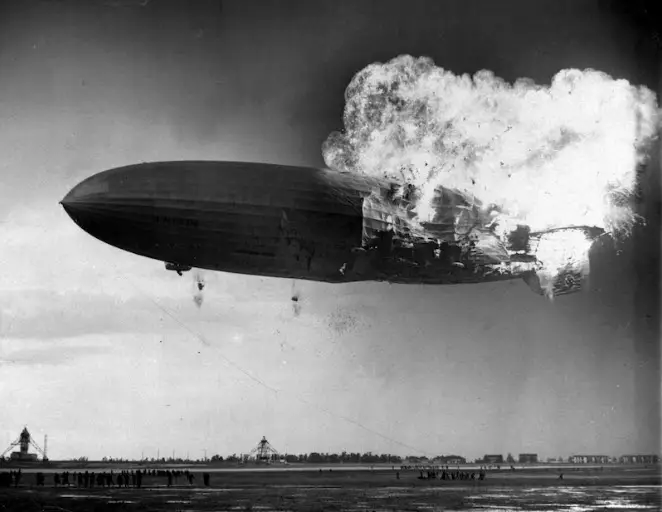
The flames spread extraordinarily rapidly through the hydrogen-filled envelope. The stern dropped while the bow rose sharply, and the entire airship descended to the ground in approximately 30–40 seconds.
The Human Cost
Of the 97 people aboard:
- 36 passengers — 13 died, 23 survived
- 61 crew — 22 died, 39 survived
- 35 people aboard the airship died
- 1 member of the Lakehurst ground crew also died
The total death toll was therefore 36.
Remarkably, 62 people aboard survived, many escaping from the burning airship as it descended. The survival rate was partly due to the manner in which the ship’s bow rose as the stern fell, bringing the forward passenger and crew areas relatively close to the ground.
Aftermath

When Hindenburg struck the ground, the wreckage was spread across the landing field at Naval Air Station Lakehurst. Much of the airship had been consumed by fire within approximately half a minute, although the diesel fuel continued to burn afterwards.
The immediate priority was, naturally, the rescue and treatment of survivors. Navy personnel, civilian ground crew and emergency services rushed into the wreckage while fires were still burning. Once the survivors had been removed, Lakehurst became a major accident investigation scene.
The site was placed under guard. Large numbers of military personnel were brought in to prevent members of the public from entering the wreckage and taking souvenirs. Soldiers, sailors and Marines were required to protect the site partly because curious visitors were repeatedly attempting to cross the cordon. The areas around the suspected point of origin of the fire. This was particularly important because the investigators needed to preserve as much of the remaining structure, fabric and equipment as possible
The wreckage was also searched for evidence of sabotage or an explosive device.
This was a particularly important consideration in 1937. Germany and the United States were politically uneasy, and almost immediately rumours circulated that Hindenburg might have been deliberately destroyed.
The German investigation explicitly considered two broad possibilities:
- a device deliberately placed inside the ship; or
- some external means of deliberately causing the fire.
The commission reported that the wreckage had been thoroughly searched for evidence of such an attack but found no conclusive evidence of sabotage.
Once the investigations had been completed, there was little reason to preserve the enormous quantity of remaining material at Lakehurst.
Much of the aluminium alloy framework was recovered because duralumin was a valuable strategic material.
The American Investigation
The United States Department of Commerce established an official investigation almost immediately.
The American investigation was headed by Colonel South Trimble Jr., and it involved investigators, engineers, scientists and aviation specialists.
The official American report eventually concluded:
The fire resulted from the ignition of a mixture of free hydrogen and air.
The investigators considered a leak in or around Gas Cells 4 and 5, towards the rear of the airship, the most probable source of the hydrogen.
The American commission then examined numerous possible ignition mechanisms.
Its preferred explanation was an electrostatic discharge — specifically what it called a “brush discharge” — which ignited the hydrogen-air mixture.
The report was nevertheless careful not to claim that this had been proved beyond doubt.
Its conclusion was essentially: Hydrogen leak → hydrogen/air mixture → electrical discharge → ignition.
The German Investigation
Germany established its own commission under the authority of the Reich Ministry of Aviation.
The commission included several extremely experienced figures from the German airship programme, most notably:
- Dr Hugo Eckener — former head of the Zeppelin company;
- Dr Ludwig Dürr — chief designer of the Zeppelin airships;
- Joachim Breithaupt — experienced Zeppelin commander;
- Professor Günther Bock;
- Professor Max Dieckmann;
- Walter Hoffmann.
The German commission travelled to Lakehurst and worked alongside the American investigators. The German investigators had direct access to the wreckage, witnesses and American evidence.
After returning to Germany, they conducted further experiments at several institutions, including the German Institution for Aviation Research at Berlin-Adlershof and facilities concerned with electrical phenomena and airship construction
The Germans also examined the possibility of sabotage very seriously.
Their report considered whether:
- an explosive device could have been placed inside the ship;
- an incendiary device could have been concealed;
- or some external agent could have caused the fire.
They found no conclusive evidence of deliberate destruction.
The German commission’s preferred explanation was remarkably similar to that of the Americans.
They believed that a hydrogen leak had probably occurred in the vicinity of Gas Cell 4 or 5 in the rear of the ship.
The commission proposed that hydrogen could have escaped into the space between the gas cell and the outer cover.
The Surviving Mail
One fascinating aspect of the aftermath was the recovery of Hindenburg’s mail.
The airship was carrying more than 17,000 pieces of mail when she crashed.
Although most was destroyed by fire or water, a small quantity survived. The United States Postal Service carefully separated, dried and processed the recovered correspondence before returning it to its intended recipients. The National Postal Museum records surviving mail and the detailed postal work undertaken after the disaster.
At least 360 pieces of mail survived the disaster.
These pieces are now highly prized by collectors and are among the most tangible surviving artefacts directly connected with the final flight.