
Introduction
With more requirements put on the Airship Service to provide more aerial cover for shipping, the final designs of the non-rigid culminated with the most efficient ships, the North Sea Class.
Designed as a long-duration patrol airship, the North Sea class airship was the largest non-rigid airship built by Great Britain during WW1. The North Sea or N.S. class airship was originally designed to act as a substitute for the rigid airships, which, in 1916, were still a long way from being available for work of practical utility.
Requirements
From experience gained at this time with airships of the Coastal type, it was thought possible to construct a large Non-Rigid capable of carrying out flights of twenty-four hours’ duration, with a speed of 55 to 60 knots, with sufficient accommodation for a double crew.
The requirements for the specification of the new type of ship fell under four headings:
- Capability to carry out flights of considerable duration.
- Great reliability
- The necessary lift to carry an ample supply of fuel
- Adequate arrangements to accommodate the crew in comfort.
If these could be fulfilled, the authorities were satisfied that ships possessing these qualifications would be of value to the Fleet and would prove efficient substitutes until rigid airships were available. The North Sea, as may be gathered from its name, was intended to operate on the east coasts of the British Isles and main bases sited therefrom.
The Admiralty signed off the development specification, and construction was approved in January 1916. Six of the new North Sea class ships were undertaken at the RNAS Kingsnorth Airship Station on the north Kent coast, in the River Thames estuary and were the largest non-rigid airships designed in Britain up to that time.
Design and Construction

There was at first some discussion as to whether the Astra Torres or the Parseval type of envelope would be the better, but the principles behind the design of the latter were not fully understood in this country. Copies could be and had been made, but any enlargements or modifications would require a redesign of the trajectory rigging bands, which were a feature on the German airship. This was a dangerous undertaking, and so the Astra Torres pattern,w hich had been adapted without trouble for the Coastal ships, was again chosen
The form used for the new design was not only larger than before, but more streamlined, looking quite similar in outline to the earlier and smaller Submarine Scout or SS class of ships.
The first ship, designated N.S.1, was assembled and tested at RNAS Kingnorth and undertook her first trial flight on 1st February 1917. The trials were voted a success, and the other five ships were rapidly continued on with. When several were finished and experience had been gained, after long flights had been carried out, the North Sea airship suffered a partial eclipse, and people were inclined to reconsider their favourable opinion. Thus it was that for many months the North Sea airship was decidedly unpopular, and it was quite a common matter to hear her described as a failure. The main cause of the prejudice was the unsatisfactory design of the propelling machinery, which will be seen was later modified altogether, and coupled with other improvements, turned a ship of doubtful value into one that can only be commended.
Envelope

The envelope of 360,000 cubic feet capacity, and designed on the Astra-Torres principle for the same reasons as held good in the cases of the Coastal and C Star. All the improvements which had been suggested by the ships of that class were incorporated in the new design, which was of streamline shape throughout, and looked at in elevation resembled in shape that of the S.S. airship. Six ballonets are fitted, of which the total capacity is 128,000 cubic feet, equivalent to 35.5 per cent of the total volume. They were fitted with crab pots and non-return valves in the usual manner.
The rigging is of the Astra-Torres system, and in no way differs from that on the earlier Coastal class ships. Nine fans of the internal rigging support the main suspensions of the car, while similar fans both fore and aft provide attachment for the handling guys. Auxiliary fans on the same principle support the petrol tanks and ballast bag.
- Four gas and six air valves in all are fitted, all of which are automatic.
- Two ripping panels are embodied in the top lobe of the envelope.
The N.S. ship carries four fins, three of which are attached to the elevator and rudder flaps. The fourth, the top fin, is smaller and for stabilising purposes, the other three being identical in design, and are fitted with the ordinary system of wiring and kingposts to prevent warping.

The petrol was originally carried in aluminium tanks disposed above the top ridges of the envelope, but this system was abandoned owing to the aluminium supply pipes becoming fractured as the envelope changed shape at different pressures. They were then placed inside the envelope, and this rearrangement has given every satisfaction.
These ships departed from the use of aeroplane technology for the gondolas, and their own design and layout were created. There were two main cars, one for the engine and one for the Command Cabin. These were often joined together by a small walkway slung below the “tri-lobe” envelope. The enclosed control cabins enabled the airships to have a longer endurance as it gave the crews some comfort, with sleeping quarters and cooking facilities. The “kitchen” cooking facilities were heated by the exhaust gases, piped through from the engines.
Control Car
Stung below the envelope of the N.S., the Control car is a long fabric-covered car. The framework of this is built up of light steel tubes, the rectangular transverse frames of which are connected by longitudinal tubes, the whole structure being braced by diagonal wires. The car, which tapers towards the stern, has a length of 85 feet, with a height of 6 feet.

The forward portion of the control car was covered with duralumin sheeting, and the remainder was covered with fabric laced to the framework. The front windows and in the rear, side portholes afford the crew both light and space to see all that is required. In the forward portion of the car are all the controls and navigation instruments, together with engine telegraphs and voice pipes linking them to the engine car and upper gun platform. Aft is the wireless telegraphy cabin and sleeping accommodation for the crew.
A complete electrical installation was provided on board by two dynamos and batteries for lights, signalling lamps and telephones. The engines were mounted in a power unit structure separate from the car and reached by a rather precarious wooden gangway supported by wire cables. This structure consisted of two V-shaped frameworks connected by a central frame and by an understructure to which floats are attached. The mechanics’ compartment was built upon the central frame, and the engine controls operated from this cabin.
Engines

In the original power units, two 250 horsepower Rolls-Royce engines were fitted, driving propellers on independent shafts through an elaborate system of transmission. This proved to be a great source of weakness, as continual trouble was experienced with this method, and a fracture sooner or later occurred at the universal joint nearest to the propeller. Later, when a modified form of ship was built, the whole system of transmission was changed, and the propellers were fitted directly onto the engine crankshafts. The problems with the Rolls-Royce engines later gave the decision that these be replaced by 260 horsepower Fiat engines, and the engineers’ cabin was modified and an auxiliary blower was fitted to supply air to the ballonets for use if the engines are not running to maintain the shape of the envelope.

The Crew Organisation
The normal crew comprised two watches of five – necessary for extended patrols – and consisted of a Captain and Second Officer, a Coxswain and Second Coxswain, two W/T (Wireless Telegraph) Operators, two Engineers and two Air Gunners. The Captain was in overall command of the vessel and was assisted by the Second Officer in navigating, maintaining height, and regulating gas pressure. The “Air Gunners” main task was to act a lookouts whilst on patrol. There was always on Lewis gun mounted on the rear of the arm that could be used for attacks on submarines or for sinking mines. The Air Gunners also acted as cooks and could fry or heat stew in a pot or pan heated by the exhaust gases from the engines.

The Coxswain was responsible for the rest of the crew, and for the care and maintenance of the ship whilst on the ground. He or the Second Coxswain steered the vessel in flight from a position at the very front of the control car. During patrols, the Air Gunners took on the duties of lookouts and also acted as cooks
The leading dimensions of the ship are as follows: length, 262 feet; width, 56 feet 9 inches; height, 69 feet 3 inches. The gross lift is 24,300 lb.; the disposable lift, without crew, petrol, oil, and ballast, is 8,500 lb. The normal crew carried when on patrol is ten, which includes officers. As with the case of the Coastal class airship, a gun was mounted on the top of the envelope, which is approached by a similar climbing shaft, and guns and bombs are carried on the car.
Operational Life
The NS class ships became notorious for breaking all flying records for non-rigid airships. Even the first ship of the class, despite the unsatisfactory power units, in the summer of 1917 completed a flight of 49 hours 22 minutes, which at the time was the record flight of any British airship. Since that date, numerous flights of quite unprecedented duration have been achieved, one of 61 1/2 hours being particularly noteworthy, and those of upwards of 30 hours have become quite commonplace.
After the Armistic,e the NS 11 had completed an unparalleled flight of some total of 101 hours, which at that date was the world’s record flight, and afforded considerable evidence as to the utility of the non-rigid type for overseas patrol, and even opens up the possibility of employing ships of similar or slightly greater dimensions for commercial purposes.


N.S. 6 appeared several times over London in the summer months of 1918, and one could not help being struck by the ease with which she was steered and her power to remain almost stationary over such a small area as Trafalgar Square for a quite considerable period.
The flights were not in any way stunt performances to pile up a large aggregate of hours to prove the ability of the larger class of ship or the success of an airship, but were the ordinary flying routine of the station to which the ships were attached, and most of the hours were spent in escorting convoys and hunting for submarines. In addition to these duties, manoeuvres were carried out on occasions with the Fleet or units thereof.
From the foregoing observations, it must be manifest that this type of ship, in its present modified state, is a signal success and is probably the best large non-rigid airship that has been produced in any country.
Of the fifteen ships, 7 were allocated at some time in their service life to RNAS East Fortune to assist in patrolling the North Sea.

(artist unknown)
Two of the most famous NS class ships were NS.7 & NS.8. Both of these ships were based at Rosyth in Scotland, and at the end of the war, they escorted the surrendered German fleet back to Rosyth. The NS 7 had one of the longest careers of the NS Class, spanning from May 1918 and spending most of her working life based at East Fortune Airship base in Scotland, and then her final days at Howden in Yorkshire. The NS.7 final flight was on 25th October 1921. The NS.7, under the command of Captain H. C. Irwin, who was later to command the R 101, undertook towing and landing trials wth H.M.S. Furious, and was land the N.S.7 on the deck of the aircraft carrier on 7th July 1919.
NS.11 The Record Breaker and Tragedy

NS11 was the eleventh North Sea-class airship ordered by the Royal Navy for the Royal Naval Air Service, but by the time NS11 was delivered in September 1918, the Royal Naval Air Service had been amalgamated with the Royal Flying Corps to form the RAF. As with all of the North Sea Class ships, the airship was built and tested at RNAS Kingsnorth. Prior to the accident, she had made voyages of more than 1000 miles (1600 km) over the North Sea, setting a world record for non-rigid airships. On 9th February 1919, based at the RNAS Longside, the N.S.11 left the ground at 14:00 with a crew of 9, and Captain W. K.F.G Warneford in command. The ship flew out over and undertook a patrol reaching up to the Orkney Islands, and across the Moray Firth, undertaking photography of the captured German Fleet, then down past East Fortune and Berwick, then around the Northumberland Coast.
Captain Warnefoot reported:
“Throughout the flight no trouble of any kind whatsoever was experienced, except one slight defect in the engines, and on coming down, the rudder and elevator controls were examined and not a trace of wear was found anywhere, despite the fact that one rudder control had been in for about 150 hour flying previous this, including the flight of 61 hours.
It is considered that it would be impossible to get a ship to be more reliable, as from the time she was commissioned (September 1918) to the present date there have been no replacements of an kind except elevator and rudder controls.
The engines gave no trouble at all, except the magneto drive stripped on the starboard engine. New parts were picked up from East Fortune and replaced the port engine has now run 350 hours and given no trouble of any kind.”
The N.S. 11 returned to base on 13th February and landed at 18:50 with a total duration of the flight of 100 hours and 50 minutes, covering some 2,300 miles, equivalent to an astounding duration of just over 4 days in the air. The Captain’s report gave a condition of the 9 crew members on board and concluded that:
The crew were in no way fatigued, except for the 1st Engineer who had to perform a great deal of heavy work, such as starting up the engines, etc. When he had started up one engine single handed, he was so fatigued that he collapsed and fell off the rail, but fortunately, he was caught by a piece of 5cwt wire between the rolling guys and recovered himself.”
This single flight of the N.S. 11 broke the previous record of 61 hours, or two and a half days, performed by the same ship and personnel.
N.S. 11 Final Flight
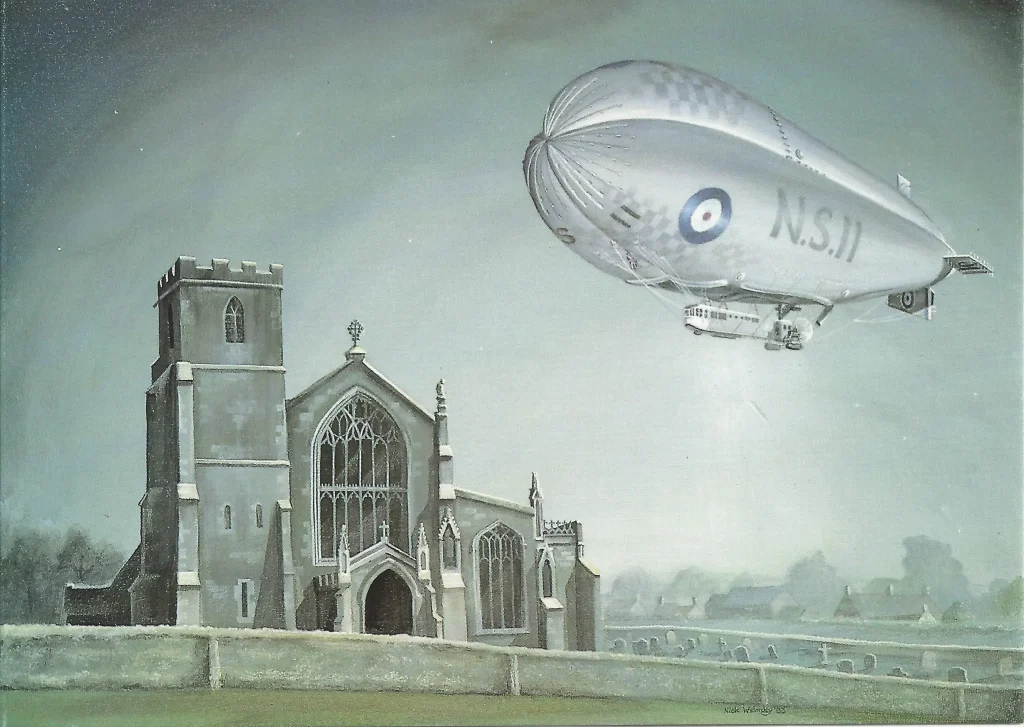
NS11 had taken off from RAF Pulham Airship Station in Pulham St Mary, Norfolk, around midnight on the night of 14 July 1919 and was heading over the North Sea on a mine-hunting patrol. In the early hours of 15 July, she was seen to fly beneath a long “greasy black cloud” off the village of Cley next the Sea on the Norfolk coast when locals reported an abnormal noise from her engines (which may have suggested she was experiencing engine trouble).
She was returning towards the coast and reportedly some 5 miles off the coast of Cromer in Norfolk, when she exploded into a ball of flames, causing a vivid glare lasting for several minutes as the burning airship descended, plunging into the sea after a second explosion. At approximately 01.45, a massive explosion was heard out to sea, carrying as far as Holt, and along the coast, the Wells and Cromer. Eyewitnesses report ” Mr Stangroom’s bedroom lit up ‘bright as day’, as did those of the Greens and the Kayes at Blakeney”. The glare lasted for a few minutes, and then a maroon flare was let off, calling out the Cley Lifesaving Rocket Brigade. As the streets of Blakeney filled with people, Mr Green roused his father, who was the coxswain of the Blakeney lifeboat.
They estimated the wreckage to be five or six miles offshore and ran to the quay to summon fellow lifeboatmen, but it was low water, and they discovered the lifeboat was stranded high and dry. The officers at RNAS Pulham Airship Station were unaware of the disaster until someone from the Eastern Daily Press office in Norwich telephoned to see if there was any comment about the explosion.
None of the nine crew members on board the airship survived. The Sheringham lifeboat was launched, but its crew could only find a small part of the aluminium wreckage. Tragically, all nine crew members were lost.
The accident occurred less than 48 hours after the airship R34 arrived at RAF Pulham after a successful double-crossing of the Atlantic Ocean, including the first-ever east-west crossing by air.
The findings of the official Court of Enquiry were inconclusive, but amongst other possibilities, it was thought that a lightning strike may have caused the explosion
Nothing more had been found by the time that seven minesweepers dropped anchor off Cromer pier on the Friday night in readiness for dragging operations. Divers were present in case any large parts of the airship were recovered
For more information, please see our N.S. 11 Special Edition Dirigible Magazine (Summer 1994)
The United States North Sea Ship
One North Sea Class ship was destined for use in America. The Aircraft Record card is for NS 14, built at Kingsnorth in late 1918 with Wheelwright modified cars.
She made flying trials on 14 December 1918, and was then deflated and shipped to the USA. Her subsequent history is a bit hazy, but this is what we have researched:
- Packed up and shipped to America for the US Navy, 22 April, 1919.
- Given Navy Bureau serial number A5580.
- Sent to Wingfoot Lake N A S, Suffield, Ohio, for evaluation.Arrived on 17 May. Not inflated. On 13 December, transferred to Hampton Roads, Norfolk, Virginia.
- Arrived on 30 January, 1920.
- Subsequent US Navy history unknown.
- Turned over to the US Army 22 September 1925.
- Stricken from the Navy List 28 January, 1926.
So far, no records have come to light to determine whether this ship was ever inflated and flown in the United States.
We would be interested to know if NS 14 was ever flown in the U.S, and if you have any information on this, then please contact us
North Sea Class Ships Logs
| Designation Number | Delivery Date | Deletion or transfer date | Reason | Hours Flown | Details |
| *Us = Unservicable | |||||
| NS.1 | 2.1917 | 22.2.18 | Wrecked | 207 | |
| NS.2 | 6.1917 | 22.2.18 | Wrecked | 11 | |
| NS.3 | 7.1917 | 22.6.18 | Lost at sea | 647 | Five dead |
| NS.4 | 10.1917 | 10.1919 | * Us. | 265 | |
| NS.5 | 12.1917 | 22.2.18 | Wrecked | 14 | |
| NS.6 | 5.1918 | 10.1919 | * Us. | 398 | |
| NS.7 | 6.1918 | 1921 | * Us. | 450 | |
| NS.8 | 7.1918 | 10.1919 | * Us | 281 | |
| NS.9 | 7.1918 | 3.10.18 | Us. | 152 | |
| NS.10 | 8.1918 | 3.10.18 | Us. | 128 | |
| NS.11 | 9.1918 | 15.7.19 | * Lightning | 492 | Ten dead |
| NS.12 | 10.1918 | 10.1919 | * Us. | 95 | |
| NS.14 | 8.11.18 | 8.11.18 | Sold To USA | ||
| NS.16 | 3.1919 | 10.1919 | 6 Us | 89 |