
Following the completion of the R101, the R.100 followed closely on, being an innovative and modern ship when compared to its counterparts at the time. The daring decision to move away from the more traditional Zeppelin design lines was shown in the more oval, streamlined and aerodynamic shape of both the R.100 and R101. It was as early as 1921 during the Imperial conference when A.H. Ashbolt, London Agent-General for Tasmania, proposed an Imperial Air Company. The idea being that a subsidy for mail carried and a proposed passenger service to connect London to South Africa, and across to Australia and New Zealand.
This plan was later adapted as part of the 1924 Imperial Air Communications Scheme. In 1923, Barnes Wallis and Sir Dennison Burney both visited the Zeppelin Company in Friedrichshafen to see if an agreement could be reached in a commercial operation between the Zeppelin Company and the Vickers Company. This plan was later not followed up on. It was after much deliberation and further discussion that in 1924, a contract between the Burney-Vickers Group was completed on 1st November 1924.
The decision had been made that separate organisations would construct two ships. One would be built by the Royal Airship Works and the other by a commercial contractor. The contract for the R.100 had been awarded to Vickers, who were regarded as one of the best airship constructors, considering their history with lighter-than-air craft. A new subsidiary of Vickers, the Airship Guarantee Company, was set up purely for the construction of the ship. It was felt by the government that having two prototypes built would lead to twice the level of innovation over traditional lines. Both the R.100 and R101 teams were the first to build airships in a more aerodynamic form than the traditional Zeppelin designs.
British designers had always tried to improve the aerodynamic shape to aid efficiency compared to other contemporary ships, the R80 being the case in point, being the most aerodynamic ship constructed to date.
Design and Construction

With Barnes Wallis using new design techniques assisted by Nevil Shute Norway as his chief calculator, the R.100 was designed as a unique and efficient craft. Construction of the R.100 began at the Howden construction facility in 1927, the ship being designed to fit within the existing shed. Construction of the ship was slow due to innovations being added, such as rainwater collection devices along the top of the ship. Also, the contract with Vickers was for a ship to be constructed at a fixed contract price. It had been remarked that there was rivalry between the R.100 and R101 design teams, fuelled by comments made by Nevil Shute Norway, but recent research contradicts these views. As part of the original design concept, Barnes Wallis had designed the R.100 to be built from as few different parts as possible, with as few machines, to cut down the need for additional costs. The plan was to design and build a ship to fit the planned contract.
Since wind tunnel tests showed that a 16-sided transverse section had about the same drag as a circular one, both R.100 and R101 used a smaller number of longitudinal girders than previous airships in order to simplify stress calculations. Even so, the calculations for the transverse frames required hand computation that took two or three months to produce a solution for each frame. The thoroughness of the stressing calculations was a consequence of new Air Ministry criteria for the strengths required of airships, formulated in response to the catastrophic structural failure of R38 in 1921. However, fewer longitudinal girders resulted in larger unsupported panels of fabric in the envelope.
Barnes Wallis created the frame of the airship using only 11 standardised components. The 16 longitudinal girders were formed of three tubes each, formed from strips of Duralumin wound into a helix and riveted together. These connected 15 polygonal transverse frames, which were held in shape by wire bracing connected to a central longitudinal girder running the length of the ship.[1] A further consequence of the new rules for airframe stress design was that a new way of harnessing the lifting force of the gasbags had to be found. Wallis’s solution to this problem later led to his innovative geodesic airframe fuselage and wing design for the Wellesley, Wellington and Windsor bombers.
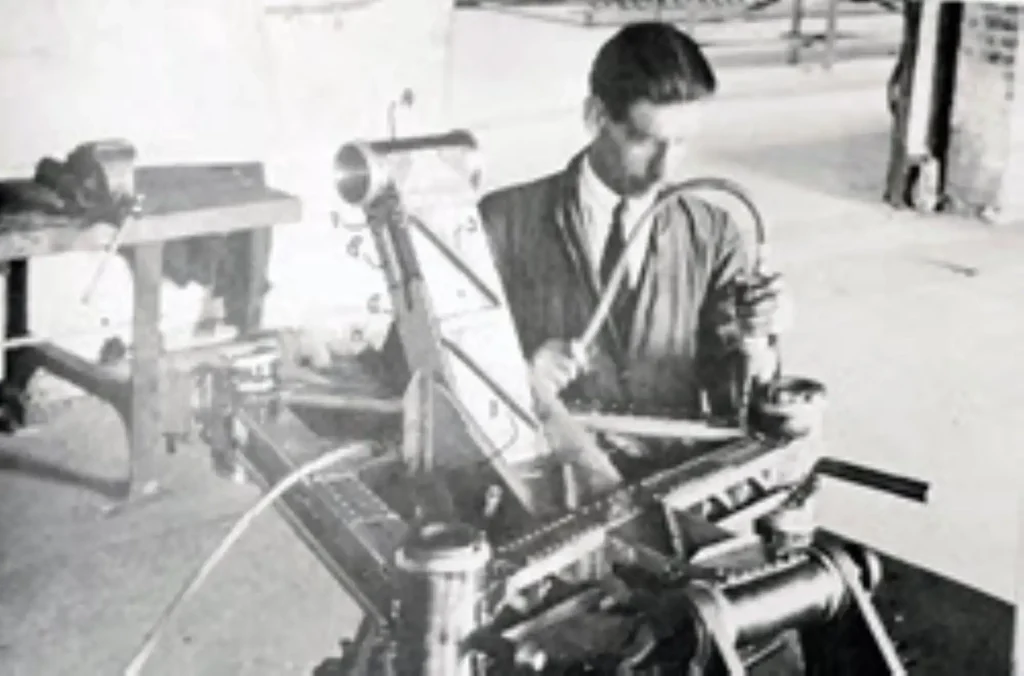

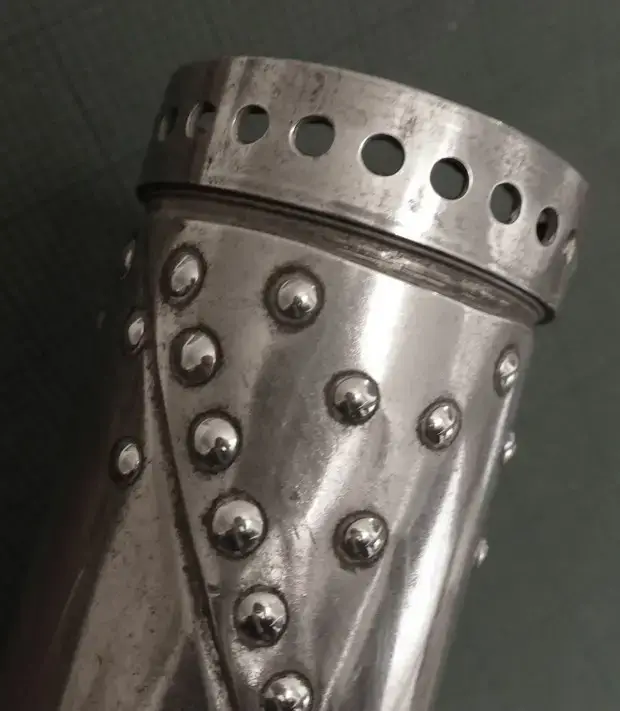
It was during the construction phase at Howden that strikes delayed works in 1926, 1927 and 1928. The ship was 80% completed by December of 1928, and it was hoped that she would be able to fly in early 1929. However, construction was hit by further strikes by fitters in 1929, and the R.100 was not ready for shed trials until 3rd July 1929.
The elevators were aerodynamically balanced, but the rudders were unbalanced. When the designers learned that R101 had been fitted with servo motors at a substantial cost in weight and money, they thought that they had made a mistake and rechecked their calculations. They eventually concluded that their calculations had been correct: when R.100 was flown, the controls proved both light and effective, and its control characteristics were compared favourably with those of R101 by Nöel Atherstone, First Officer of R101.
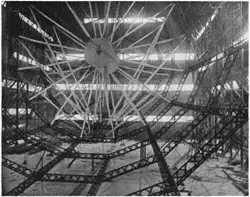
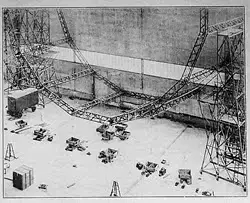
R.100 was built suspended from the roof of its shed. The individual transverse frames were assembled horizontally, then lifted up and slung from roof-mounted trackways before being slid into position and attached to the adjacent frames by the longitudinal girders. The ship remained suspended until the gasbags were inflated with hydrogen.


By summer 1929, the ship’s structure was nearly complete, and her gasbags were inflated. Following inflation of the gasbags, the outer covering of linen fabric painted with aluminium aircraft dope was put in place, and she was completed at the beginning of November. Lift and trim trials were carried out on 11 November.
With the prototype completed, the R.100 had design features which were to be incorporated within the next generation of ships. The interior passenger space was completely new to airship design and was very different from that which was designed for the R101.
Competition was high between the two design teams, but it was still seen that both of these ships were unique experimental prototypes. On a global scale, the Imperial Airship scheme was the largest project of its kind, and in 1929, the only competition was from Germany with the smaller LZ127 “Graf Zeppelin”. Not until the Hindenburg and Graf Zeppelin II, some seven years later, would newly designed commercial passenger airships of this scale take to the skies.
Propulsion

It had originally been intended to design special engines for R.100, which would be fuelled by hydrogen and kerosene, but after a year’s work, it was realised that the engine would not be developed in time and it was decided to fit the Beardmore Tornado diesel engine that was being developed for the Air Ministry for installation in R101. However, at a very early stage, the Tornado was judged unsuitable because of its weight and other problems. Wallis finally settled on the use of six reconditioned Rolls-Royce Condor petrol engines, even though the fuel, with its lower flash point, was considered to be a fire risk under tropical conditions.[5] The engines were contained in three gondolas, each with one engine driving a 17 ft (5.18 m) diameter tractor propeller and a second driving a 15 ft (4.57 m) diameter pusher propeller. The engines driving the pusher propellers were also fitted with a gearbox to provide reverse thrust for docking the airship

The ship was designed with only 13 longitudinal girders compared to previous designs of up to 25, and hence the ship was lighter. Upon completion, the R.100 contained 58,200ft (11 miles) of tubing, 5,000,000 rivets, 400,000 minor bracing pieces, and yet as per the specification and Barnes Wallis’ design genius, was made of only nine basic and 50 different parts.
Trial Flights

With all tests completed, on the morning of 16th December, 1929 the R.100 was brought out of the Howden Shed, with clearance of 9ft each side of the hull and only 5 feet clearance of the roof. Her first flight was from her constructional base, at Howden and down to Cardington, as her operational home.
R.100 made her maiden flight on the morning of 16 December 1929. After departing Howden at 07:53, she flew slowly to York, then set course for the Royal Airship Works at Cardington, Bedfordshire, running on five engines since one of the engines had to be shut down because of a cracked water jacket, and completing the mooring process at 13:40.

A second flight was made the next day, with the intention of making a flight to London, but shortly after slipping the mast, a strip of fabric became detached from the lower fin, and the flight was limited to a cruise around Bedfordshire to test control response, lasting 6 hours 29 min.
The following day, R.100 was taken from the mast to No.2 shed at Cardington and work on modifying the wiring holding the cover in place began; this took until 11 January 1930.
During a test on 16 January 1930, R.100 achieved a speed of 81.5 mph. It was at speed, a problem with the outer covering became apparent: it tended to ripple and flap excessively in the form of a standing wave. During a fourth flight on 20 January, cine film was taken of this phenomenon, which occurred because of the large areas of unsupported fabric; it is also clearly visible in some photographs.

A further short flight was made on 20 January before an endurance flight, starting at 09:38 on 27 January when R.100 slipped the mast at Cardington and ending at 15:26 on 29 January after more than 53 hours in the air. The flight was down over the south west of England, and then down over the Channel Islands, and returned to Cardington.
Following this flight, it was returned to the shed for work on the cover to be carried out. At the same time, the original reconditioned Condor IIIA engines were replaced by six new Condor IIIBs and some weight was eliminated by reducing the amount of passenger accommodation. The work was complete by the end of April, but on 24 April it was caught by a gust while being walked out of the shed, damaging the tail surfaces. The wind prevented it from being replaced in the shed, so it was moored to the mast. It was not possible to return it to the shed for repairs until the morning of 27 April. Repairs took longer than expected, and R.100 remained in the shed until 21 May, when it made a 21-hour flight intended to test the new engine installation and modifications to the cover. The flight this time was to the north of England and up to Hull and her home town of Howden.

An initial design problem was that the outer cover would ripple in flight; however, this did not affect the performance of the ship. Also, there was a slight problem with the aerodynamic forces acting on the tail. This had shown up on wind tunnel tests but was dismissed as a scale anomaly.
On return from testing the outer cover and investigating the ripple, on a flight on 22nd May 1930, the R.100 was on its return leg of the trial, when the officers were very surprised to receive a wireless message from the Cardington base saying, “I suppose you know your tail is buckled?” The officers knew nothing of the sort.
The air pressure around the hull had built up, and the tip broke off. The faring behind the last frame had buckled. It was thought that this was done during a full speed test, which the ship had undertaken for 10 minutes.

The R.100 landed safely at Cardington mast in gusty winds, showers and sunshine, and then was carefully let down to the ground and walked into the shed.
On inspection in the shed showed that the conical section of light alloy tubes had buckled, and there was a discussion on how best to repair it.
It was decided that the designers and engineers would trim the tail and replace it with the more traditional rounded tail, thus shortening the length of the ship by 15ft (4m)
Some say that this detracted from the streamlined shape of the ship and changed its beautiful, originally designed, sleek looks.
Interiors – Luxury in flight
With individual design ideas, the R100’s design team came up with a totally unique interior for the passenger accommodation on the ship.
As with the R101, the main design considerations for the contract for the R100 were to be able to carry 100 passengers for a number of nights’ accommodation in comfort. This, of course, had to include sleeping accommodation and public spaces on the ship.
The R100 team came up with the idea to have a three-deck approach whereby the passengers could enjoy a two-deck area with the crew on the third or bottom deck. This would also bring the feeling of space and height. In the main brochures describing the R100 issued at the time, it was seen that the accommodation was “intermediate in comfort between a Pullman coach and an ocean liner.” It was described as being inside a “small hotel”
The Main Lounge & Grand Staircase

The Main lounge. The main lounge was on the inside of the airship. The idea being that this double-height deck would give a feeling of space. The lounge was also to double up as the main dining area of the ship.
A double entrance staircase led down from the galleries where some of the sleeping accommodation was arranged. The staircase led down onto the main floor, then down again to the crew’s quarters and the lower deck.
The seating arrangements were of small tables of four, but these also could be put together to form long dining tables, as was the current fashion. Various rugs were placed on the floor to give the feeling of a club atmosphere.
The entrance to the promenade areas was on either side of the main lounge.
The Promenade Decks
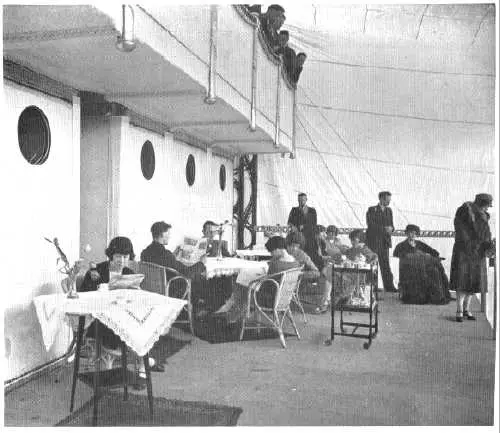
The promenade decks were wider in design than the R101 and were again of double-deck construction to ensure that enough light would enter the ship. Seen here are passengers enjoying tea on the promenade decks. Notice the “portholes”, which were the passenger cabin windows. Also, notice the side entrance to the left of the dining room. The upper gallery as seen, was also a place to enjoy the view and provided entrance to further passenger cabins. The promenade decks were on both sides of the lounge, as with the R101. As they were wider, it was viewed that they could be seen as more of a “lounge” area.
The window configuration can be seen in this photo with two sets of windows fitted into a curved recess.
A double staircase led down to the interior dining room. The dining and central space had galleries in which passengers could access the accommodation. Flanked on each side were two large panoramic windows allowing a two-tier promenade deck, giving the interior a large, open and light feel.
The Passenger Cabins

The sleeping arrangements were in the form of bunks. Even though they may seem spartan by today’s standards, they were fitted out with a “porthole” light, a chair and space for luggage. This would continue with the “nautical” influence.
Some 50 cabins were constructed in formations of single, two and four berth arrangements.
Toilets and washroom facilities were available close by
Below Decks – The main corridor

The main corridor leads from the bow entrance to the passenger accommodation one one-third of the length down from the nose. As this slightly out of focus photo shows, the superstructure was ope,n and some of the interior of the ship can be seen. We are unaware as to whether, in the final stages of ship construction, as to whether the walls were “doped” as in the R101. The wooden door at the end of the corridor is the entrance to the lowest level of the ship.
The interior was different again from the setup of the R101, the idea being that design details would be taken from each airship and utilised in the next generation. The R.100 could carry 100 passengers in a selection of accommodations; an arrangement of 14 two-berth and 18 four-berth cabins was available. With two sets of double-height windows in a curved shape on either side of the ship gave light to two sets of promenade decks on both sides of the passenger accommodation.
A gallery led to the upper deck cabins, which could overlook the lower promenade deck. The dining room was internal to the ship and could seat 56 passengers in one sitting. The catering was undertaken in an electric kitchen next to the dining room, where the food would be passed through a large window by the serving staff to the diners.
St Hubert
Canada really became involved in the Imperial Airship Scheme during the 1926 Imperial Conference, when Prime Minister William Lyon Mackenzie King, showing an unusual amount of enthusiasm, pledged Canada’s assistance to the mother country. Patriotic duty was not the only thing he had in mind—King was certainly counting on an increase in foreign trade if the program came through. Ironically, of all the Dominions, only Canada and South Africa showed any inclination toward the Airship Scheme; the Air Ministry’s well-rehearsed presentation had fallen somewhat flat, since Australia, New Zealand, at this stage, were not convinced of its value.
Despite problems at the House of Commons, money was set aside for the construction of an airship base, airport and mooring mast in eastern Canada. British experts came over in May 1927 to choose a site; they visited a number of locations in Ontario, Quebec and Atlantic Canada, finally settling on a piece of land on the south shore of Montreal, at St Hubert, and officially announcing this decision in August 1927.

Work on the airfield began almost immediately, and St Hubert’s first airmail delivery took place in November 1927. It was also during the summer of 1927 that the Air Ministry decided to send R.100 to Canada and R.101 to India. The mooring mast at St Hubert was a gigantic structure, sixty metres high, which enclosed all the complex machinery required for mooring, refuelling and servicing future airships coming to Canada. Design work was done in Canada by the Department of Public Works, while Canadian Vickers of Montreal received the building contract. To ensure proper handling, and at the request of the British authorities, a small team from the Royal Canadian Navy spent eighteen months training at Cardington.
Preparations were also made to handle the huge crowds, 600 000 people or more, which were expected to flock to see the R.100. In anticipation, the Canadian National Railway (CNR) ran an extra siding into St Hubert; elaborate traffic regulations were prepared and published in the papers; special flights in and out of the airport were duly planned; and a special camp was established for the six hundred troops needed for traffic and crowd control.
Media coverage was on a scale never seen before in Canada; the CNR, the Canadian Pacific Railway and other groups set up observation posts in a number of places, in both Quebec City and Montreal. It was agreed that bilingual official commentators would be on hand, but only after a fair amount of pressure was applied by some newspapers and Quebec Members of Parliament. The mooring tower was finally completed in May 1930. The flight of the R.100 to Canada was originally scheduled to take place in May or June 1930, but was delayed. Unfortunately, one of the R.100’s fins was damaged in April 1930, and the ship’s tail cone was damaged in May. By the time these were repaired, the event had to wait until after the Canadian federal election, in late July.
24-Hour Endurance Flight
On the 25th May, the R. 100 was put into shed 1 for repairs to her tail, and during this time the tail was rounded off and a loss of length of some 15ft, reducing the ship’s original length from 709.5ft to 695ft. Also during this time in the shed, it was agreed to save weight for the forthcoming Canada trip, that some of the upper cabins had their bunks and fittings removed.
On 25th July, the R.100 emerged from the shed showing the world her new, more rounded tail design, and then was flown up to the Cardington mast. Preparations were made for a 24-hour endurance flight to test the outer cover, and also the handling of the ship with the new tail design. The R.100 left the Cardington mast at 19:02pm that evening, and flew out over the Midlands, then across Wales, and out over the Irish Sea. The ship then turned south and made her way over Cornwall and down to the Channel Islands of Guernsey and Jersey.
The R.100 then turned northeast and headed back up the English Channel and across southern England, to return to Cardington on 26th July, mooring on the Cardington mast at 19:18pm, a journey of some 24 hours and 16 minutes. The R. 100 had successfully passed the trial, and preparations were now to be made for the trip to Canada.
See more details, with original R.100 footage kindly donated by Roger Dawson, taken by his Grandfather whilst on holiday in St Peter Port on Guernsey, 26th July 1930.
Voyage to Canada
After the 7 successful trial flights and flights checking the outer cover ripple effect, the decision was made for a transatlantic flight or long distance proving flight by one of the two new airships. As the R101 had been put back in Shed Number 1 for further changes to the design to increase the disposable lift, the R.100 was tasked with a trip to Canada, successfully crossing the Atlantic to Montreal to the newly erected mast.
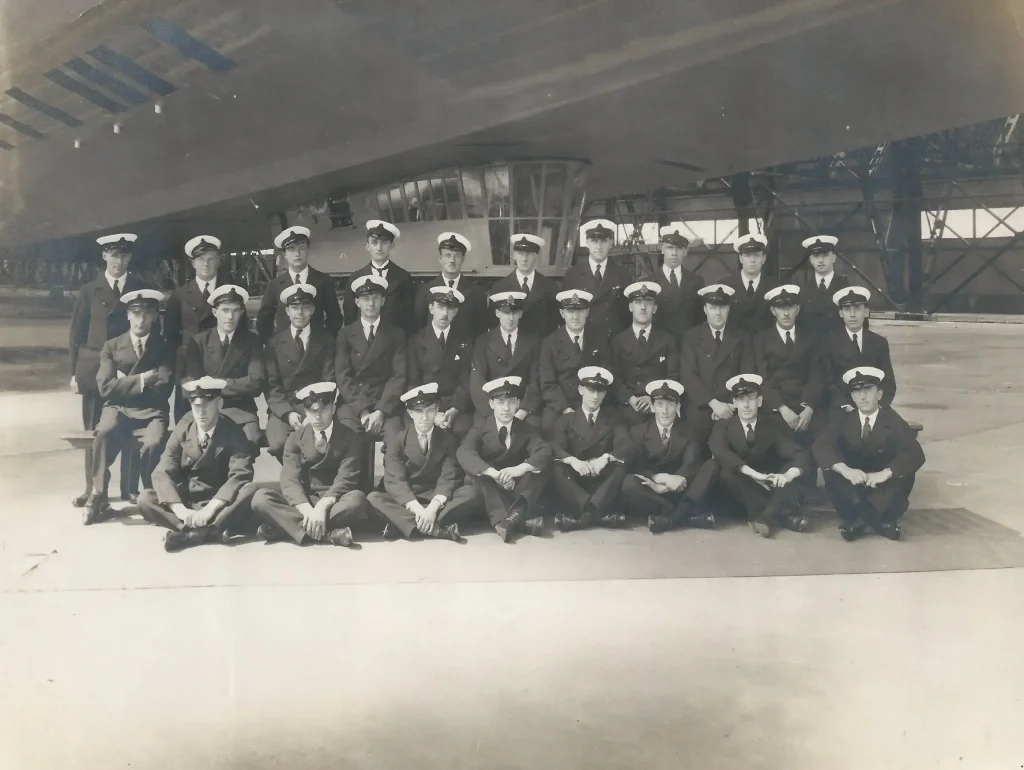

The ship slipped the moorings from the Cardington mast at 02.48 am on the morning of 29th July 1930. The first two days of crossing were very smooth, and the crew settled down into a normal routine of standard watches. As day 3 approached, the ship flew over the Atlantic and headed down the Newfoundland coast.
The transatlantic passage was smooth but the airship ran into difficulties over the St Lawrence valley on a couple of occasions. Near l’Ile aux Coudres, the R.100 was buffeted by shifting winds like never before. A number of very large tears appeared on three fins and the engines had to be stopped for eight hours so that repairs could be made. The people of Quebec City, forty thousand or more, cheered and waved as the airship slowly flew overhead.
A second incident occurred closer to Montreal as the R.100 flew through storm clouds, and very strong updrafts caused more damage to the fabric of the fins.
The R.100 finally arrived at the Montreal mast, on 1st August at 05.37am, after a voyage of some 78 hours and 49 minutes; a journey of 3,364 miles.
Temporary repairs were made in flight and then the cover was replaced at the mast at Montreal.
The best definition of how the airship was moored was described in the Barry Countryman book “R.100 in Canada” 1982
“With streaks of dawn showing in the eastern sky the R.100 [on her first landing in Canada] swung in narrowing circles about the St Hubert field. A few minutes before 5 o’clock she turned toward the mooring mast. On the passenger platform stood Lieutenant Commander Pressey, the landing officer, and his assistant at the cabinet controlling all the mooring machinery … The R.100 had to valve little hydrogen, having collected almost 5 tons of rain water in her ballast bags. As she slowly approached the mast head from the east at a height of about 500 feet, her 900 foot long mooring cable snaked down in swinging loops to the ground. Her aft engines were put in reverse. Pressey’s 14 men, 3 of whom watched the winch drums, allowed the wire to discharge any static electricity in order to avoid a severe shock. … With not a breath of wind the main wire was secured by three of the ground crew and spliced to the ¾ inch cable which had been led from the top of the tower through the mooring arm to a spot determined by the direction of the wind – airships approached a mast head to wind. The ground crew signalled to the ship and the tower. As the engines eased off a little more the cable became taut. …At 5:13 am, as the variable speed, electro-hydraulic winch was slowly reeling in the wire the airship dropped her first water ballast from frame 3 in the bow to keep an even keel. … The 750 foot starboard yaw guy was paid out 4 minutes later, coupled with a yaw winch cable from the base of the tower and carried to a snatch block on one of the 24 concrete blocks spaced at 15º intervals on the circumference of a circle of 750 foot radius. … The port yaw guy dropped and was seized by the waiting ground crew and coupled to the mast’s second yaw cable. The last engine stopped at 5:25 am, but the ship continued to release ballast, some of the water drenching the ground crew and those on the passenger and searchlight platforms. … Dungareed mechanics climbed out of the silent engine cars as the ship’s dew drop neared the mooring cup. … Pressey called “Ship secure” at 5:37 am Friday, August 1 as the ram contracted and locked, allowing the airship to swing freely. … The mooring in a record 27 minutes versus 35 minutes at Cardington was a signal for rolling cheers from early risers and those who had remained all night.” (Countryman, 1982:58-62)

Upon its arrival, Montreal simply went wild; there were dozens of VIPs on hand, and a huge crowd. Companies used the visit to advertise everything from beer to cigarettes; there were signs everywhere, not to mention special R.100 songs, in both English and French. The forty-six–by–nine-metre sign erected by the SunLife Insurance Company was by far the biggest.
Two dozen aircraft transported sightseers by the hundreds. According to some estimates, more than one million people came to see the R.100 at St Hubert; three thousand actually had a chance to tour the airship, many of them “borrowing” souvenirs along the way. The visit may have been a rare pleasure, but the half-metre gap between the gangway and the tower’s platform gave quite a scare to many visitors.
The crew were deemed heroes for this voyage.
The crew enjoyed banquets and receptions in their honour. There were banquets too, ten or so in all, in Montreal and Toronto, where
Burney and Air Ministry representatives extolled the virtues of airship travel and greater Imperial co-operation. The two sides did not always see eye to eye; the British officials promoted the Air Ministry’s ideas, while Burney put forward his own. All offers of help by the U.S. Navy were politely but decisively turned down by the federal authority; this was, after all, Canada’s day.
New fabric panels for the damaged fins were prepared by Canadian Vickers, which also did some interior repair work.
It was seen that this trip would be the start of many crossings and the start of commercial operations. On 13th August 1930, the R.100 was required to go on a “local” flight, where it was received excitedly by all the towns she crossed over. Flights over southern Ontario, Quebec and the Eastern Townships had been planned from the start, but had to be postponed and modified due to the damage to the fins.
Ontario Local flight
At 6.15pm on the evening of 10 August, the R.100 left with a number of senior military officers, government officials and one journalist, eighteen people in all. During the next twenty-six hours, it flew over Ottawa, southern Ontario, the Niagara Peninsula and most notably Toronto, where the R.100 caused horrendous traffic jams
The route it covered was Ottawa-Hull, Kingston, Peterborough, Oshawa, Toronto, Niagara Falls, St Catharines, Hamilton, Burlington, Gananoque, Prescott, Cornwall and Montreal.


Everything worked perfectly, until the reduction gear of one of the engines failed just before mooring, and it is suspected that some damaged gearing flew into the path of the spinning propeller, causing damage to the outer cover and knocking a fist-sized hole into a 4″ transverse tube, and bending it as well. The engine was quickly closed down, and the propeller was held in place by its brake.
Repairs could not be made since the special derrick needed to hoist the engine had been left in England; the R.100 had to fly home on five engines instead of six. The R.100 started back to England on 13 August, as thousands cheered it on; many were expecting to see it return within a few months.
Return to Cardington
On 16th August 1930, R.100 made her return to Cardington and, making use of the Jet Stream, managed to knock off some 21 hours off the outward bound flight time, arriving on 16th August 1930 at 11.06 am after 2,995 miles and a trip of 57hours 56 minutes. Some 19 journalists were invited as passengers for the return leg to the United Kingdom. There were a few problems on the way home, notably the loss of cooking facilities as the electric oven was “shorted” out on the return due to ingress of water through the fabric. This means the lack of hot food, and so only cold meals could be served. Some dairies of crew and journalists noticed this discomfort for 3 days.

On her return to Cardington, there was less of a public reception; however, some 200 cars and coaches turned up. The crews were congratulated by Lord Thompson when they descended the mast. On mooring, the new watch was formed of members of the R101 crew, under the charge of Grabby Atherstone. Early the next morning, on Sunday 17th August, a landing party was assembled and the R.100 was flown from the mast to the ground. The ship was then carefully put into the shed for inspection, and attention switched to the R101’s flight to India, which was anticipated to be at the end of the year. Because many of the crew members were actually operating on both ships, the majority were transferred over to the R101
Final Life of the R.100 1931-32
Not much was written about the R.100 following her retirement to the shed in August of 1930 and the crash of the R101. However, recent research by AHT member Brian Harrison uncovered some very interesting facts regarding the final days of the ship.
The R.100 was put back in the hangar on 17th August 1930, and the crew switched their attention to the R101 for the next long trip. It was noted of the poor condion the R.100 was, on return from the trip from Canada. The outer cover was in a poor condition and liable to split, as had occurred over the St Lawrence River, on the outward journey. Considering the cover was starting to come to the end of its life, a refit was in discussion, and more expense was required. It had been decided that after the refit and repairs that a return flight to Canada to be prepared for in early 1931.
At this stage of the Imperial Airship scheme, there was only a small group of trained officers to cover both ships. However, with the R102 in the planning stage, more crews would be required, and training was underway. This was abandoned when the destruction of the R101 in October 1930 led to the decision to halt all future flights.
Airship Policy Development and Continuity – 1930
The R.100 was deflated on 11th December 1930 and “hung” in the shed. The outer covers were still under inspection, but it was seen to be deteriorating in places. After the R101 inquiry, Parliament then had to discuss where the future lay for the R.100.
A personal statement issued on 13th September 1930 by C Buloch to H C T Dowding shows a very interesting insight into the state of the Airship Programme, which seems to have been largely overlooked by many sources. The document proved to be seen as a snapshot of the situation with regard to the programme moving forward.
It was seen that the initial phase was the “teething period” for large airship design and construction was largely over, and the unforeseen difficulties should not arise in the case of the new ships, which are to be in the main “scaled-up” editions of the R.101.
Plans were not to be submitted at the forthcoming Imperial Conference as it was viewed that this would be unjust at this date/stage. Understanding that the quote given at the 1926 Imperial Conference had not been met with R.100 and R.101, and also the ships at present cannot operate with useful loads without additional masts at Malta and Baghdad. A prudent course of action, as it seemed at this stage, the scheme had provided very little of what they said it would in the original conference back in 1926.
What could be released were the plans were which were to look at building some of the new ships in July 1931, the proposed movable mooring tower would have been delivered by May 1931. The R.100 would have an extra bay fitted.
It was seen that the crux of the commercial operation is the view of reliability of operation before they were to embark on the construction of the new ships
The R.100 Refit
Plans for the R.100 were underway and noted in this documentation. It was stated that it would take “6 months for the outer cover to be put on the ship as the material was not ready to be put in the new bay, which would take some 7- 8 months to install. It was urged that this would be done on the recovery of the ship. It would be no more difficult than had been with the R.101”.
Both the R.100 and R.101 were planned to be the workhorses of the England-Egypt route, but is was noted that the Malta Mast had to be constructed if both ships were to carry workable loads. A final note planned both ships to carry out occasional flights to the Canadian and Indian provinces to keep their interests alive and show that airships were part of the communication plans. The R102 and R103 would be suitable for these routes as working airships.
Revenues were considered as a fair income from the ships when operational. Fares charged for the flights were outlined as :-
- £ 200 each way to Montreal for the first 18 months
- £150 each way to Karachai
It was noted that these figures were not unreasonable whilst airships remained “a novelty”. After this time, the fares were reduced to compete with the Imperial Airways charges
| Proposed fares via Airship | Imperial Airways |
| £150 Montreal | (no service) |
| £ 55 Ismailia | £ 49 |
| £ 130 Karachi | £ 121 |
Some of the original redesign ideas had been started in August of 1930. Documents and plans show that progress was being made in making changes to the R.100, to again allow more lift. One of the main ideas was to remove the upper deck of the passenger accommodation, remove the upper deck wooden flooring and wood pannelling, then have some of the accommodation moved to an extended external cabin behind the control car. With some of the weight saving, plus allowing the gasbag to be enlarged above the passenger accommodation, this would gain an extra 9.25 tons in lift.
It was hoped that by placing some of the car externally to the ship, this would give more room in the gasbag, which was immediately above the passenger accommodation. This would have also allowed more disposable lift suitable for more commercial operations. By removing the large passenger areas and reviewing the use of the R.100, it was seen that the new class of ship, the R102 class be deemed more suitable for carrying the large number of passengers as originally planned in the R.100 and R101.
It was also planned that the R102 was also to have some of the passenger accommodation protrude from below the main hull, and so this could have been seen as early concepts for part of the planned external smoking lounge for the R102. The passenger capacity of the R102 was deemed to be a realistic 50 passengers, and so the potential reduction in cabin numbers and configuration on the revised R.100 would have been realistic in line with the plans as discovered.

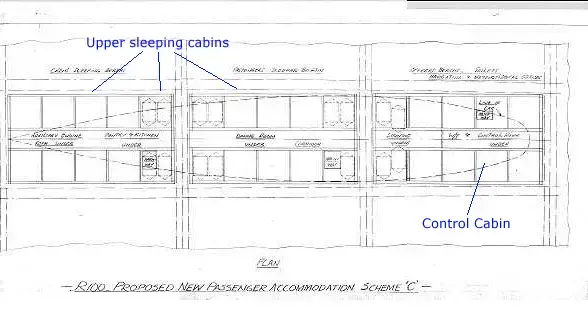
In May of 1931, Parliament and the Government, led by Ramsay MacDonald, discussed the options and their costs. The country was coming out of the depression years, but still had a long way to go, and so there were many financial restrictions.
Full Details of the Programme issued by G S Reynolds
As promised, I now forward the programme of Airship Development, which is recommended as a basis for consideration at the Imperial conference and also an estimate of the cost of the Programme, which covers a period of three years.
The new programme might be looked upon as a Programme of Airship Demonstration Services.
Demonstration Services would appear to be an essential preliminary to Commercial Services financed by Private Enterprise.
In these services, we should endeavour to
- Ascertain the earning capacity of an Airship
- Demonstrate the possible regularity of Airship Service
- Obtain some reliable data in regard to operating and maintenance costs.
I do not think we can hope to do either 1 or 2 with the existing ships; they do not have sufficient lift to give a fair indication of the possible regularity of Airship Flying and its consequence reaction on earning capacity. I feel, therefore, we shall not be making any real progress toward Commercial Services unless new construction is included as part of the next programme. Much data in regard to operating and maintenance costs might be obtained from the operations of existing ships.
Briefly, the main items of the Programme are recommended as follows
- Commence construction of one new Airship.
- 2. Order the second mooring tower for Cardington to be completed as soon as possible. Until this Tower is provided the operations of the R.100 and R.101 concurrently must be strictly limited.
- 3. Order a new Shed for Cardington to be completed as soon as possible.
- 4. Lengthen both No. 1 and No. 2 Sheds at Cardington
- 5. Continue experiments with Transporter Tower and Handling Rails.
- 6. Continue mooring tower experiments.
- 7. Carry out improvements to R.100 and R.101, such as modifications to passenger accommodation in both ships, fit dieselised Condors to R.100 and possibly a new bay to that ship.
- 8. Operations with R.100 and R.101 on the Atlantic during the Summer months and on the Egypt route during the Winter months and certain operations and experiments from Karachi. A total of 1,500 hours for the two ships.
- 9. The selection of sites and the provision of Mooring towers in the Maritime Provinces, Matla and Middle East.
- 10. Provision of certain additional ground facilities and equipment for operational purposes at Cardington, Ismailia, and Karachi, such as improved ydrogen facilities, accommodation, etc, to be completed by the middle of the third year.
- 11. Continue the development of Meteorological and Wireless organisation on the Indian and Atlantic routes and commence investigation in to Winter flying conditions on the Atlantic route to Canada.
- 12. Provision of spares for existing ships.
R.100 – The Flying Aircraft Carrier
Over the Spring and Summer of 1931, the staff at the Royal Airship Works still continued to maintain and monitor the ship. Recent documents have been uncovered which show the condition of the ship, plus the costs involved in making good for further flights.
Plans in December 1930 were also being drawn up for the R.100 to not only have the re-arrangement of the passenger accommodation, but also to have two hatches, winches and suspension frames attached from the main corridor for up to 4 Tiger Moth aircraft to be attached.
We know that there had been successful trials with the R26 and the R33 as aerial aircraft carriers, and the experimental work with the R33 was being considered to be transferred to the R.100. Plans were drawn up, and the idea that the adjustments would be ready for the RAF Hendon display in 1931.
The R.100 was seen as very advanced for its time, and in the lighter-than-air world, it was a real innovation. So much so that the American Government had offered cheap or even free helium to inflate the ship in return for the British technical know-how and data. It was declared that helium deposits had been discovered in Canada, and so an option was for the sale of the ship to the Canadian Government. There was even a suggestion that helium had been found in Ceylon and Singapore, within the bounds of the British Empire. Canada already had a mast from which the ship could be serviced, and this was deemed a reasonable option. The future of the ship and the service was debated for a long time, with opinions given from many people for and against.
The three main options were to:
- 1. Keep the ship, refurbish the cover and continue with the project, moving on to the R102;
- 2. Reduce the staff numbers from 850 to 300 at the Royal Airship Works and keep the ship for scientific study until future plans can be made;
- 3. Scrap the project.
After long and hard deliberation, the final outcome was that the British Government could not afford to keep the project in place nor the staff at Cardington. The world was emerging from a global financial depression, and a project of this scale could not find financial backing from either the private or public sector.
The transcript from Hansard for 21st December 1931:
R.100 in the House of Commons. On Wednesday, December 2nd 1931
Lord Scone:
asked the Under-Secretary of State for Air in the House of Commons to give an estimate of the annual cost of preserving the framework of R.l00 on a “care and maintenance” basis, had this course been preferred to selling the framework as scrap
The Under-Secretary of State for Air (Sir Philip Sassoon):
It is estimated that the cost of material and labour necessary for preserving the framework of R.100 on a “care and maintenance” basis would have been approximately £1,000 per annum in direct charges. This, however, makes no allowance for the occupation of the airship shed and for other overhead charges of the Royal Airship Works.
Lord Scone:
asked the Under-Secretary of State for Air what use it is proposed to make of the houses, offices, hangars, workshops and hydrogen-producing plant at Cardington; and what annual outlay their maintenance is likely to involve?
Sir P. Sassoon:
Some of the houses will be occupied by the care and maintenance party, and the remainder will be let to suitable applicants for housing accommodation. The hydrogen-producing plant will be closed down, and the use to be made of the offices, hangars and workshops no longer required for airship purposes or for the care and maintenance party is still under consideration.
The annual cost of maintenance cannot, therefore, be exactly stated at present: it will probably be in the neighbourhood of £4,000.
Capt. Sir William Brass:
Can the right honourable member say whether the hydrogen plant will be kept or sold?
Sir P. Sassoon:
It is being kept. The cost of maintaining the hydrogen plant in its present condition is included in the figure of £4,000.
Dismantling the R.100
The R.100 was therefore sold for scrap, and work began to dismantle her on 16th November 1931. The work was finished in February 1932. The interior fixtures and fittings were sold of,f and the framework was sold for It was originally £627.00. But £100 was deducted when the final ring section to be retained for testing was excluded – final price £527.00 paid by Elton Levy & Co. Ltd., 18 St Thomas Street, London Bridge. Some original footage of the disassembly can be seen here. The major purchaser of the scrap was Elton Levy. A presence was, however, kept at Cardington with some 300 people continuing to be employed there. Even though the ship was scrapped, the sheds and workshops were still kept in place for future plans.
The transcript from an article of a visit during the scrapping reported in Flight Magazine, December 11th 1931
Breaking up R.100
MEMORIES of many pleasant visits to Pulham. Howden and Cardington were awakened by the journey to the Royal Airship Works on Thursday. December 3rd to witness the destruction of R.100 by the workmen of Messrs. Elton, Levy & C0. Ltd.
All previous visits to airship stations were characterised by a spirit of hope and a band of enthusiasts full of belief in their own craft of the air, and extremely convincing in the arguments by which they supported their belief, always made the visitor very welcome, especially if that said visitor was prepared to take an intelligent interest in the subject of airships. A more delightful set of hosts it would be impossible to imagine, and the arguments which they used, if still not proved by practice, are still unrefuted.
lt was true that on those visits one sometimes had to say goodbye to a particular airship which had made a name, but had outlived its usefulness. Gallant old R.33 comes first to the mind, and the wisdom of breaking her up when we had no other airship in which to train and practise crews is still in question. Regret was felt too, when the doom of R.36, with her passenger saloon, was pronounced. No tears were shed over the unfinished framework of R.37, or the interesting little R.80, or the two surrendered Zeppelins, all of which went to the airship knackers. In those days, one was always looking forward to something bigger and more advanced.


R.100 seemed to fulfil those expectations. It is true that she was experimental, and at the utmost only pointed the way to better things; but still, she did fly the Atlantic twice with ease, and she survived the dreaded ordeal of a storm with violently rising air currents. She accomplished a good deal, and at the same time, she asked a lot of questions, which could only be answered by further trial and experiment.
Admittedly the nation is too poor at the moment to pursue those investigations, but one wonders, is it really so poor that it could not have afforded a small number of men to keep the framework in order until such time as the experiences of Germany and the United States; should have enabled us to decide definitely whether it would be worthwhile to carry on or to close down? Is the nation so poor that the price received for some 50 or 60 tons of scrap duralumin was a consideration sufficient to deprive the future of the chance of making a free decision?
As I entered the shed at Cardington last Thursday, the sound of hammers at work came to my ears. Then, passing through the offices into the main shed, the skeleton of the great airship met my eyes. The breakers had been at work for a week (w/com. 23/11/1931. – almost a year after the expiry of the original contract, RAA) and they had already made considerable havoc. The main longitudinal and transverse rings were still in place, slung from the roof.
Wooden props supported the passengers’ coach and the control car. The passenger quarters were being rapidly dismantled. The gangway from the nose to the quarters had been removed intact. Mr. Elton, with whom I travelled down from London, said that there might be some use found for that, and it would be a pity to break it up. l was surprised to and what a pleasant companion Mr. Elton is.
I had expected to find him a sort of Jack Ketch, but he seems to consider his vocation in life is the beneficent one of preventing waste. He had many interesting stories to tell of how he had retrieved metal from all sorts of unlikely places, where others thought that it would be no good for anything, and had made it available for the further service of mankind. I suppose that it had never occurred to him that anyone might have a sentimental affection for R.100 and feel it a desecration to see the axes at work on her once beautiful duralumin structure.
He reckoned that the work of converting the ship to scrap would take some three months. The bays would be lowered one at a time to the floor, and broken up so far as axe and saw, and blow-lamp could accomplish it. He thought that a steamroller would have to be used to flatten out the main girders before they could be carted away.
On one side of the shed, the beds, kitchen equipment, and tables. etc., were all neatly stacked. The beds have only three legs apiece, the framework itself having supported the fourth corner. They are light and strong, and yachtsmen may find them a good investment. I was rather taken by a little ladder, used. I suppose, for climbing into the upper bunks, which would be an acquisition to, say, a library. Some sections of the framework may be disposed of intact, and there have been inquiries for sections of certain dimensions.
One can imagine that some sections might serve as useful bridging material for surveyors or explorers, perhaps in Africa, who need lightness combined with strength. Two of the sections were already on the floor, and for a while, I watched a workman with a heavy axe cutting the lighter webbing away from the girders.
But I found the sight too brutal. and speedily turned away. Talk about breaking a butterfly on the wheel! One bay, I think it is No. 11 aft of the centre, is to be kept for experiment.


On each side of it were large discs of fabric connected by radial strips of fabric to the transverse rings. Sqd. Ldr. Nixon explained to me that those discs were an experiment to prevent sections of the gas bag from wrapping around the wires, as they sometimes were inclined to do. Various experiments were in progress when the work was stopped. Outside the shed was a large frame covered with a panel of fabric. Underneath the fabric ran a number of wires, to which the fabric was attached at various points by pieces of cord.
The cords were secured to the fabric by various methods. This represented some experimental alternatives to the original method of securing the cover to the framework, which had been criticised a good deal, and which had, as a matter of fact, led to a good deal of rain getting inside the cover. This panel had been out in all weathers for several months, and none of the points at which the cords were attached to it had leaked at all. I remarked that this showed how much more experiment was desirable, and the reply was: “That is just where R.100 would have come in so useful.”
I returned to the shed in time to see the nose section of the ship lowered to the ground. The transverse had been disconnected from the longitudinal. The supporting ropes, which passed over pulleys in the roof and were secured to weights on the floor, were loosened, and the whole section came to the ground with a grinding noise which re-echoed fearsomely through the vast shed. The hatch by which crew and passengers used to embark and disembark was still covered with fabric, and it hung limply down like the mouth of a dead creature until the nose section rolled forward on the floor and forced the hatch to shut. I have been in dissecting rooms more than once, but I dislike them. I was glad to leave the shed and the horrid work that was going on inside it.
Cardington is to be reduced to a “care and maintenance” basis; but those in charge will care for the place and will maintain the sheds, the mast, and hydrogen plant, etc… in good condition. I believe that the mooring tower will be used for experiments with kite balloons. So, if the results of the present work on airships that is going on in Germany and the United States should have the effect of deciding us to resume airship work when out national pocket is a little less empty, the Royal Airship Works will be ready to use-.
We shall not have an airship, and we shall not have a crew in training. The price of the scrap duralumin will have been spent—swallowed up in the vast maw of our national expenditure. So if, for example, the Admiralty clamours for airship cruisers as a great measure of efficiency and economy (as it seems almost certain that they would be), we shall have to start building and training afresh, possibly under foreign guidance, and certainly at vast expense.
However, R.100 is now spilt milk, and to shed tears over its fate would be almost as profitless as to hope to pay our national debt by selling scrap duralumin.
F. A. de V. R.
Flight Log of H.M.A R.100
| Flight no. | Date | Departure | Arrival | Duration | Miles | Route |
| 1 | 16th Dec 1929 | 07.53 am | 13.40am | 5h 47min | 130 | Howden – York- Cardington |
| 2 | 17th Dec 1929 | 09.47am | 16.16pm | 6hr 29min | 174 | Cardington – local area/base – return |
| 18th Dec 1929 -16th Jan 1930 | In Shed for Winter | Initial post trial inspections | . | . | . | |
| 3 | 16th Jan 1930 | 09.20am | 22.40pm | 13hr 36min | 217 | Cardinton – Grantham- Spalding – return |
| 4 | 20th Jan 1930 | 09.10am | 16.20pm | 7hr 18min | 214 | Cardington – London -Croydon -Reading- Retrun |
| 5 | 27th Jan 1930 | 09.38am | ¬ | . | . | . |
| 29th Jan 1930 | . | 16.30pm | 53hr 52min | 1,780 | Cardington – S.W. England – Channel Islands – return | |
| 30th Jan- 24th Apr1930 | In Shed | . | . | . | . | |
| 24th Apr -27th Apr 1930 | On Mast | . | . | . | Tail damaged on exiting shed | |
| 27th Apr – 21st May 1930 | In Shed | . | . | . | . | |
| 6 | 21st May 1930 | 19.00pm | ¬ | . | . | . |
| 22nd May 1930 | . | 17.50pm | 22hr 50min | 691 | Cardington – Hull (cover tests) – Cardington | |
| 26th May – 25th July 1930 | In Shed | Repair of tip of the broken tail | . | . | . | |
| 7 | 25th Jul 1930 | 19.02pm | ¬ | . | . | Cardington – Midlands – Wales – |
| 26th Jul 1930 | . | 19.18pm | 24hr16min | 805 | Channel Islands – return | |
| 8 | 29th Jul 1930 | 02.48 am | ¬ | . | . | Cardington – Montreal |
| 1st Aug 1930 | . | 05.37 am | 78hr49min | 3,364 | . | |
| 9 | 10th Aug 1930 | 18.18pm | ¬ | . | . | . |
| 11th Aug 1930 | . | 20.15pm | 25hr 57min | 805 | Montreal -Quebec- return | |
| 10 | 13th Aug 1930 | 21.30pm | ¬ | . | . | Montreal – |
| 16thAug 1930 | . | 11.06am | 57hr 56min | 2,955 | Cardington | |
| Total | 294h 10min (12.25days) | 11,135 miles |